Dream About Moths Eating Your Clothes: What It Really Means

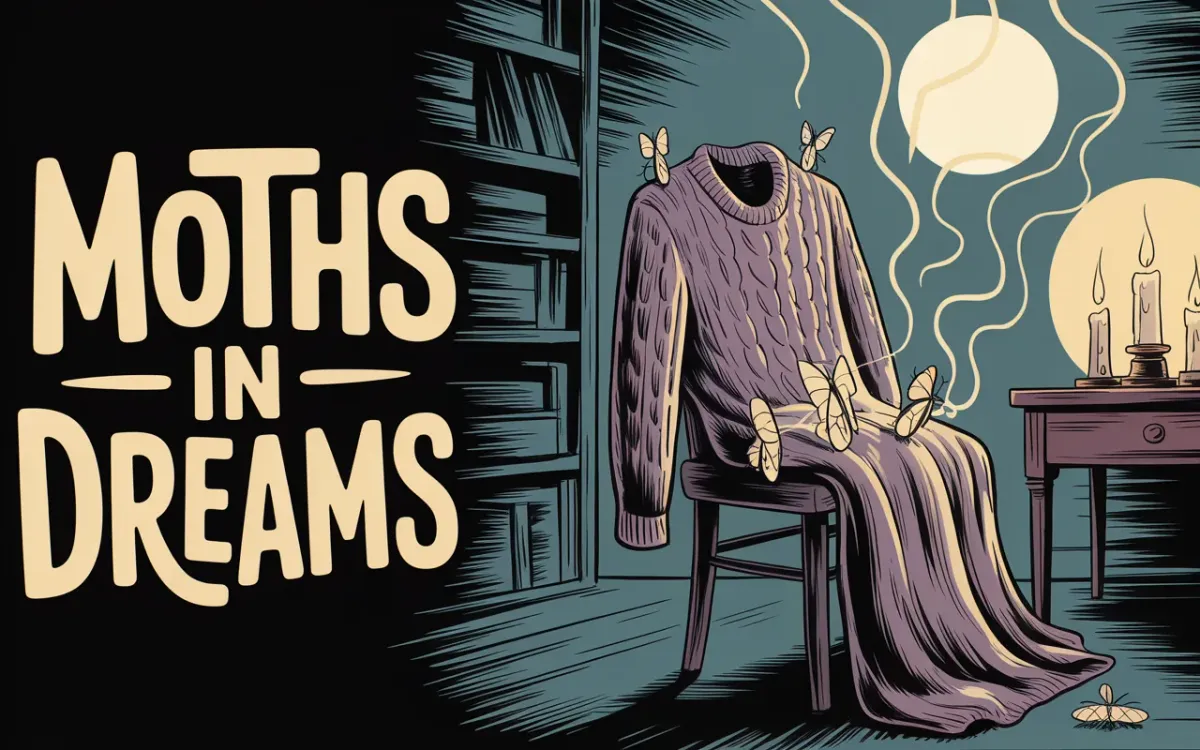
It starts somewhere in the back of a dream-wardrobe — a favourite coat, a childhood jumper, a dress you haven\'t worn in years. You pull it from the shelf and there they are: pale moths lifting off fabric riddled with holes, the garment unravelling at the seams before your eyes. When I first started collecting accounts of this dream, I expected it to be rare. It isn\'t. Across the hundreds of dream journals I\'ve studied, moths eating clothes appears with surprising regularity — and it carries a surprisingly consistent emotional signature: a gnawing sense that something precious is quietly being lost.
The details matter enormously. Were the moths on your own clothes or someone else\'s? Did you feel horror, or a strange, hollow calm? Was the damage already done, or were you watching it happen in real time? I\'ve come to believe these subtle differences point to very different psychological territories — from unprocessed grief and financial anxiety to questions about identity, legacy, and the things we neglect until they\'re gone.
Quick answer: Dreaming of moths eating your clothes typically signals unacknowledged loss, creeping anxiety about something slowly deteriorating in your waking life, or feelings of neglect around identity and self-worth. The specific garment, the moth\'s colour, and your emotional reaction all refine the meaning considerably.
What Do Moths Eating Clothes Symbolize in Dreams?
Clothes in dreams are almost universally understood as representations of identity — how we present ourselves, what roles we inhabit, how we protect or expose the self. Moths, by contrast, are creatures of the threshold: nocturnal, drawn compulsively to light they can never quite reach, associated across cultures with the soul, with the dead, and with the invisible passage of time.
When the moth turns its attention to your clothing, the symbolic equation becomes pointed. Something is consuming your sense of self. The damage isn\'t violent or sudden — it\'s slow, quiet, cumulative. In many of the dream accounts I\'ve encountered, the dreamer only notices the holes after the fact: the destruction happened while they weren\'t paying attention. That temporal quality is significant. This is rarely a dream about a sudden crisis. It\'s a dream about what happens when you look away for too long.
The specific garment carries weight too. I\'ve found that dreamers who see moths attacking a wedding dress or formal suit often describe recent anxieties about social status, reputation, or a relationship fraying at the edges. Those who see moths in a childhood wardrobe tend to be processing loss — of youth, of a particular version of themselves, of someone from the past who shaped them.
Culturally, the moth-and-garment image has deep roots. The Biblical warning about "moth and rust" corrupting earthly treasures (Matthew 6:19) has filtered into Western consciousness as an archetype for the impermanence of material things. In Japanese tradition, clothes moths (Tineola bisselliella) were associated with the spirits of ancestors returning to touch the things they once wore. The subconscious, it seems, has been using this image for a very long time.
What Do Different Moths Eating Clothes Dream Scenarios Mean?
The scenario shapes the meaning substantially. Here\'s what I\'ve observed across the most common variations:
\n
| Scenario | Most Likely Meaning |
|---|---|
| Moths eating your favourite coat or jacket | Fear of losing a protective identity or role — something you rely on to face the world |
| Moths eating someone else\'s clothes | Concern that someone close to you is being depleted or harmed in a way you feel helpless to stop |
| Finding moth holes in old clothes from a wardrobe | Grief or nostalgia; reconnecting with a past version of yourself that feels inaccessible |
| Watching moths actively eat clothes in real time | Acute awareness of something deteriorating now — a relationship, a project, your health |
| Trying to swat or kill the moths but failing | Frustration at feeling unable to prevent a loss or stop a damaging process |
| White moths eating clothes | A more ambivalent image — loss that may contain transformation; grief mixed with acceptance |
| Black moths eating clothes | Heavier, more foreboding; often connected to fears of mortality or a significant ending |
| Moths eating clothes in a wardrobe you\'ve forgotten about | Neglected aspects of self or unaddressed problems that have quietly worsened |
| Saving the clothes before the moths destroy them | A positive omen — you\'re catching something before it becomes irreparable |
\n
What Does Psychology Say About This Dream?
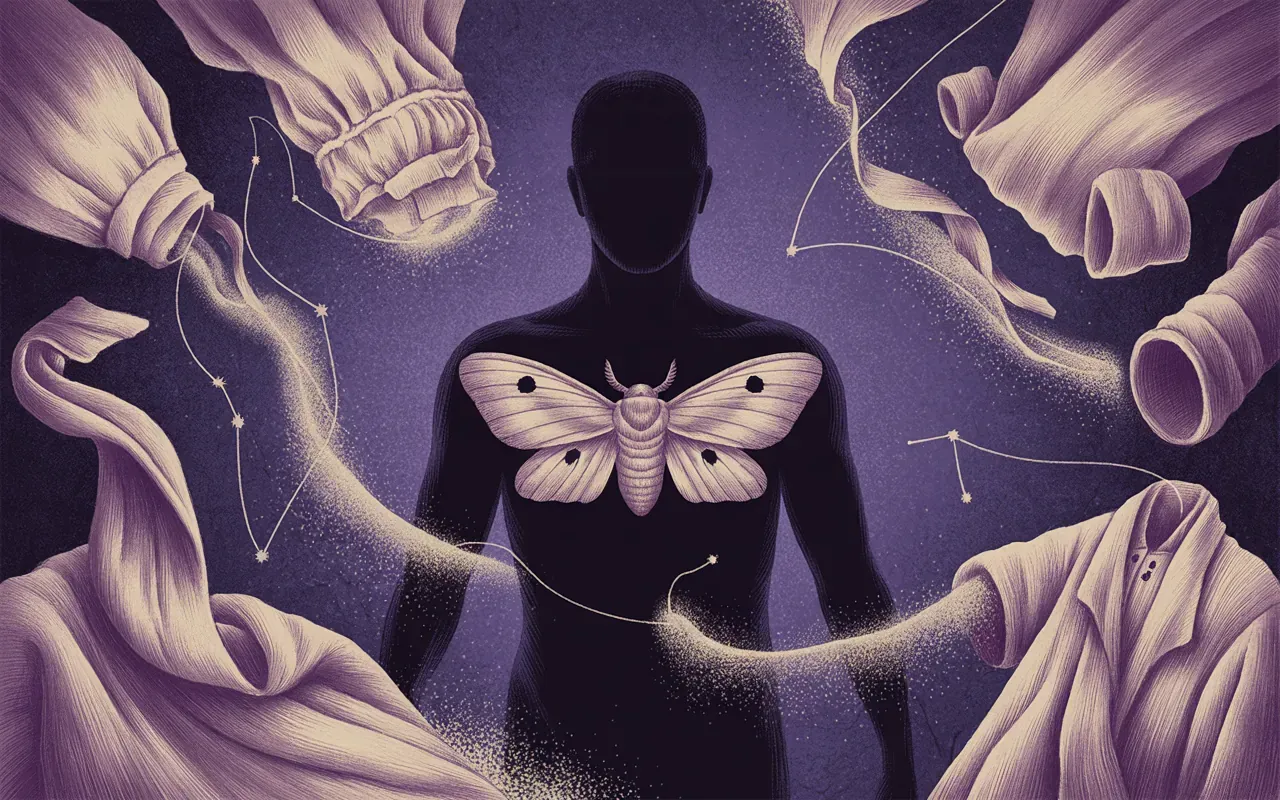
From a Jungian perspective, the clothes-eating moth sits squarely in the territory of the Shadow — those aspects of the self that we push into the unconscious, ignore, or refuse to examine. Jung saw decay and dissolution in dreams not as straightforwardly bad omens, but as the necessary disintegration that precedes transformation. The moth doesn\'t destroy for its own sake; it reveals what was already weakening.
In my research into contemporary cognitive dream theory, the moth-eating-clothes image aligns closely with what researchers call deterioration dreams — a category that includes rust, rot, and gradual damage. These tend to spike during periods of prolonged low-grade stress: financial pressure that hasn\'t reached crisis point, relationships that are slowly cooling, health concerns that haven\'t been addressed. The mind reaches for an image that captures the slow-motion quality of the threat.
There\'s also a strong connection to what psychologists call "identity maintenance anxiety" — the underlying concern that the roles and personas we\'ve built (represented by the clothes) are not as stable or permanent as we\'d like. This is particularly common during major life transitions: mid-career shifts, the children leaving home, the years after a divorce, the approach of old age. The moth becomes a symbol for time itself, for the inexorable thinning of what we thought was solid.
Freudian readings tend to emphasise the possessive element: the dreamer\'s specific attachment to what is being consumed. If the garment being eaten carries strong emotional associations — a deceased parent\'s coat, a wedding dress, a school uniform — the dream may be working through unresolved grief or attachment.
Why Do People Dream About Moths Eating Their Clothes?
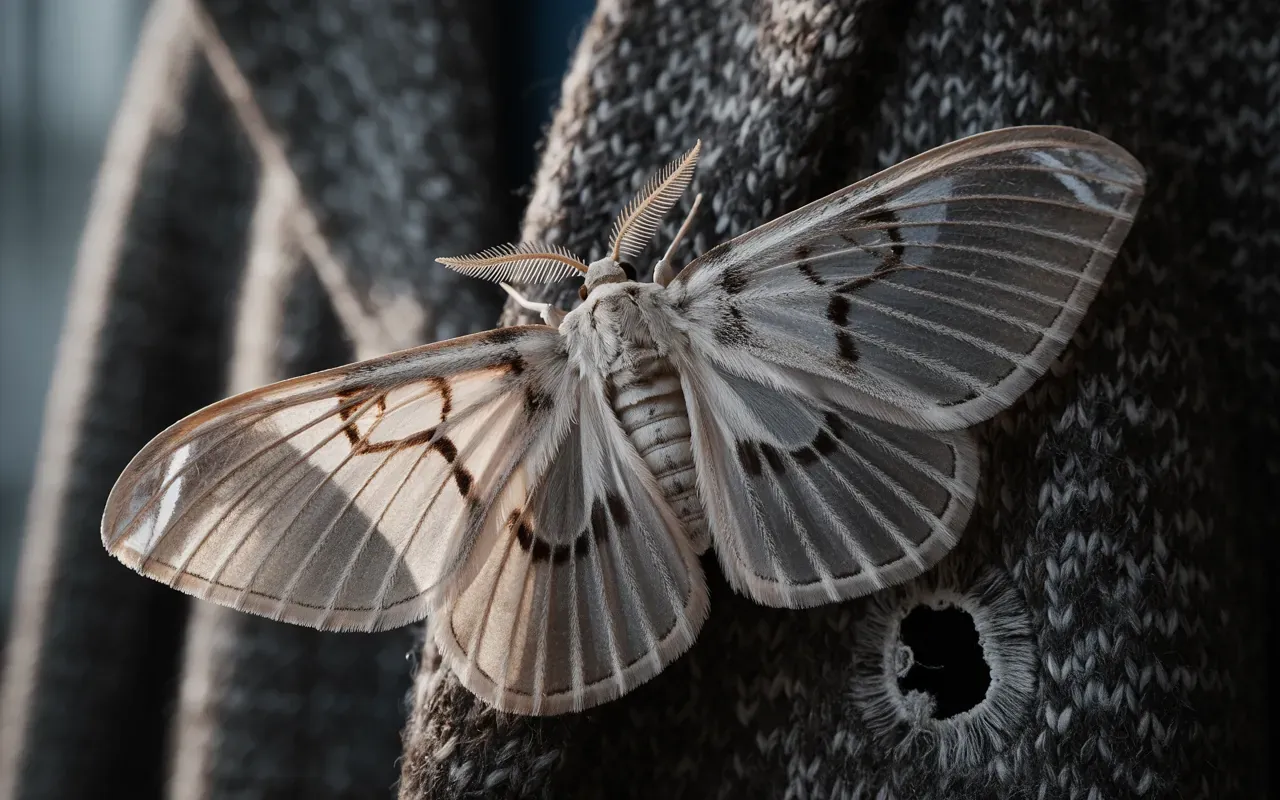
In my experience, this dream tends to cluster around a handful of specific waking-life triggers.
Unacknowledged financial anxiety is the most common. Clothes represent material wellbeing — having what you need, being presentable to the world. When the household budget is quietly being eaten away, when debt is accumulating in the background, when career stability feels uncertain, the dreaming mind reaches for the image of the moth: something destroying your resources slowly, invisibly, while you sleep.
Relationship neglect is the second cluster. Several dreamers I\'ve studied described this dream during periods when they knew, at some level, that an important relationship was being eroded by inattention. The moths appear when connection has been left undisturbed in the dark — like garments you haven\'t worn or checked on — long enough for damage to take hold.
Creative or professional stagnation also features strongly. Writers, artists, and people who\'ve put a meaningful project on indefinite hold often report this dream. The unlived work, the deferred ambition, the skill you\'re not using — all of these can manifest as the thing being slowly consumed while stored away.
Finally, there\'s the straightforward grief response. If someone important in your life has died recently, or if you\'re mourning the end of a chapter — a job, a city, a relationship — the moth-and-clothes image can be the dream\'s way of processing the texture of that loss: the slow recognition of absence, the way things once worn with someone are never quite the same afterwards.
Is There a Scientific Explanation?
Sleep researchers have documented that the brain, during REM sleep, draws heavily on emotional memory networks when constructing dream imagery. The more affect-laden an image or concept in waking life, the more likely it is to appear in symbolic form during sleep. Clothes are among the most personally charged objects most people own — they carry memories, associations with specific people and times, markers of identity and status. It\'s not surprising that the dreaming brain enlists them when processing anxiety, loss, or change.
The moth specifically may enter via what researchers at the Sleep Foundation have described as the "day-residue" effect — where elements encountered even briefly during waking hours (a moth glimpsed at a window, a news story about clothes storage, even the word "moth" in a poem) can become activated symbols during the emotionally-charged processing of REM sleep. The subconscious, in other words, doesn\'t invent its imagery from nothing. It recruits from the available catalogue of things that already carry weight.
Recurring versions of this dream — where the dreamer returns again and again to the same wardrobe of ruined garments — tend to indicate that the underlying waking concern hasn\'t been resolved or even consciously acknowledged. The repetition is the mind\'s way of escalating the signal.
Related Dreams Worth Exploring
If the moths-eating-clothes dream resonates, these related interpretations may add further context to what your subconscious is working through:
- Being Chased by a Swarm of Insects in a Dream — the broader symbolism of insect infestations and overwhelming anxieties
- What Does a Butterfly Mean in a Dream? — the moth\'s daytime counterpart, and the transformation they share
- What Does a Spider Mean in a Dream? — another night-associated creature with rich dream symbolism around weaving, trapping, and hidden fears
What Should You Do After This Dream?
I always recommend starting with the specific garment. Write it down immediately on waking — what was being eaten, whose it was, what associations it carries. Then ask honestly: what in my waking life feels like it\'s being quietly consumed right now? What have I been leaving in the back of the wardrobe, assuming it would keep?
If the dream returns multiple times, treat it as a direct message from your own attention. The repetition means the underlying concern is significant enough that your mind keeps returning to it. Try to name it — not in vague terms ("I\'m stressed") but concretely ("I haven\'t looked at my finances in three months" or "I haven\'t spoken honestly to this person in six weeks").
Some people find it useful to do a literal as well as figurative audit: check the actual clothes stored in boxes or bags you haven\'t opened in a while. There\'s something psychologically satisfying about addressing the literal version of the dream\'s concern — it can signal to the subconscious that you\'ve heard the message.
Finally, if the dream is connected to grief — if the clothes belong to someone who is no longer here — give yourself permission to simply feel that. Not every dream requires action. Sometimes the right response is to take out the coat, hold it, and let the loss be real for a moment.
Frequently Asked Questions
What does it mean to dream of moths eating your clothes?
It typically signals unacknowledged anxiety about something quietly deteriorating in your waking life — finances, a relationship, your sense of identity, or a project being neglected. The specific garment and your emotional reaction in the dream help narrow down the source.
Is dreaming about moths eating clothes a bad omen?
Not necessarily. In many traditions, moth imagery is associated with transformation rather than simple destruction. The dream is less a warning of inevitable loss and more a nudge to pay attention to something you\'ve been overlooking. Catching the dream\'s meaning is often itself the act of "saving the clothes."
What does it mean when you dream of moths eating a specific item — like a wedding dress or a coat?
The item carries the meaning. A wedding dress points to anxieties about a relationship or commitment. A coat or jacket often represents a protective identity or professional role. A childhood garment tends to involve grief, nostalgia, or the loss of a former self.
What do moths symbolize prophetically in dreams?
In prophetic or Biblical dream traditions, moths symbolise the impermanence of earthly possessions and the corrupting effect of placing too much value in material things (Matthew 6:19–20). A dream of moths eating clothes in this framework may be read as a call to reorient toward what truly lasts.
Are moths in dreams good or bad luck spiritually?
Spiritually, moths occupy an ambiguous space — they are soul-symbols, messengers of the dead, creatures of the liminal hours. The eating of clothes introduces a note of warning, but many traditions see the moth as a teacher rather than a destroyer: it shows you what you\'ve been unconsciously losing.
What does it mean if I keep having recurring dreams of moths eating my clothes?
Recurring dreams almost always indicate an unresolved waking concern. If this dream returns regularly, the underlying anxiety — whether financial, relational, or emotional — hasn\'t been consciously acknowledged or addressed. The repetition is the mind escalating its signal.
What does it mean to dream of moths eating someone else\'s clothes?
This often points to concern about someone close to you being gradually depleted, harmed, or losing themselves in some way — and a feeling of helplessness about how to stop it. It can also, more rarely, reflect projected anxieties about your own situation displaced onto another figure.
What\'s the difference between dreaming of a white moth versus a black moth eating clothes?
White moths tend to carry more ambivalent imagery — loss mixed with peace, grief that contains acceptance, or transformation that feels necessary even if painful. Black moths eating clothes carry heavier symbolism: finality, fear of a significant ending, or mortality-adjacent anxieties. The emotional tone of the dream usually confirms which reading fits.
What does psychology say about dreams of clothes being destroyed?
Cognitive dream researchers categorise these as deterioration dreams, which are associated with prolonged low-grade stress. Jungian analysts read them as Shadow material — the parts of the self being quietly consumed by what we refuse to look at. Either way, the consensus is that these dreams deserve conscious attention rather than dismissal.
Conclusion
Of all the moth dreams I\'ve encountered, the ones about eaten clothes stand out for their emotional precision. The image doesn\'t exaggerate — it simply shows you something you already know: that the quiet destruction of the unloved or the neglected is the most insidious kind. If you woke from this dream with that gnawing feeling in your chest, I\'d encourage you to take it seriously. Open the wardrobe. Check what\'s in there. The moths are already at work — but you\'ve caught them earlier than you think. Spinorino online casino