Falling from a Great Height but Landing Softly in a Dream


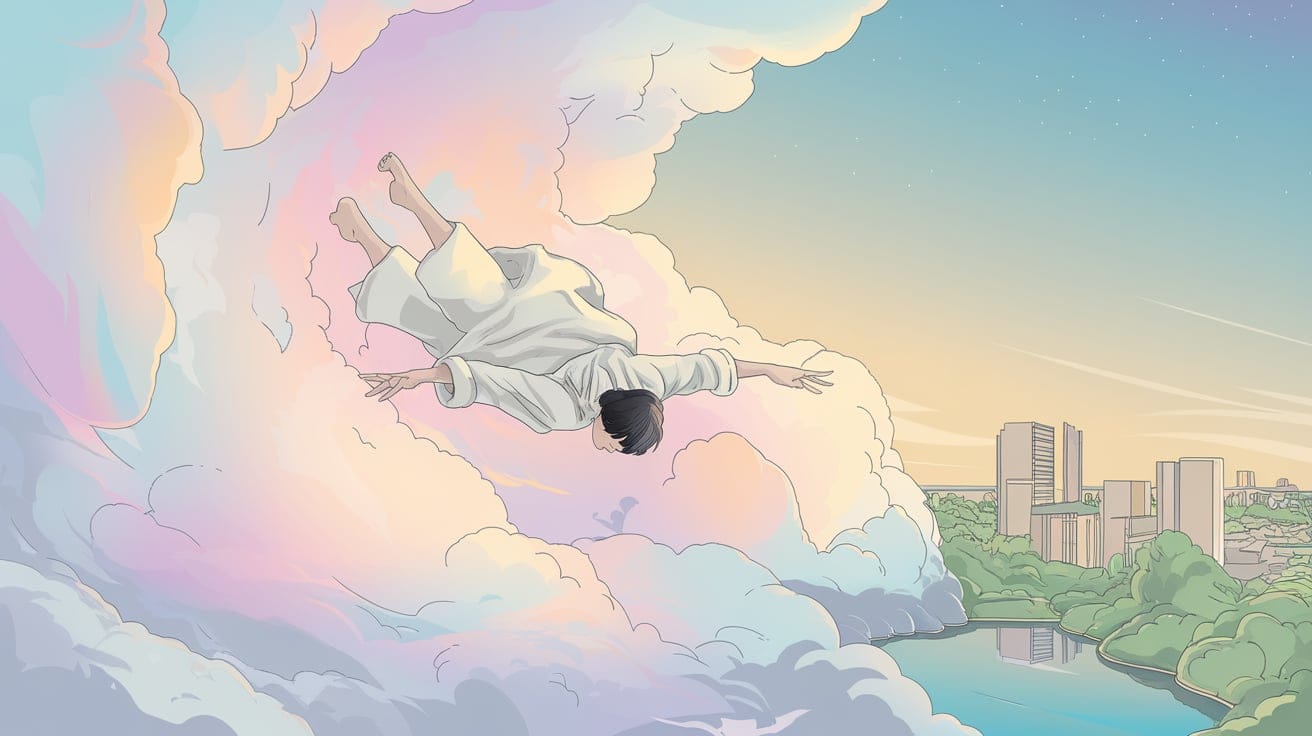
You fall. Your stomach drops. You brace — and then nothing happens. You touch down soft, unharmed, almost gently. That specific dream combination — falling from a great height but landing safely — is one of the more striking experiences people report in the dream accounts I\'ve studied. It breaks the script of a classic anxiety dream and leaves people genuinely confused about what it means.
Quick answer: Falling from a great height but landing softly in a dream typically means you\'re facing real fear or uncertainty in waking life — but your subconscious is signaling resilience. The soft landing is the key detail: it suggests you\'ll navigate the challenge without the damage you\'re expecting.
What does landing softly actually change about a falling dream?
Standard falling dreams are anxiety signals. Landing softly rewrites the ending. The fear is still there — the drop, the helplessness, the height — but the outcome is calm. That gap between what your brain expects and what actually happens is where the meaning lives.

According to the American Psychological Association, dreams often process emotional conflicts by running them through narrative scenarios. A soft landing is your brain\'s resolution layer — it\'s telling you the situation has a survivable outcome, even if you don\'t consciously believe that yet.
What does falling from a building, cliff, or sky mean when you land safely?
The source of the fall adds texture to the interpretation. Here\'s how the most common scenarios break down:
\n
| Where you fall from | What it often represents | What the soft landing adds |
|---|---|---|
| Tall building or skyscraper | Career pressure, professional anxiety, fear of failure at work | You\'ll handle it — the outcome is less catastrophic than feared |
| Cliff edge | Fear of drastic change, stepping into unknown territory | You can survive the leap; change isn\'t as dangerous as it looks |
| Open sky or endless height | Existential anxiety, feeling unmoored or without structure | Acceptance — you don\'t need the ground to feel secure |
| Stairs or a ledge | A smaller but immediate decision, social stumble, or personal setback | The stumble is recoverable; you land on your feet |
\n
What does psychology say about falling dreams that end safely?
Freud saw falling dreams as expressions of underlying anxiety — the loss of control, the fear of what\'s below the surface. But the soft landing complicates that reading. It suggests the unconscious is doing something more than cataloguing fear. It\'s working through it.
Carl Jung\'s framework handles this better. Jung read the downward fall as a descent into the unconscious — not a punishment, but an invitation to integrate what lives there. The soft landing is the integration. You went down, you faced what was there, you came back whole. In my research into recurring dream patterns, people who report the soft-landing version tend to be in a transitional phase: not in crisis, but moving through one.

Energy work traditions like Reiki associate this dream with the Root Chakra. An overactive Root Chakra produces fear and instability — the fall. The soft landing mirrors a calming response, a return to grounded energy.
What is the spiritual meaning of falling and landing safely in a dream?
Spiritually, the soft landing is a reassurance. Across different traditions, the pattern I keep seeing is this: the fall is surrender, and the landing is grace. You stopped fighting the descent and found that what was waiting at the bottom wasn\'t destruction — it was solid ground.
In some Christian dream interpretations, landing safely after a fall signals divine protection. In Islamic tradition, a fall with a safe outcome can indicate that a feared trial will pass without the harm you anticipated. Both frameworks share the same core message: the fear was real, but the outcome is in your favor.
What causes these dreams — and who has them most often?
Two things drive them: life circumstances and sleep physiology.
People navigating major transitions — job changes, relationship shifts, moving, health scares — have these dreams more often. The fall is the transition. It doesn\'t feel safe. But if your deeper sense of self is intact, the dream resolves with a soft landing rather than an impact.
On the physiological side, hypnagogic jerks trigger many falling sensations. That\'s the sudden muscle twitch as you slip from wakefulness into sleep. Your brain may incorporate that sensation into a dream narrative, and whether you land hard or soft depends on the emotional state you\'re processing at that moment.
If this dream keeps recurring, what does that mean?
Recurring soft-landing dreams usually mean one thing: the same fear keeps showing up, and you keep surviving it. Your unconscious is doing the emotional math repeatedly because the waking situation hasn\'t fully resolved. That\'s not a problem — it\'s the system working. Once the real-life pressure lifts or you fully accept the change you\'re resisting, the dream typically stops.
If the landing shifts from soft to hard across multiple dreams, pay attention to that. It may track how your confidence in the situation is changing.
For more on what the brain does during extended anxiety dreams, see our guide to falling endlessly in a dream — which covers the version of this experience that never resolves — and the spiritual meaning of falling in a dream for broader context. If you\'re also getting falling dreams where you hit the ground, comparing both can tell you a lot about how your subconscious is processing the same fear.
How to work with these dreams rather than just enduring them
A dream journal is the most practical tool here. Write down the height, the source of the fall, how the landing felt, and what you were feeling emotionally when you woke up. After a few entries, patterns emerge — specific fears, specific life areas, specific emotional states that precede the dream.
Mindfulness before sleep can shift the landing. If you process the fear consciously — name it, sit with it briefly before bed — the dream tends to stay in soft-landing territory rather than escalating. Addressing the waking fear directly is faster: the dreams follow.
If these dreams cause significant sleep disruption, a therapist familiar with somatic or CBT approaches can help you work through the underlying anxiety directly.
Frequently Asked Questions
Is falling in a dream good or bad?
Falling dreams are neither inherently good nor bad — they reflect emotional processing. Standard falling dreams signal anxiety, loss of control, or fear. When you fall and land softly, the dream shifts toward a positive reading: your subconscious is working through fear and arriving at resilience rather than catastrophe.
What does falling and landing safely in a dream mean spiritually?
Spiritually, falling and landing safely means you\'re being protected or guided through a feared transition. Across multiple traditions, the soft landing is read as reassurance — that the thing you\'re afraid of will not destroy you. The fall is the test; the landing is the answer.
What does falling and landing safely in a dream mean biblically?
In a biblical context, falling and landing safely is often interpreted as a sign of divine protection — that God is present in your difficulty and will not let you be overwhelmed. Psalm 37:24 ("Though he may stumble, he will not fall, for the Lord upholds him with his hand") is commonly referenced in this context.
What does falling and landing safely in a dream mean in Islam?
In Islamic dream interpretation, falling and reaching the ground safely is generally a positive sign. It suggests a feared outcome — illness, financial loss, or conflict — will not materialize as badly as anticipated. The safety of the landing is the key element; harm was avoided despite the trial.
Why do I dream about falling but not hitting the ground?
Not hitting the ground at all is slightly different from landing softly. It often signals unresolved anxiety — you\'re in the fall, but the situation hasn\'t concluded yet. Psychologically, it reflects uncertainty: the fear is present but the outcome is still open. Landing softly, by contrast, suggests resolution is near.
What does it mean to dream about jumping off a building and landing safely?
Jumping — rather than falling — adds agency. It means you chose the risk. Landing safely after a jump from a building often signals a turning point: you took a leap in waking life (or are contemplating one), and the dream is telling you the outcome will be survivable, even good. It\'s the subconscious version of "you\'ve got this."
What does falling in a dream mean spiritually?
Spiritually, falling in a dream means you\'re releasing control — willingly or not — and descending toward something deeper in yourself. Most spiritual traditions treat the fall as a necessary movement, not a failure. What matters is what happens when you land. A soft landing means the descent was purposeful.
Can recurring falling dreams predict something in real life?
Dreams don\'t predict specific events. Recurring falling dreams reflect ongoing emotional states — usually sustained anxiety or an unresolved life transition. They track your internal experience, not external events. When the real-life pressure resolves, the dreams typically stop on their own.
What causes the physical jerk when you feel like you\'re falling in a dream?
That\'s a hypnagogic jerk — an involuntary muscle contraction that happens as the body transitions from wakefulness to sleep. The brain sometimes frames this physical sensation as a falling narrative. It\'s a normal physiological event and not a sign of a sleep disorder, though it\'s more frequent in people who are overtired or stressed.
What does it mean to dream about falling from a mountain and landing safely?
A mountain fall with a soft landing often reflects a major life goal or challenge. Mountains in dreams represent ambition, hard work, or something you\'ve been climbing toward. Falling from one but landing safely suggests a setback that doesn\'t end your journey — you fell short of the summit this time, but you\'re intact and can try again.
Wig preparation should consider comfort, tangling and how the fibres appear under camera lighting. Fringe placement can change the overall impression of the character. For styling and photo preparation, Marin Kitagawa cosplay wig(喜多川海夢 コスプレウィッグ) provides the correct wig reference. This reference remains specific to wigs and does not use costume sizing language. Gentle detangling and suitable storage help maintain the wig between uses. A stand can help preserve volume after styling.
What to take away from this dream
The soft landing is the signal that matters. Your brain ran the fear, processed the fall, and delivered a survivable outcome. If this dream is recurring, the specific source of the fall — building, cliff, sky — will point you toward the exact life area generating the anxiety. Write it down, identify the parallel in your waking life, and address the real-world pressure directly. The dream will follow.