What Does a Wolf Mean in a Dream? Discover Its Deep Significance

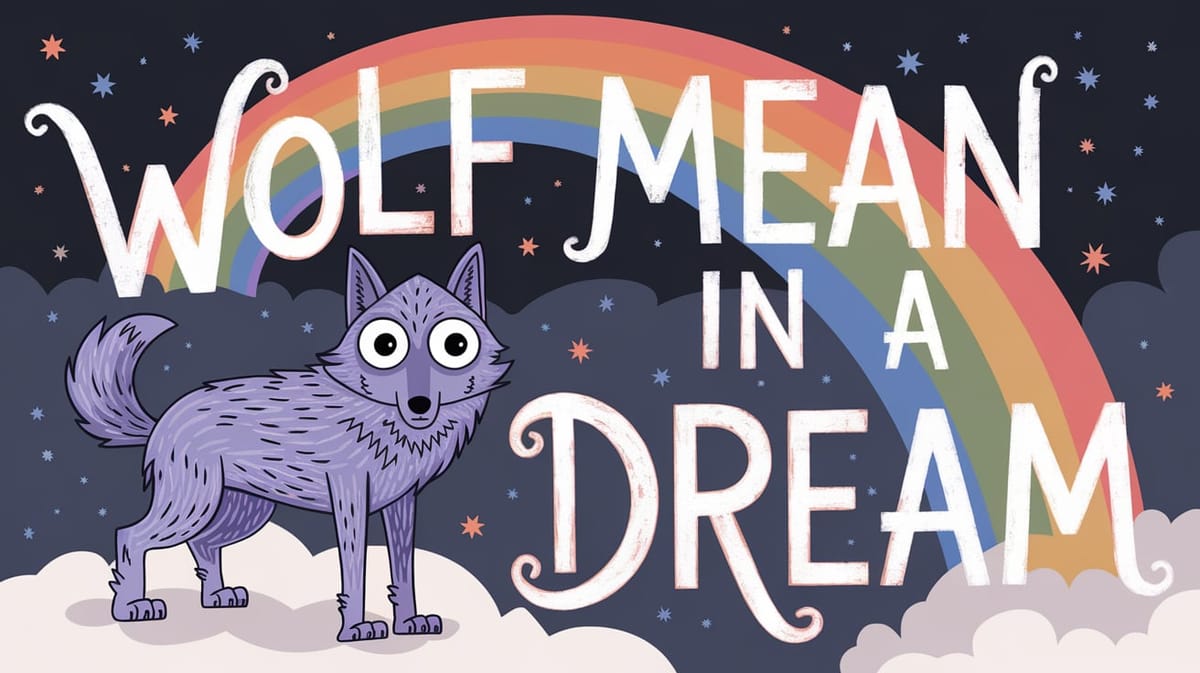
Quick answer: A wolf in a dream most often signals your raw instincts, independence, or a perceived threat in waking life. Depending on context — calm encounter, attack, or howl — it can point to untapped inner power, social conflict, or a call to trust your gut.
I\'ve been interpreting animal dreams for years, and the wolf comes up more than almost any other creature. It sits at this fascinating crossroads between fear and reverence — and that tension is exactly what makes it so meaningful when it visits your sleep.
What does a wolf mean in a dream — and why should you pay attention?
Wolves carry a dual reputation across cultures: revered as spirit guides in Native American traditions, cast as predators in European folklore, and honored as loyal pack leaders in shamanic practice. When a wolf appears in your dream, your subconscious is likely drawing on this deep symbolic weight to communicate something urgent about your inner life or outer circumstances.
The core meanings associated with wolf dreams cluster around five themes: instinct, independence, perceived threat, loyalty, and shadow integration. Which one applies to you depends heavily on the emotional tone and specific events of the dream.
\n\n| Wolf Dream Scenario | Most Common Meaning | Emotional Tone |
|---|---|---|
| Lone wolf watching you | Self-reliance; a need for solitude | Neutral / contemplative |
| Wolf attacking you | Real-life threat; suppressed anger | Fear / urgency |
| Wolf approaching slowly | Gradual awakening; insight arriving | Anticipation |
| Friendly wolf / running with pack | Harmony with instincts; strong community | Joy / belonging |
| Wolf howling | A subconscious call for expression or warning | Alert / mysterious |
| Black wolf | Shadow self; hidden emotions; mystery | Unease or curiosity |
| White wolf | Spiritual guidance; wisdom; purity of purpose | Peace / awe |
What is the spiritual significance of a wolf in a dream?
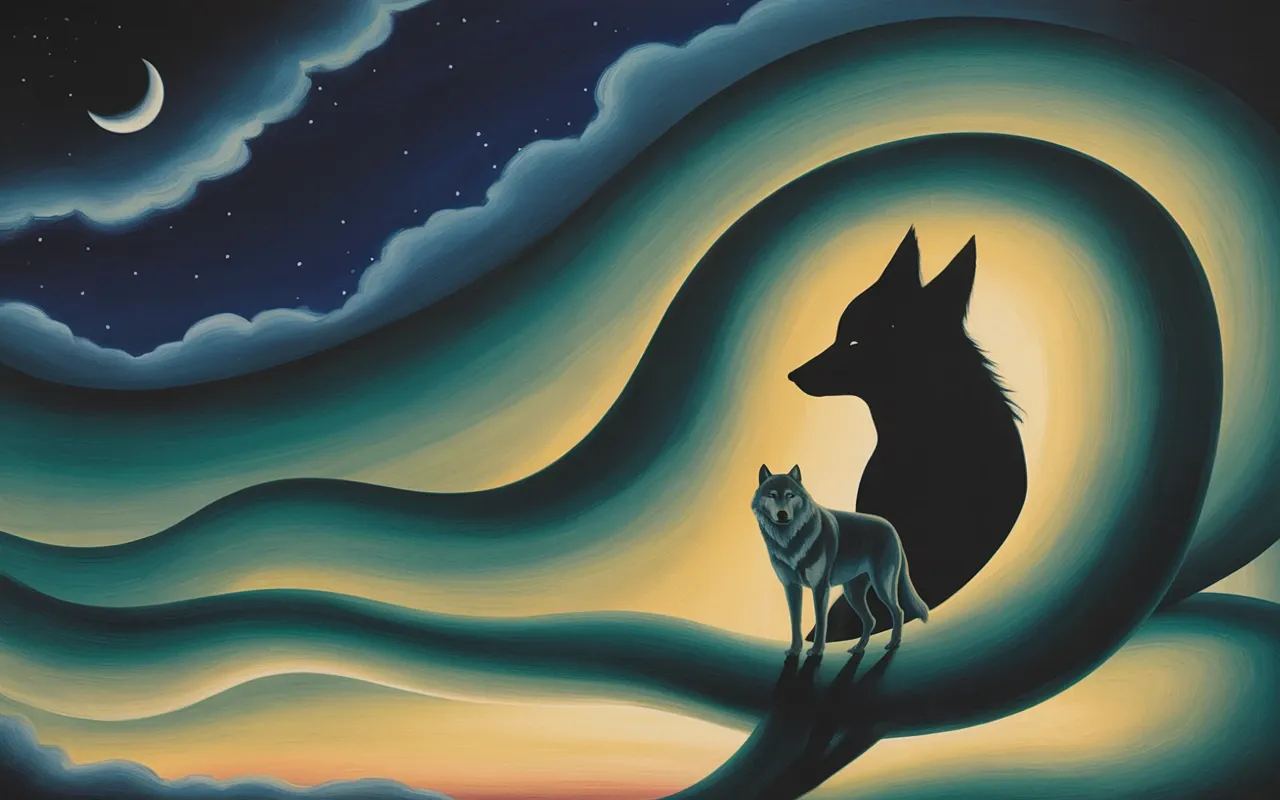
Spiritually, wolves are ancient guides. Many Indigenous traditions regard the wolf as a teacher of loyalty, communication, and reading the world through instinct. In those frameworks, dreaming of a wolf is not a warning — it\'s an invitation to reclaim the wisdom you\'ve been ignoring.
From a biblical standpoint, wolves carry a sterner message. Matthew 7:15 warns of "false prophets who come to you in sheep\'s clothing, but inwardly are ravenous wolves." If your wolf dream feels sinister or deceptive, it may be pointing toward a person or situation in your life that is not what it appears.
In shamanic and Reiki traditions, the wolf represents an energy imbalance between assertiveness and heart-centered wisdom. The appearance of a wolf in this context may be a nudge to channel strength without losing compassion.
What do different wolf dream scenarios actually mean?
Context is everything with wolf dreams. Here\'s what the key scenarios typically signal:
Being chased by a wolf points to avoidance — something you\'re running from in waking life, whether an emotion, a decision, or a person. The wolf rarely catches you when you turn around and face it.
Befriending a wolf suggests you\'re making peace with a wild, instinctual part of yourself. This is often a positive omen for creative people or those who have suppressed their true nature to fit in.
A wolf pack reflects your social world — either the strength of your community or the pressure to conform to group norms. If the pack feels threatening, examine where you feel outnumbered or unseen.
A wolf howling is a call for communication. Your subconscious may be telling you to speak up, or alerting you to listen more carefully to those around you.
In my experience, the emotional tone of the dream matters more than the specific action. A fearful wolf encounter and a peaceful one point in completely different directions, even when the surface imagery looks similar.
How do psychologists interpret wolf dreams?
Freud viewed the wolf as a symbol of repressed desires or primal fears — specifically the parts of the id that civilization has taught us to suppress. His famous patient "the Wolf Man" (Sergei Pankejeff) had recurring wolf dreams that Freud linked to early childhood trauma and castration anxiety. Whether or not you subscribe to Freudian theory, it\'s worth asking: what drives or urges have I been keeping locked away?
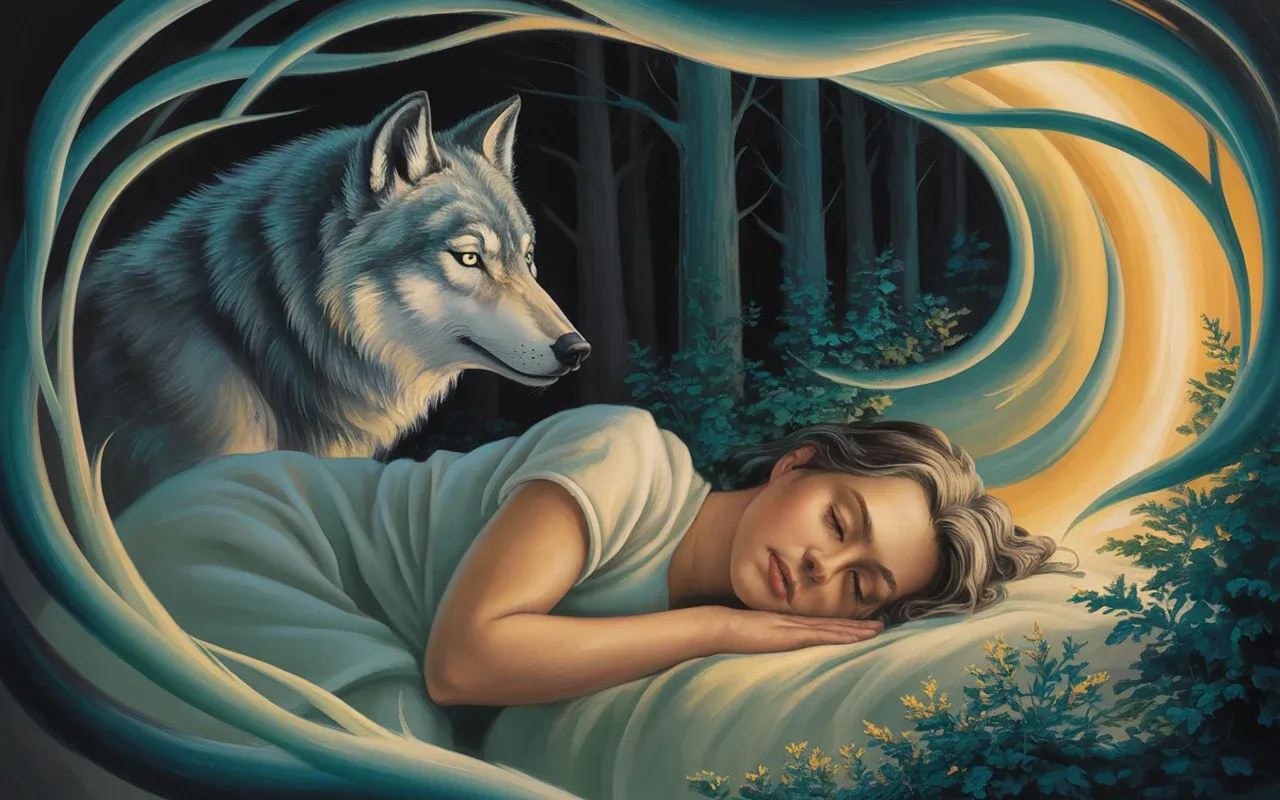
Jung\'s approach was richer. He saw the wolf as an archetypal Shadow figure — the dark, instinctual side of the psyche that holds everything the conscious self refuses to own. Rather than fearing this shadow, Jungian analysis encourages integration: acknowledge the wolf, engage it, and absorb its energy constructively.
Modern sleep science adds another layer. The amygdala — your brain\'s fear-processing center — is especially active during REM sleep. If you\'ve been under stress, your brain may generate wolf imagery as a symbolic stand-in for perceived threats, helping you rehearse responses to danger in a safe, dream environment. Research published in Sleep Foundation\'s dream research overview supports the idea that emotionally significant symbols recur in dreams during periods of psychological stress.
What causes wolf dreams?
Several factors commonly trigger wolf dreams:
- Major life transitions — starting a new role, ending a relationship, or moving.
- Social conflict — tension at work, feelings of exclusion, or rivalry.
- Suppressed instincts — long-ignored creative drives, desires, or emotions pushing back.
- Anxiety and perceived threat — a sense that someone around you is not who they appear to be.
- Spiritual awakening — in many traditions, wolf dreams intensify during periods of growth.
The wolf is also a commonly encountered figure for empaths and highly intuitive people. If you pick up on subtleties others miss, your subconscious may have recruited the wolf as a messenger long before your conscious mind recognized the pattern.
How should you respond to a recurring wolf dream?
Start with a dream journal. Write down every detail immediately on waking — the wolf\'s color, your emotional state, whether it was alone or in a pack. Over several entries, patterns emerge that make the message clearer.
If the dreams are distressing, consider working with a therapist who has experience in Jungian or dream-based approaches. Active imagination — a technique developed by Jung — involves consciously re-entering the dream scenario and having a dialogue with the wolf figure. Many people find this surprisingly transformative.
At a practical level, stress reduction (meditation, regular sleep schedules, reducing late-night screen time) often softens or resolves anxiety-driven animal dreams within a few weeks.
You might also enjoy exploring related dream symbols. If you\'re seeing other large animals in your sleep, our guide to seeing a tiger in a dream or the interpretation of seeing a fox in a dream may offer additional context. And if your wolf dream involves a chase, the broader analysis of being chased in a dream is worth reading alongside this one.
FAQ: Wolf Dream Meanings
What does it mean to dream about a wolf attacking you?
A wolf attack in a dream typically signals a perceived threat in waking life — someone who feels dangerous, a situation spiraling out of control, or suppressed anger turning inward. It can also reflect the Jungian Shadow demanding acknowledgment rather than continued repression.
Is dreaming of a wolf a good or bad omen?
It depends on context. A calm, friendly wolf is generally positive — it reflects alignment with your instincts and inner strength. An aggressive or lurking wolf often points to external threats or internal conflict that needs addressing. Neither is purely good or bad; both are informative.
What does a white wolf mean in a dream?
White wolves most commonly symbolize spiritual guidance, wisdom, and purity of intent. If a white wolf appears calm and watchful, many interpreters see it as a protective spiritual presence or a sign that you\'re on the right path.
What does a black wolf mean in a dream?
A black wolf is closely tied to the Jungian Shadow — the unconscious aspects of your personality that you\'ve pushed aside. It can also represent mystery, hidden power, or intuition you haven\'t yet learned to trust. Dreaming of a black wolf is rarely a bad sign; it\'s more often an invitation to look inward.
What does it mean to dream of a wolf pack?
A wolf pack reflects group dynamics — your social circle, family structure, or workplace tribe. A harmonious pack suggests strength through belonging. A threatening pack may indicate peer pressure, feeling outnumbered, or conflict within a group you\'re part of.
What is the biblical meaning of wolves in dreams?
Biblically, wolves represent false prophets, deception, and spiritual danger (Matthew 7:15, Acts 20:29). A wolf in a biblical dream context may be a warning to stay discerning — not everyone presenting themselves as trustworthy deserves that trust.
Why do I keep dreaming about wolves?
Recurring wolf dreams usually signal an unresolved issue your subconscious keeps returning to — a threat you haven\'t addressed, an instinct you\'ve been ignoring, or a major life change still being processed. Journaling, therapy, or active imagination exercises can help you work through the recurring imagery.
What does it mean to dream of a friendly wolf?
A friendly wolf — one you feel calm around, run with, or see as a companion — is one of the more positive wolf dream experiences. It suggests harmony with your instincts, confidence in your own power, and possibly a period of creative or personal vitality ahead.
Can wolf dreams be spiritual messages?
Many traditions — particularly Native American and shamanic — treat animal dreams as genuine spiritual communications. Whether or not you hold that belief, wolf dreams consistently draw attention to aspects of the self or environment that deserve closer examination. The "message" may be psychological, spiritual, or both.
What your wolf dream is really telling you
Wolf dreams are rarely random. Whether the wolf appears as protector, pursuer, or silent observer, it almost always points to something real: an instinct asking to be honored, a threat asking to be seen, or a shadow asking to be integrated rather than feared. The details of your dream — the wolf\'s color, its behavior, your emotional response — are your best guide to which of these meanings applies.
Write it down. Sit with it. If the wolf keeps returning, that\'s the dream asking you to listen more carefully. In my experience, the people who take these animal dreams seriously — who engage with them rather than dismiss them — tend to find genuine insights about who they are and what they need.