What Does It Mean When You\'re Being Blind in a Dream?

Quick answer: Dreams about being blind usually reflect feelings of uncertainty, fear of the unknown, or a refusal to acknowledge something in waking life. They can also signal a spiritual shift — an invitation to trust your inner knowing when external clarity fails you.
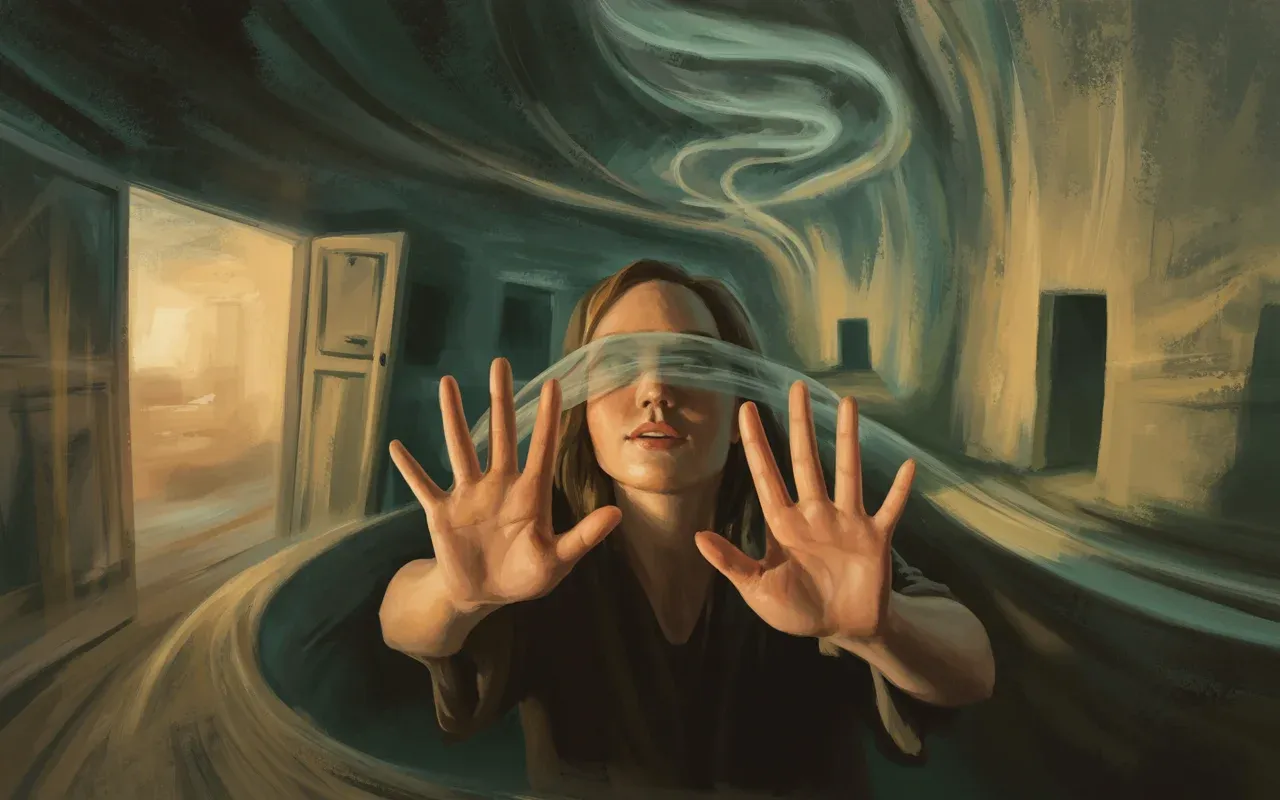
Few dream experiences hit as hard as suddenly losing your sight. One moment you\'re moving through a scene, and the next — total darkness. I\'ve found that blindness dreams tend to surface during periods when people feel genuinely lost or overwhelmed, and they carry messages worth paying attention to.
What Does Blindness in a Dream Symbolize Spiritually?
In short, it often points to inner transformation. Across many spiritual traditions, losing physical sight precedes a deeper awakening. Think of Saul on the Damascus road — struck blind before his conversion. When you lose your ability to see in a dream, your subconscious may be pushing you to develop inner vision and intuition instead of relying on what\'s right in front of you.
In my research, I keep seeing this pattern: the dreamers who feel peaceful during their blindness tend to be going through genuine spiritual growth. The darkness becomes a kind of cocoon — stripping away distractions so you can hear what your deeper self is actually saying. Those who panic, on the other hand, are usually wrestling with a situation they refuse to look at honestly.
Blindness in dreams also connects to the archetype of the "wounded healer" — the idea that loss of one capacity opens a door to something greater. Many mystic traditions, from Sufism to certain Buddhist practices, treat voluntary darkness as a path to enlightenment.

Why Do Different Blindness Scenarios Mean Different Things?
The details matter more than the blindness itself. Here\'s how the most common variations break down:
\n\n| Scenario | Likely Meaning |
|---|---|
| Sudden total blindness | Feeling unprepared for upcoming changes; being "in the dark" about something important |
| Blind but calm and peaceful | Acceptance of uncertainty; growing trust in your intuition |
| Blind and panicking | Anxiety about losing control; fear of the unknown |
| Blind in one eye only | Seeing only one side of a situation; selective awareness |
| Navigating familiar spaces while blind | Struggling to adapt to new circumstances in a place that used to feel safe |
| Helping a blind person | Your role as a guide for others, or nurturing parts of yourself that feel lost |
| Gradually losing sight | Slow realization that you\'ve been avoiding a truth |
If you\'re struggling to navigate a familiar space — your childhood home, your workplace — while blind, that usually points to a situation where the rules have changed but you haven\'t caught up yet. The pattern I keep seeing is that the emotional tone of the dream matters as much as the blindness itself.
What Do Psychologists Say About Blindness Dreams?
Freud interpreted dream blindness as a symbol of powerlessness — the inability to see as a form of psychological impotence. While his specific theories have fallen out of favor, the core idea holds up: blindness dreams often appear when you feel inadequate or unable to influence your circumstances.
Jung took it somewhere more interesting. He saw dream blindness as an invitation to meet your shadow self — those parts of your psyche you normally avoid looking at. When the dream strips away your sight, it forces you to confront what you\'d rather keep hidden. Modern Jungian therapists still use blindness dreams as entry points for shadow work.
Contemporary dream researchers at institutions like the UC Santa Cruz dream research lab have found that sensory deprivation dreams — including blindness — often spike during periods of high stress or major life transitions. The brain appears to process uncertainty by simulating the loss of its primary information-gathering sense.
What Triggers Blindness Dreams?
These dreams don\'t come out of nowhere. They tend to cluster around specific life circumstances:
- Major life transitions — new jobs, moves, relationship shifts where the future feels unclear
- Relationship uncertainty — when you feel "blind" to someone\'s true intentions or feelings
- Creative blocks — artists and writers report blindness dreams during periods of stagnation
- Emotional overload — when your mind needs to shut out external input to process what\'s already inside
- Avoidance patterns — the dream forces confrontation with something you\'ve been refusing to see
On the physical side, REM sleep patterns that affect visual processing centers can trigger blindness dreams. Pressure on the eyes during sleep, certain medications, and temporary sleep paralysis all play a role. But in my experience, the psychological triggers outweigh the physical ones by a wide margin.
What Does Blindness in a Dream Mean in the Bible?
Biblical blindness carries a specific weight. Scripture consistently uses blindness as a metaphor for spiritual ignorance — the inability or unwillingness to perceive God\'s truth. In 2 Corinthians 4:4, Paul writes about minds being "blinded" to the gospel. In John 9, Jesus heals a man born blind, and the miracle is as much about spiritual sight as physical.
If you\'re a person of faith dreaming about blindness, the biblical framework suggests a call to examine what spiritual truths you might be missing. It\'s rarely a punishment — more often it\'s a prompt. The consistent biblical pattern is that blindness precedes revelation, not abandonment.
For Christians specifically, blindness dreams may also connect to the concept of "walking by faith, not by sight" (2 Corinthians 5:7). The dream could be an invitation to trust God\'s guidance when you can\'t see the path ahead.
What Does Being Blind in a Dream Mean in Islam?
In Islamic dream interpretation (ta\'bir), blindness carries layered meanings. According to scholars like Ibn Sirin, dreaming of being blind can indicate straying from the right path or being unaware of one\'s sins. However, context changes everything — if the dreamer is blind but feels guided, it can mean relying on Allah\'s wisdom rather than worldly understanding.
Some Islamic interpretations also connect dream blindness to financial loss or separation from loved ones, depending on the surrounding details. A blind person being led by someone trustworthy in the dream is generally seen as a positive sign — it suggests divine guidance is present even when personal understanding falls short.
What Does It Mean to Dream of Being Blind in One Eye?
This is one of the more telling variations. Blindness in one eye almost always points to partial understanding — you\'re seeing a situation from only one angle and missing something important on the other side.
The specific eye can matter too. In many symbolic traditions, the right eye is linked to rational, analytical thinking while the left connects to intuition and emotion. If your right eye goes blind, you may be over-relying on logic when the situation calls for feeling. If the left eye fails, you might be ignoring your gut instincts in favor of "reasonable" thinking.
People going through relationship conflicts report one-eye blindness dreams frequently. It\'s the subconscious saying: you\'re only hearing your own side of this story.
How Should You Respond to Blindness Dreams?
Rather than fearing these dreams, treat them as useful data. Here\'s what actually helps:
- Journal the details immediately — the emotional tone, who was present, where you were, what you were trying to do
- Identify avoidance patterns — ask honestly what you might be refusing to look at in your waking life
- Practice mindfulness — develop the kind of non-visual awareness the dream is pointing toward
- Talk about it — a therapist or trusted friend can help you see (literally) what you\'re missing
- Check your stress levels — these dreams spike during overwhelm, and reducing stress often reduces them
If you\'re interested in how other sensory changes show up in dreams, you might find it useful to read about losing your voice in a dream — another common "lost sense" dream with overlapping themes. Dreams about seeing the world in black and white also deal with altered visual perception and carry similar messages about emotional numbness or transition. And if your blindness dream involves seeing impossible things, our piece on seeing colors that don\'t exist in reality is worth a look.
The Bottom Line on Blindness Dreams
Blindness dreams are your subconscious stripping away the comfortable illusion that you can see everything clearly. They show up when you\'re avoiding something, transitioning through uncertainty, or ready for a deeper kind of knowing that doesn\'t depend on your eyes. The dreamers who benefit most from these experiences are the ones who stop trying to "fix" the blindness and start asking what they\'re being invited to perceive differently. Whether the message is spiritual, psychological, or both — the darkness in your dream is almost always pointing toward a light you haven\'t found yet.
Frequently Asked Questions
What does it mean when you have a dream about being blind?
It typically reflects feelings of uncertainty, avoidance, or being unprepared for change. Your subconscious uses blindness to represent situations where you lack clarity or are refusing to acknowledge something important. The emotional tone — panic vs. peace — tells you whether you\'re resisting the unknown or learning to accept it.
Is dreaming of blindness a bad omen in Christianity?
Not usually. In Christian tradition, blindness in dreams more often signals a call to deepen your faith or examine areas of spiritual neglect. The biblical pattern — from Saul\'s temporary blindness to Jesus healing the blind — frames loss of sight as a precursor to greater understanding, not punishment.
What does being blind in a dream mean in Islam?
Islamic scholars like Ibn Sirin interpret dream blindness as potentially indicating deviation from the straight path or unawareness of one\'s shortcomings. However, feeling guided while blind is a positive sign, suggesting reliance on divine wisdom. The surrounding details and emotions in the dream heavily influence the interpretation.
What does dreaming of being blind in one eye mean?
One-eye blindness points to seeing only part of the picture. You may be approaching a situation with bias — hearing only your side of a conflict, or over-relying on either logic (right eye) or emotion (left eye) while neglecting the other. It\'s a call to seek the perspective you\'re missing.
Can blindness dreams be caused by physical health issues?
Occasionally. Eye strain, sleep position compressing blood flow, certain medications, and conditions affecting REM sleep can all trigger blindness dreams. If they\'re frequent and don\'t connect to any emotional context, a medical check-up is reasonable. But most blindness dreams have psychological rather than physical roots.
Why do I keep having recurring dreams about being blind?
Recurring blindness dreams signal an unresolved issue your subconscious keeps flagging. Something in your life needs attention, and you haven\'t addressed it yet. The dreams will typically decrease once you identify and confront the avoidance pattern — whether it\'s a relationship truth, a career decision, or an emotional wound you\'ve been sidestepping.
Does temporary blindness in a dream mean something different from permanent blindness?
Yes. Temporary blindness usually reflects passing confusion about a specific situation — a phase you\'ll move through. Permanent blindness in dreams points to more fundamental shifts: a complete change in worldview, a permanent loss you\'re processing, or a deep transformation in how you understand yourself and others.
How can I use blindness dreams for personal growth?
Start by journaling the dream immediately — capture the emotions, setting, and what you were trying to do. Then ask yourself honestly: what am I refusing to see in my waking life? Use the dream as a prompt for meditation or therapy. Many people find that blindness dreams, once understood, become turning points rather than recurring nightmares.
Are blindness dreams more common during certain life events?
They spike during major transitions — career changes, relationship upheavals, moves, identity shifts, and spiritual awakenings. Any period where the future feels genuinely uncertain can trigger them. They also increase during prolonged stress, grief, or when you\'re suppressing strong emotions.