Being Trapped in a Mirror or Reflection in a Dream: Reflecting Upon the Glass House of Dream Symbolism


Quick answer: Being trapped in a mirror in a dream signals your subconscious grappling with self-perception, identity, or a cycle of over-analysis. It most often surfaces during periods of personal change — when who you think you are no longer matches who you\'re becoming.
Dreams about finding yourself trapped in a mirror or reflection trigger something primal: alarm, fascination, and a creeping sense of disorientation. In my research into recurring dream themes, the mirror-trap ranks among the most emotionally charged — and the most personally instructive — symbols the sleeping mind produces. What looks like a strange horror-film scenario is actually your psyche holding up a very direct message about self-identity and inner reflection.
What does being trapped in a mirror mean spiritually?
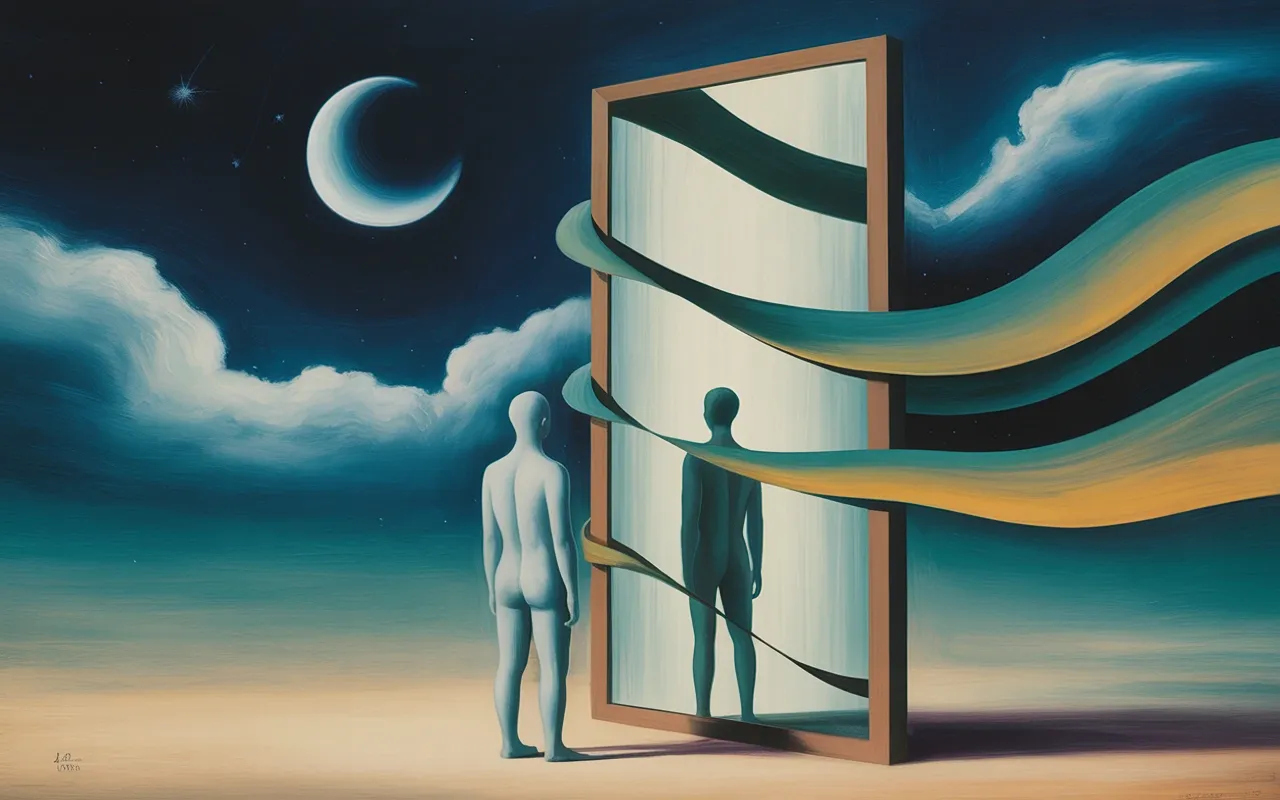
Spiritually, mirrors have carried profound weight across cultures for millennia. They are thresholds — surfaces between what is seen and what is hidden. When you find yourself inside the mirror rather than looking at it, the spiritual message shifts from passive observation to active soul-searching. This dream type often signals a period of deep self-reckoning: a calling to examine your beliefs, your identity, or what you project to the world versus what you truly feel inside.
Across Islamic dream tradition, seeing yourself clearly in a mirror is considered a sign of self-awareness, while distorted or trapped reflections point to confusion about one\'s true path. In Christian and biblical symbolism, mirrors represent the soul\'s condition — being imprisoned in one suggests spiritual stagnation or an unresolved inner conflict that needs divine clarity.
What does Jungian psychology say about mirror dreams?
Carl Jung would read the mirror-trap as a powerful encounter with the Shadow — the parts of yourself you haven\'t fully acknowledged. When you\'re locked inside the reflection, you\'re not simply seeing yourself; you\'re confronting the self you\'ve been avoiding. The mirror becomes a container for repressed aspects of personality: the anger you suppress, the ambition you downplay, the grief you haven\'t processed.
Freud\'s lens is somewhat different: he\'d frame it as suppressed self-analysis breaking through. In his model, the trapped-in-mirror dream arises when the ego\'s defence mechanisms can no longer keep self-scrutiny at bay. The dream forces the confrontation the waking mind keeps deferring.
\n\n| Theoretical Framework | Core Interpretation | Key Question It Raises |
|---|---|---|
| Jungian (Analytical) | Shadow confrontation; individuation process | What part of yourself are you refusing to integrate? |
| Freudian (Psychodynamic) | Suppressed self-analysis; ego defence breakdown | What self-knowledge have you been avoiding? |
| Cognitive Neuroscience | Brain processing self-concept during REM | Are recent experiences challenging your self-image? |
| Spiritual / Transpersonal | Soul-searching; threshold between known and unknown self | What truth about yourself is asking to be seen? |
What do different mirror-trap scenarios actually mean?
The emotional tone and specific details of the dream shift its meaning considerably. Here\'s what the pattern I keep seeing in dream journals and client accounts suggests:
- Panicked or terrified inside the mirror: Fear of self-examination, or a deep anxiety about specific qualities you\'ve discovered — and don\'t want to accept — about yourself.
- Calm and curious inside the mirror: Readiness for self-growth. Your subconscious is signalling that you\'re psychologically prepared to face what\'s inside.
- Your reflection moves independently: A strong indicator of a disconnect between your public persona and your private inner life. The autonomous reflection is the self you\'re not showing the world.
- You see other faces in the mirror with you: The dream may be processing how you perceive certain people — their qualities, expectations, or judgments — as part of your own self-image.
- You shatter the mirror to escape: A powerful symbol of breaking free from a restrictive self-concept. This dream often arrives just before a significant personal transformation.
- The mirror shows a distorted funhouse reflection: Conflicting self-views; you may be receiving very different messages about yourself from different people or contexts in your waking life.
What causes mirror-trap dreams?
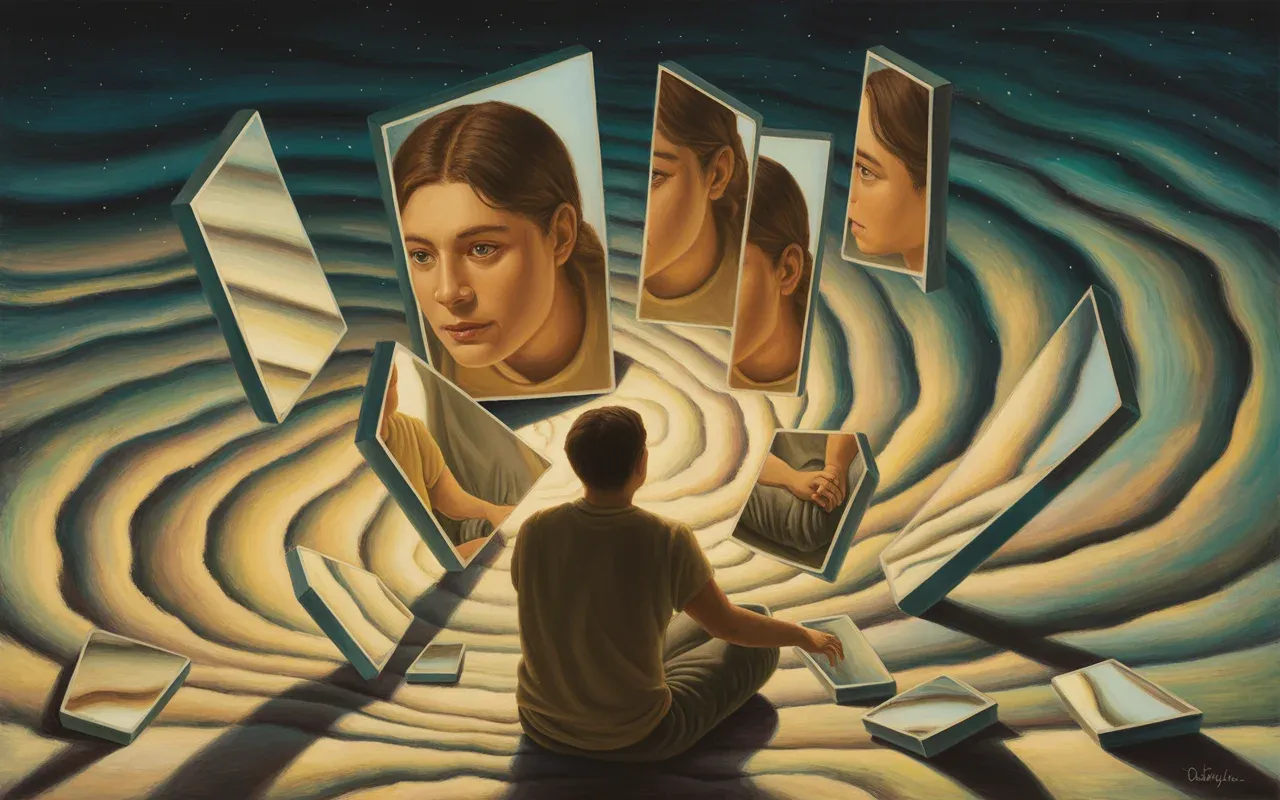
These dreams tend to cluster around specific life circumstances. Based on the themes I\'ve studied, the most common triggers include:
- Identity transitions: Career changes, ending or beginning relationships, moving to a new place — any situation where you\'re asking "who am I now?"
- Intense self-criticism cycles: Periods when you\'re ruminating heavily on past decisions or measuring yourself harshly against others.
- Suppressed aspects surfacing: When qualities or desires you\'ve pushed down — creativity, sexuality, anger, ambition — begin pressing for recognition.
- Social comparison pressure: Environments or relationships that constantly prompt you to evaluate how you\'re perceived.
If these dreams are frequent, they\'re worth treating as data rather than disturbances. A consistent mirror-trap dream pattern is your subconscious running a diagnostic on self-perception — worth taking seriously.
For broader context on how the dreaming mind processes fear and identity, being followed by a shadow figure in a dream covers the related archetype of the pursued self, while encountering a doppelganger in a dream explores what happens when you meet a double of yourself in the dreamscape.
It\'s also worth watching this video from our channel on the spiritual meaning of seeing the world in black and white in a dream — the themes of perception, contrast, and altered reality connect directly to mirror symbolism.
How do you stop or process recurring mirror-trap dreams?
You don\'t necessarily want to stop them — you want to understand what they\'re pointing to. Start by keeping a dream journal specifically for self-perception themes. Note the emotional tone, the scenario details, and what was happening in your life the day before. Over time, patterns emerge that point directly to the waking-life context the dream is addressing.
Practices that reduce the distress without suppressing the insight include: somatic stress-release work (since the trapped feeling often has a physical counterpart), reflective journaling on identity questions the dream raises, and — where the dreams are causing significant sleep disturbance — working with a therapist trained in dream-oriented or depth psychology approaches.
For related dream language around self-image and identity, see also dreaming that your reflection acts independently of you, which covers the specific meaning of autonomous mirror-reflections in depth.
Frequently Asked Questions
Is it bad to see yourself in a mirror in a dream?
Not inherently. Seeing yourself in a dream mirror usually points to self-reflection and self-awareness rather than misfortune. The context matters most: a clear, calm reflection suggests healthy self-understanding; a distorted or frightening one points to unresolved self-perception issues worth examining.
What does a mirror dream mean in Christianity and the Bible?
Biblically, mirrors are associated with the soul\'s true condition — seeing "through a glass darkly" (1 Corinthians 13:12) refers to imperfect self-knowledge. A dream of being trapped in a mirror in this context often signals a call to deeper honest self-examination before God, or an area of life where one\'s self-image has become disconnected from spiritual truth.
What is the Islamic interpretation of being trapped in a mirror in a dream?
In Islamic dream tradition, mirrors symbolise self-knowledge and how one is seen in the community. Being trapped inside a mirror may indicate a period of confusion about one\'s identity, role, or how others perceive you. Scholars generally advise treating such dreams as prompts for sincere self-examination (muhasaba).
What does it mean when your reflection doesn\'t match your actions in a dream?
A reflection that moves independently or contradicts your actions points to a significant gap between your self-concept and your behaviour — or between who you believe yourself to be and who you are acting as in certain relationships or contexts. It\'s one of the more direct symbols of internal incongruence the dreaming mind produces.
What does shattering the mirror mean in a dream?
Breaking the mirror to escape carries a largely positive meaning: a strong drive to break free from limiting self-beliefs, a restrictive self-image, or an oppressive cycle of self-criticism. It often precedes real personal change, or appears when you\'re on the cusp of deciding to leave behind an old identity that no longer serves you.
Can a funhouse or distorted mirror in a dream have a specific meaning?
Yes. Distorted reflections typically represent conflicting self-views — receiving contradictory messages about who you are from your environment, or holding competing self-images simultaneously. This is common during periods of major life transition when multiple versions of "you" are in play at once.
Why do I keep having dreams about being trapped in a mirror?
Recurring mirror-trap dreams usually signal an ongoing, unresolved question about identity, self-worth, or self-perception that your waking mind keeps setting aside. The recurrence is the subconscious insisting the question matters. Examining what specifically changes or repeats in each dream episode often reveals which particular aspect of self-image is asking for attention.
Does dreaming about a mirror relate to body image issues?
It can, but body image is typically a secondary rather than primary layer. Mirror dreams most often engage with psychological and emotional self-image: how you feel about your character, choices, and identity. Physical self-perception can be one component, particularly if body-image concerns are currently prominent in your waking life.
What your mirror-trap dream is really telling you
Being trapped in a mirror in a dream is not a bad omen — it\'s a highly specific invitation. Your subconscious has chosen one of the most ancient symbols of self-knowledge to deliver a message: something about how you see yourself is due for honest examination. Whether it\'s a gap between your public persona and private feelings, an aspect of your identity you\'ve been suppressing, or a cycle of self-critical thinking that has become its own kind of prison, the dream is pointing directly at it.
The most useful thing you can do after this dream is resist the urge to dismiss it as strange, and instead ask: What am I afraid to see clearly about myself right now? That question, taken seriously, tends to dissolve the mirror\'s glass walls on its own.