Discovering a Hidden Talent or Ability You Don\'t Have in Real Life in a Dream: Unveiling the Phantom Skills in the Dream Theater

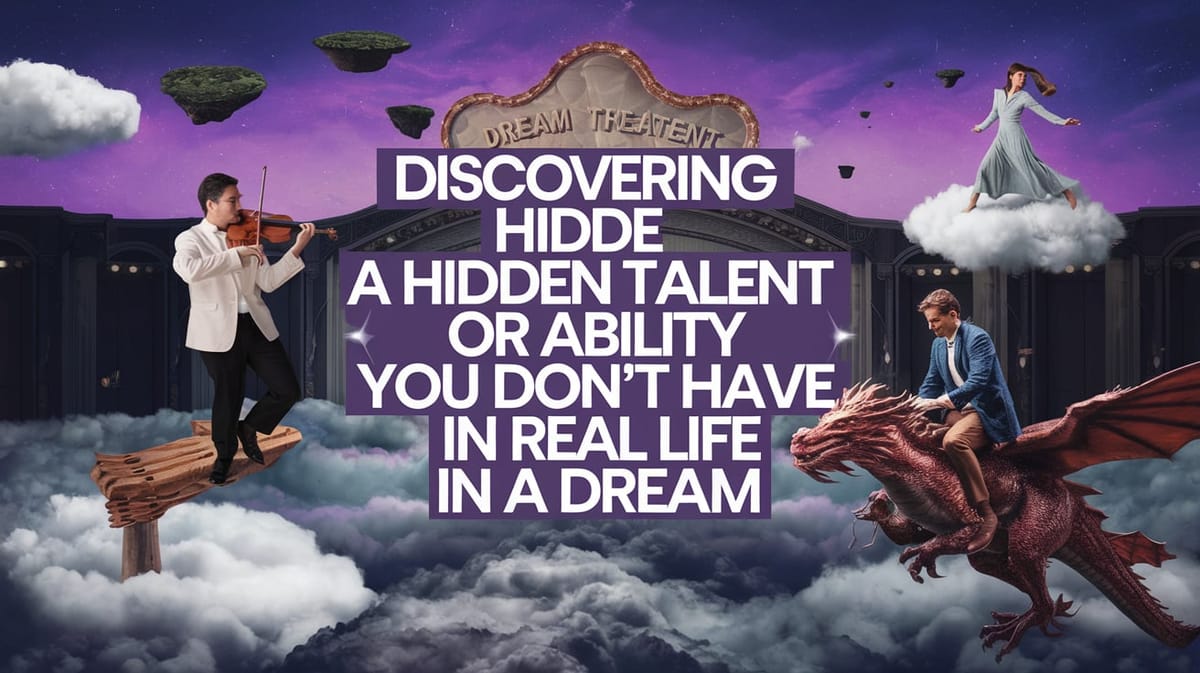
Dreams where you suddenly sing like a professional, paint stunning art, or speak languages you\'ve never studied — these aren\'t random glitches in your sleep. They\'re among the most emotionally vivid dreams people report, and they carry real psychological weight. I\'ve spent years studying these "phantom skill" dreams, and the pattern I keep seeing is consistent: your sleeping mind is showing you something your waking mind is afraid to admit.
Quick answer: Dreaming of a hidden talent or ability you don\'t have in real life signals unexplored potential, suppressed ambition, or a desire for self-expression. Psychologically, these dreams reflect Jung\'s concept of the "Shadow" — the unacknowledged parts of yourself. They\'re your subconscious nudging you toward growth you\'ve been avoiding.
What Does It Mean to Discover a Hidden Talent in a Dream?
The short answer: your subconscious is louder than your self-doubt.
These dreams appear when there\'s a gap between who you are and who you sense you could become. The talent itself is often symbolic rather than literal — dreaming you can play piano doesn\'t necessarily mean you should buy a keyboard. It usually points to a broader capacity: creativity, precision, discipline, or emotional expression.
In my research into recurring dream themes, hidden talent dreams cluster most around three life phases: career transitions, creative blocks, and major relationship changes. The timing matters.

What Does Jungian Psychology Say About These Dreams?
Carl Jung would place these dreams squarely in the process of individuation — the lifelong journey toward wholeness. According to analytical psychology, the Shadow contains everything we\'ve rejected or never developed about ourselves. A hidden talent in a dream is the Shadow offering you a gift.
Three distinct psychological readings apply here:
- Wish fulfillment (Freud): The dream gives you what waking life denies — the applause, the mastery, the recognition.
- Individuation (Jung): The talent represents an unlived aspect of the self pressing for integration.
- Self-efficacy processing: Your brain rehearses competence scenarios, especially when you\'re facing a real challenge that requires new skills.
What Specific Dream Scenarios Mean
The talent type shapes the interpretation significantly. Here\'s what I\'ve found across the most common variations:
\n\n| Dream Talent | Likely Symbolic Meaning |
|---|---|
| Singing or playing music | Suppressed need for emotional expression or creativity |
| Speaking a foreign language | Desire to connect, communicate, or be understood on a deeper level |
| Athletic ability (running fast, etc.) | Craving freedom, momentum, or escape from current stagnation |
| Drawing or painting masterpieces | Unexpressed creativity or unacknowledged aesthetic intelligence |
| Healing or helping others | Strong but unused empathic capacity; possible calling toward service |
| Solving complex problems | Untapped analytical strength; imposter syndrome in a current role |
How You Feel in the Dream Changes Everything
If you feel excited or proud: This is your subconscious expressing genuine enthusiasm for growth. The dream is validating a direction you haven\'t yet committed to. Take it seriously.
If you feel frightened or overwhelmed: The ability represents something you actually want but fear claiming. This is classic approach-avoidance conflict playing out in REM sleep.
If you feel confused or disoriented: You may not yet recognize what the talent symbolizes. Keep a dream journal for a few nights — context from surrounding dreams often clarifies it.
What\'s the Spiritual Meaning?
Across spiritual traditions, these dreams carry a consistent theme: you have been given something and haven\'t used it.
In Christian and Islamic dream interpretation, hidden abilities appearing in dreams are often read as divine indication of purpose — a calling that hasn\'t been answered. In Eastern traditions, they can signal the awakening of a dormant gift that karma or dharma has placed on your path.
Regardless of your spiritual framework, the message is the same: something is asking to be expressed.
What Triggers These Dreams?
Four situations consistently precede hidden talent dreams:
- Career dissatisfaction — You\'re competent at your job but feel your actual strengths are being wasted
- Creative suppression — You once did something creative (music, writing, art) and stopped
- Comparison to others — Someone you admire is doing something you secretly wish you could do
- A recent challenge — Your brain is rehearsing a skill it knows you\'ll need soon

What Science Says
Neuroscience points to the brain\'s default mode network (DMN) as the engine behind these dreams. During REM sleep, the DMN runs simulations of identity and capability — who you might become, not just who you are. Hidden talent dreams may be the brain stress-testing new possible selves.
Research on skill consolidation during sleep also shows that the sleeping brain actively processes and integrates recent learning. If you\'ve been curious about a skill, even passively, your dream mind can simulate having it fully.
What Should You Do After This Dream?
Three concrete steps, in order:
- Write it down immediately. Don\'t just note the talent — write how it felt to have it. The emotion is the data.
- Ask what the talent represents. Not "should I take guitar lessons?" but "what does music mean to me? What does it give people that I\'m not currently giving?"
- Take one small action. Even five minutes exploring the symbolic area (a creative project, a conversation, a new course) closes the loop your subconscious opened.
Also see: what it means to dream of supernatural powers, finding a secret passage in a familiar place, and meeting all versions of yourself in a dream — all closely related themes about unexplored potential.

Watch: Telepathy in a Dream — Related Dream Abilities Explained
Frequently Asked Questions
What does it mean when you dream of having a talent you don\'t have in real life?
It signals unexplored potential or suppressed ambition. The talent is usually symbolic — pointing to a quality (creativity, strength, expression) your waking self hasn\'t claimed yet, not necessarily the specific skill itself.
Is dreaming of hidden talents a sign of wish fulfillment?
Often, yes. Freud\'s wish fulfillment theory applies here — your sleeping mind grants what your waking life denies. But Jung\'s individuation framework is equally useful: the dream may be urging you to integrate a real but unacknowledged part of yourself.
What\'s the spiritual meaning of discovering a hidden talent in a dream?
Many spiritual traditions interpret this as a calling or divine nudge — an indication that a gift has been given to you but not yet used. The specifics depend on your tradition, but the core message across frameworks is: something in you wants to be expressed.
Why do I dream about being good at things I can\'t do in real life?
Your brain\'s default mode network simulates possible selves during REM sleep. If you\'ve been curious about a skill, felt stifled creatively, or are facing a growth challenge, your sleeping mind can model mastery before you\'ve earned it.
Do hidden talent dreams predict real ability?
Not literally. They don\'t mean you secretly have that specific skill. They do suggest you have unmet capacity in the broader area the talent represents — and that your subconscious is ready for you to explore it.
What does it mean to dream of singing beautifully when you can\'t sing?
Singing in dreams almost always relates to emotional expression and being heard. If you can\'t sing in waking life but do so beautifully in dreams, you likely have something important to say or express that you\'ve been holding back.
What if the hidden talent in my dream frightens me?
Fear of a dreamed ability typically means you want it but are afraid of claiming it — or afraid of the responsibility that comes with it. This is an approach-avoidance pattern worth exploring in a journal or with a therapist.
Can recurring hidden talent dreams have special significance?
Yes. Recurring dreams amplify the message. If you keep dreaming of the same unexpressed ability, your subconscious is treating it as unfinished business. The longer the pattern continues, the stronger the underlying drive.
How do I use a hidden talent dream productively?
Start by writing down both the talent and your emotional state in the dream. Then identify what quality the talent symbolizes. Finally, take one concrete step toward expressing that quality in your real life — even a small one breaks the loop.
Are hidden talent dreams more common during certain life stages?
Yes. They cluster around career transitions, creative blocks, and major life changes — moments when identity is in flux. Midlife is particularly fertile ground for these dreams, often signaling unlived aspects of the self pushing for attention.
Final Word
Dreams of hidden talents don\'t arrive randomly. They show up when the gap between who you are and who you could be has grown wide enough that your sleeping mind can\'t ignore it. The talent is the symbol. The real message is: you have more capacity than you\'re currently using. Start with one step toward whatever that talent represents — and pay attention to how it feels when you do.