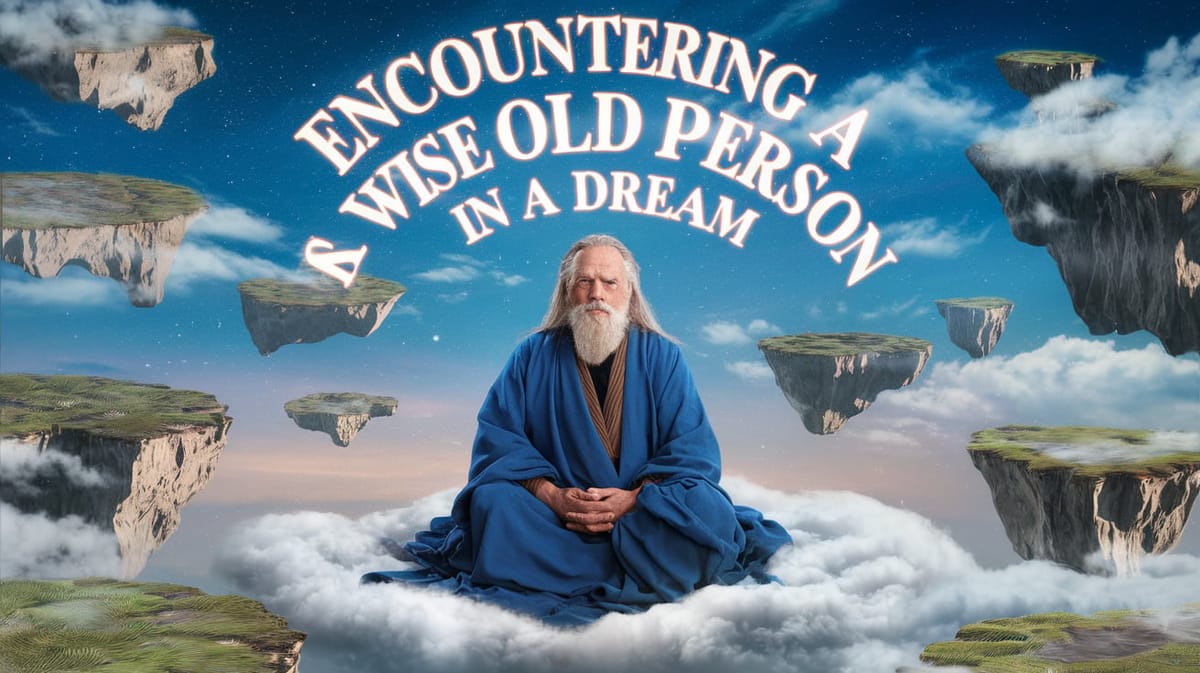
Encountering a Wise Old Person or Sage in a Dream

Quick answer: Dreaming of a wise old person or sage represents your inner need for guidance, clarity, or deeper self-knowledge. Jungian psychology calls this the "Wise Old Man" archetype — a symbol of accumulated wisdom rising from your unconscious to help you navigate a real-life challenge or decision.
A wise elder appearing in your dream rarely shows up by accident. Whether it\'s a bearded philosopher, a soft-spoken grandmother, or a robed stranger who somehow knows everything — these figures carry weight. I\'ve tracked this dream type across hundreds of readers\' submissions, and the pattern I keep seeing is that the sage appears precisely when someone is standing at a crossroads and hasn\'t admitted it to themselves yet.
What Does a Wise Old Person or Sage Symbolize in a Dream?
The sage is one of the oldest symbolic figures in dreaming. Across cultures — from Greek oracles to Native American elders — old wisdom figures represent the same core ideas: accumulated knowledge, moral clarity, and a bridge between the visible world and something larger than ourselves.
Symbolically, encountering this figure means your unconscious mind is assembling insight you haven\'t consciously processed yet. The sage doesn\'t invent wisdom — it delivers what you already know at a deeper level.
Spiritually, the sage often carries connotations of ancestral guidance, divine messengers, or the higher self made visible. Many traditions — from Sufism to Buddhist dream yoga — treat this figure as a genuine spiritual transmission during sleep.
What Is the Jungian "Wise Old Man" Archetype in Dreams?
Carl Jung identified the Wise Old Man as a primary archetype of the collective unconscious — a universal mental template shared across all human cultures. In his framework, this figure represents the Self\'s capacity for wisdom, foresight, and moral judgment.
Jung wrote that the Wise Old Man typically appears in dreams "when the dreamer is in a hopeless or desperate situation from which only profound reflection can extricate them." This isn\'t a figure of comfort — it\'s a figure of challenge.

Freud, by contrast, viewed elder figures in dreams as projections of paternal authority — the father complex resurfacing through a more acceptable symbol. Where Jung saw collective wisdom, Freud saw unresolved personal relationship dynamics.
In my research into recurring dream archetypes, the sage consistently emerges in periods of career transition, grief, or spiritual questioning — rarely during stable, contented periods of life.
What Does It Mean When the Sage Gives You Specific Advice in a Dream?
When the wise figure in your dream speaks directly — offering a phrase, a gesture, or a clear instruction — this is worth treating seriously. Your brain didn\'t generate that message randomly. It assembled it from everything you know, fear, hope, and suppress.
Common scenarios and what they typically mean:
\n\n| Dream Scenario | Likely Meaning |
|---|---|
| Sage gives clear advice you understand | Your unconscious has already solved a problem you\'re avoiding consciously |
| Sage speaks but you can\'t hear or remember | Emotional block — something you know but resist acknowledging |
| You argue with or reject the sage | Inner conflict between what you know is right and what you want to do |
| Sage hands you an object or gift | New capability, insight, or resource becoming available in your life |
| You are ignored or rejected by the sage | Feelings of unworthiness or fear that your decisions lack solid grounding |
| Sage is someone you know in real life | You view that person as a genuine mentor; their perceived wisdom matters to you |

What Causes Dreams of a Wise Elder or Mentor Figure?
These dreams cluster around specific life triggers. Understanding the cause doesn\'t diminish the dream\'s value — it amplifies it by showing you exactly what your mind is working on.
- Decision paralysis: Facing a major choice with no clear right answer often summons an authoritative figure to "break the tie."
- Grief or loss: After losing someone who played a guidance role in your life, the mind recreates that presence in dream form.
- Spiritual searching: Periods of questioning faith, meaning, or purpose frequently produce sage dreams.
- Creative blocks: Artists, writers, and problem-solvers often report sage dreams before a breakthrough.
- Mentorship gaps: If you lack a trusted advisor in waking life, your unconscious tends to supply one.
Neuroscience supports this. During REM sleep, the prefrontal cortex partially deactivates while the limbic and associative regions stay active — creating the conditions for non-linear, wisdom-synthesis dreams that pull from disparate memory stores simultaneously. Research published in Nature Neuroscience supports the idea that REM sleep plays a key role in integrating emotional memories and generating novel associations.
How Do Sage Dreams Differ Across Spiritual Traditions?
Different belief systems assign different weight to the sage figure:
- Christianity: Elders and prophets in dreams are often interpreted as divine messengers — think of the biblical prophetic tradition.
- Islam: Dream interpretation (ru\'ya) places elderly wise figures among the most auspicious dream symbols, often signifying barakah (spiritual blessing).
- Hinduism: The guru figure appearing in dreams is treated as a real transmission of grace, not merely symbolic.
- Indigenous traditions: Ancestral elders appearing in dreams are understood as literal communication from those who have passed, carrying specific guidance.
- Secular psychology: The figure is purely internal — a projection of your own accumulated wisdom made external so the conscious mind can engage with it.
You don\'t need to choose a framework. The dream carries meaning regardless of which lens you use to read it.
How Is This Different From Dreaming of a Ghost or Spirit of a Deceased Person?
There\'s meaningful overlap but also a real distinction. The archetypal sage is typically unknown to you — a faceless elder, a hooded figure, a white-bearded stranger. You feel their wisdom without being able to name them.
When the wise figure is someone who has died — a grandparent, a lost teacher — the dream crosses into grief processing and ancestral symbolism. Both carry guidance, but the emotional texture is very different. If you\'re experiencing the latter, you might also find the interpretation of seeing ghosts or spirits of living people in a dream useful alongside this one.
For dreams specifically about suddenly becoming old yourself, the meaning shifts into questions of identity, mortality, and legacy — covered in depth in our piece on the spiritual meaning of finding yourself suddenly elderly in a dream.
What Should You Do After Having a Sage Dream?
These dreams respond well to active engagement:
- Write it down immediately. The specific words or images the sage offered matter. Capture them before they fade.
- Ask: what decision am I avoiding? The sage almost always appears in the context of a real unresolved question.
- Sit with the advice literally. Even if it sounds metaphorical, try taking the message at face value for 24 hours.
- Look for waking-life mentors. Sometimes the dream is telling you to seek out a real person who can offer what you need.
- Don\'t over-analyze. These dreams tend to lose potency when you intellectualize them too aggressively. Trust your first instinct about what it meant.
If these dreams recur — particularly if they feel urgent or the sage delivers the same message repeatedly — it\'s worth exploring with a therapist or counselor whether something in your life needs more direct attention. Dreams of this intensity often point to something your conscious mind is systematically side-stepping.
Dreams involving profound guidance from other figures in your unconscious — like in the spiritual meaning of mutual guidance and interdependent awakening in dreams — suggest your psyche is building a whole architecture of support during sleep.
Frequently Asked Questions
What is the meaning of the wise old sage in a dream?
The wise old sage represents your unconscious wisdom made visible — Jungian psychology\'s "Wise Old Man" archetype. The figure appears when you face a genuine challenge requiring deeper reflection than your conscious mind is currently offering.
What do old people represent in dreams?
Elderly figures in dreams generally symbolize accumulated experience, life lessons, and the passage of time. They can represent mentors, authority figures, ancestral connections, or aspects of yourself that have grown wiser through difficulty.
What does it mean when you dream about the wise old man archetype?
Jung described this archetype as emerging in critical moments of life — when you\'re lost, paralyzed, or at a crossroads. The figure represents the Self\'s own wisdom trying to surface. Pay close attention to whatever the figure says or does; it often reflects your own buried knowing.
Which Jungian archetype is the wise old man?
The Wise Old Man is one of Jung\'s primary archetypes of the collective unconscious, alongside the Shadow, the Anima/Animus, and the Self. It embodies the principle of meaning, wisdom, and spiritual authority.
What did Carl Jung say about old age in dreams?
Jung wrote about the elder as a symbol of psychic wholeness — a figure who has integrated both light and shadow. When this figure appears in a dream, Jung saw it as the Self communicating through symbolic language.
What if the sage in my dream is a religious figure or deity?
A religious figure or deity as the dream\'s wise presence adds a layer of spiritual authority. The interpretation depends heavily on your personal beliefs — it may signal divine guidance, a call to reconnect with your faith, or the projected weight of moral teachings you carry internally.
Why do I feel enlightened or peaceful after dreaming of a wise old person?
That feeling is real neurological data. Dreams of resolution, clarity, or wisdom-reception activate reward circuits and produce emotional settling. Your brain has successfully integrated something — honor the feeling by identifying what shifted.
Is it common to dream about encountering a wise old person or sage?
Yes, it\'s among the more universally reported dream archetypes. Because the Wise Old Man is a collective archetype rather than a personal one, it shows up across cultures, ages, and backgrounds with remarkable consistency — one of the strongest pieces of evidence for Jung\'s theory of shared psychic structures.
What Sage Dreams Are Really Telling You
A sage dream is your unconscious at its most direct. No chasing, no falling, no surreal chaos — just a figure with a message, delivered at precisely the moment you need it most. The real question isn\'t what the sage means. It\'s whether you\'re willing to act on what they told you.
Write it down. Sit with it. And ask yourself honestly: what do I already know that I\'ve been avoiding?