Seeing Familiar Faces on Strangers\' Bodies in a Dream: Decoding the Enigma of Dream Symbolism

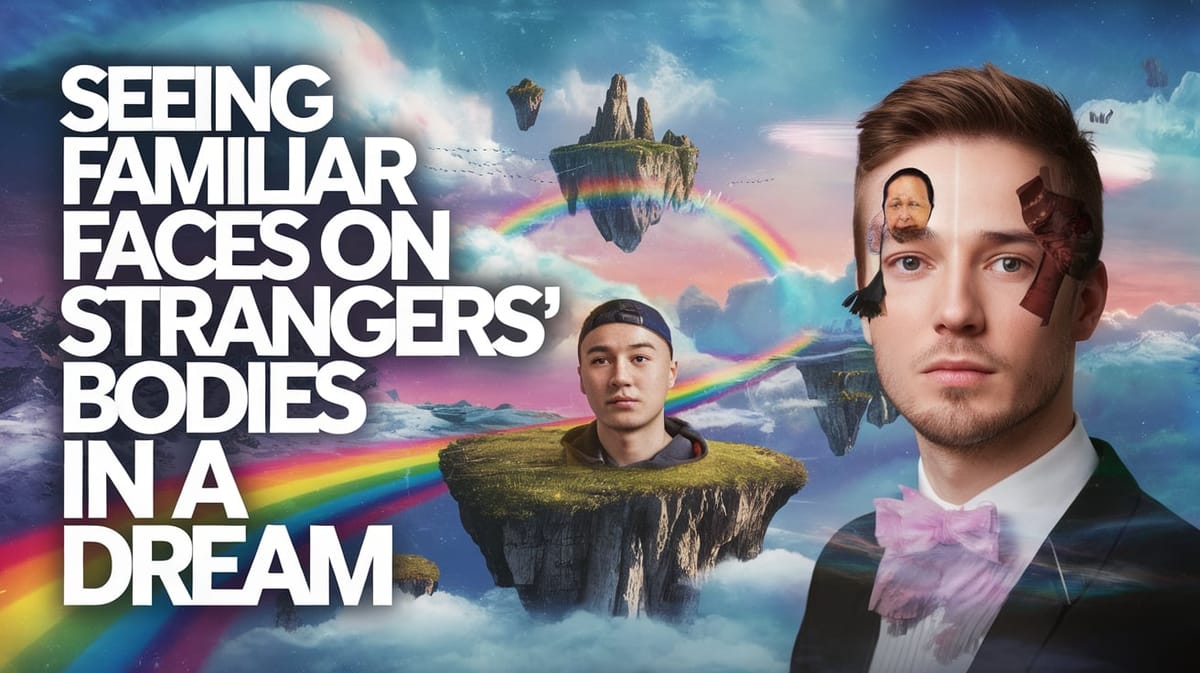
Quick answer: Seeing a familiar face on a stranger\'s body in a dream usually signals emotional projection — your subconscious is attaching the feelings or traits you associate with that person onto someone new. It reflects shifting perceptions, unresolved emotions, or evolving expectations within that relationship.
Dreams where you recognize familiar faces on strangers\' bodies are among the most disorienting experiences the sleeping mind produces. You see your mother\'s eyes in a stranger\'s face, or your ex-partner\'s grin on someone you\'ve never met. The image is wrong, yet the recognition is unmistakable. In my research on recurring dream archetypes, I\'ve found this particular dream type comes up far more frequently than most people expect — and it carries surprisingly consistent psychological meaning across dreamers.
Rather than brushing these dreams off as random neural noise, treating them as symbolic messages worth decoding can open up genuine insight into how you really feel about the people in your life.
What does seeing a familiar face on a stranger\'s body actually symbolize?
Symbolically, this dream type centers on emotional transference — the unconscious act of projecting feelings, traits, or expectations from one person onto another context. The face you recognize carries the emotional charge; the strange body represents a new context or changed circumstance.
Key symbolic readings include:
- Transferred emotions: Feelings you hold toward the familiar person are being processed in a new setting, suggesting your emotional relationship with them is shifting.
- Mixed identity perceptions: You may be subconsciously comparing someone new in your life to someone older, blending characteristics from both.
- Evolving relationship dynamics: The familiar person may be changing in your eyes — the body they inhabit in the dream no longer matches who you knew them to be.
- Spiritual or psychic attunement: Some spiritual traditions interpret this dream as a sign of deep empathic connection or soul-level awareness of another person\'s inner state.
What do psychologists say about this dream?
Psychology gives us two especially useful frameworks for understanding this dream type.
Freudian interpretation: Freud would likely read the familiar face on a stranger\'s body as an instance of displacement — a defense mechanism where the emotional weight attached to one person gets transferred to a safer, more acceptable target. The unfamiliar body provides psychological distance, allowing the dreamer to process intense feelings without direct confrontation.
Jungian interpretation: Carl Jung would approach this through the lens of projection, one of his central concepts. When you see your own emotional projections reflected back at you — a familiar face superimposed on someone unknown — Jung would see this as the psyche highlighting unintegrated content. The stranger\'s body represents the "other" you haven\'t yet owned as part of yourself. It\'s the individuation process at work: the dream nudges you to examine what you\'re projecting onto the people around you.
Modern sleep research adds a cognitive layer: the brain\'s face-recognition regions (particularly the fusiform face area) and memory systems stay remarkably active during REM sleep. When emotional memories involving a specific person are being consolidated, the brain can composite faces from fragments — producing the uncanny effect of a known face on an unknown body.
\n\n| Framework | Core Interpretation | What It Suggests |
|---|---|---|
| Freudian | Displacement of affect | Processing intense feelings at a safe remove |
| Jungian | Psychological projection | Unintegrated traits or emotions being surfaced |
| Cognitive neuroscience | Memory consolidation / face compositing | Brain processing recent emotional interactions |
| Spiritual | Soul-level empathic awareness | Deep psychic connection to the recognized person |
What do different scenarios of this dream mean?
The emotional tone and context of the dream dramatically change its meaning. The pattern I keep seeing in reader accounts is that the feeling upon recognition matters most of all.

Feeling scared or uneasy
Anxiety on recognizing the familiar face signals unresolved tension with that person. You may be carrying apprehension, unspoken conflict, or conflicting feelings you haven\'t processed in waking life. The fear isn\'t really about the stranger — it\'s about what the familiar person represents to you right now.
Feeling comforted or reassured
A warm, positive recognition suggests emotional security and trust. This dream type often appears when you\'re forming a new relationship and your subconscious is drawing reassuring parallels to someone you already love and trust.
Feeling confused or disoriented
Confusion points to a transitional state — you\'re adjusting to how someone is changing, or how your perception of them is shifting. The body and face don\'t match because your internal model of this person is in flux.
Familiar face on a body that behaves unexpectedly
When the body acts unlike the real person, the dream is highlighting the gap between your expectations and reality. You may be projecting old patterns onto someone who has genuinely changed, or onto a new person who simply resembles them emotionally.
Seeing a deceased person\'s face on a stranger
This specific variant — a loved one\'s face appearing on an unknown body — is one of the most emotionally powerful dream experiences. It typically reflects grief processing, unresolved conversations, or the continuation of a bond even after loss. For more on seeing spirits of people you know in dreams, the patterns run deeper than most expect.
What causes this type of dream — and why does it keep recurring?
This dream is most likely to occur when:
- You\'re meeting new people who remind you of someone significant from your past
- A close relationship is undergoing visible change — through conflict, growth, or distance
- You\'re experiencing heightened emotional processing around a specific person
- Stress, grief, or life transitions are activating deep memory systems during REM sleep
- You\'ve recently had significant interactions with the familiar person (positive or negative)
Recurrence usually signals an unresolved emotional thread. The dream keeps returning until the underlying feeling — whether that\'s grief, tension, admiration, or lingering attachment — gets consciously acknowledged. Keeping a dream journal to track recurring patterns can help you identify what the dream is pointing to over time.
Is there a scientific explanation for seeing familiar faces on strangers?
Yes, and it\'s fascinating. During REM sleep, the brain doesn\'t simply replay memories — it actively recombines them. Neuroscientists call this process memory generalization: the brain extracts emotional patterns and replays them in new configurations to test associations and reinforce learning.
Face recognition specifically is handled by the fusiform face area, which remains highly active during REM. When emotional memories involving a specific face are being processed, the brain can "paste" that face onto a dream figure whose body was generated from a different memory source entirely. The result is the deeply strange but neurologically coherent experience of a known face on an unknown body.
A 2019 study from the University of California found that emotional significance strongly predicts which faces appear in dreams — the more emotionally charged your relationship with someone, the more likely their face is to appear in your sleep. You can read more in Sleep Foundation\'s overview of dream science for broader context.
How should you respond to this dream — what does it want from you?
These dreams are your subconscious asking you to look at something you may be avoiding. Practical steps worth taking:
- Write it down immediately. Capture the familiar face, the emotional tone, and any context before the memory fades. Over multiple entries, patterns will emerge.
- Identify the emotion, not just the person. What do you feel toward the person whose face appeared? That emotion — not the person themselves — is usually the message.
- Ask if you\'re projecting. Are you expecting someone new in your life to behave like the familiar person? Projection is often the engine behind this dream.
- Consider the relationship. Is anything changing between you and the familiar person? Unspoken tension, unresolved grief, or rapidly evolving dynamics are common triggers.
- Seek perspective if recurring. If this dream keeps coming back with distress attached, it may be worth exploring with a therapist, particularly if the relationship involved has unresolved trauma.
Understanding how your subconscious processes identity and relationships in dreams connects to broader patterns — like encountering a doppelganger of yourself in a dream, which follows similar projection dynamics.
What do Islamic and Christian traditions say about this dream?
Both traditions offer frameworks for interpreting face-identity dreams:
Islamic interpretation: In Islamic dream scholarship, seeing a known person\'s face in an unexpected context often signals concern for that person, a subconscious spiritual awareness of their circumstances, or a warning about projection and false perception in a relationship. It may prompt reflection on whether you\'re seeing someone clearly or through the lens of your own assumptions.
Christian interpretation: Christian dream traditions tend to interpret faces as symbolic of the soul\'s condition. A familiar face appearing on a stranger\'s body might suggest spiritual discernment — being called to look beyond surface appearances in a relationship — or a prompt toward prayer and reflection concerning the person whose face appeared.
Frequently Asked Questions
What does it mean when you dream about strangers\' faces?
Unknown faces in dreams typically represent unintegrated aspects of yourself (in Jungian terms, the "shadow" or anima/animus) or stand-ins for abstract emotional concepts. When a stranger\'s body appears alongside a familiar face, the familiar face usually carries the emotional weight while the body signals unfamiliar context.
Can you actually see people\'s faces clearly in your dreams?
Most dreamers report hazy or composite faces rather than photorealistic clarity. What they "know" a face is, however, can be precise — the brain generates recognition without necessarily generating detail. This is why you can wake up certain you saw your friend\'s face even if you can\'t describe specific features.
Does dreaming about someone mean they\'re thinking about you?
No scientific evidence supports this. Dreams are generated internally and reflect your own emotional processing, not transmission from others. Seeing someone in a dream means they occupy significant emotional space in your mind — not that any external signal is being received.
Is it common to dream of a known person\'s face on a stranger\'s body?
More common than people realize. This dream type is particularly frequent during periods of significant relationship change, grief, new social environments, or heightened emotional processing around a specific person.
What does it mean if the stranger with the familiar face behaves differently from the real person?
Divergent behavior highlights the gap between who someone is and who you expect (or need) them to be. The dream may be signaling that you\'re holding outdated expectations, or alternatively, that someone has changed and your subconscious is still catching up.
What does it mean if I see my deceased loved one\'s face on a stranger?
This is one of the most emotionally significant variants. It typically reflects active grief processing, the continuation of emotional attachment beyond death, or unfinished emotional business with the person who passed. It is almost universally experienced as a meaningful encounter rather than a random image.
Does the body type of the stranger matter in the interpretation?
Yes, to a degree. If the stranger\'s body is markedly different from the familiar person\'s — different age, build, or gender — the contrast can amplify the meaning. A much younger body might suggest you\'re connecting with how that person used to be; a very different gender might point to aspects of their character you\'re integrating into your own identity.
What if the familiar face belongs to someone I\'ve lost touch with?
Dreams about people we\'ve drifted from often surface during periods of nostalgia, unresolved longing, or when present circumstances mirror past ones. It doesn\'t necessarily mean you should reconnect — but it\'s worth asking what that relationship represented at its best and whether you\'re missing that quality now.
Should I be worried if this dream keeps recurring?
Recurring dreams signal persistent unresolved emotional content. If this dream keeps appearing with distress attached, it\'s worth examining what emotional work hasn\'t been done around the relationship — whether that\'s grief, a difficult conversation, or a pattern of projection you haven\'t yet acknowledged.
What your dream is really telling you
Seeing a familiar face on a stranger\'s body is your subconscious doing visible, active work on your most emotionally significant relationships. The face is the emotion; the body is the context it\'s now appearing in. When you recognize whose face it is and sit with how that recognition makes you feel, you\'ve already done the most important interpretive work.
The dream isn\'t a warning or a prophecy — it\'s a mirror. It shows you where your emotional projections are active, where your relationships are shifting, and which unprocessed feelings are loud enough to break through into sleep. That\'s not something to dismiss. That\'s your inner world asking for attention.
Watch our video on telepathy in dreams for more on how the mind processes deep interpersonal connections during sleep.