
Seeing Your Body Separate From Your Consciousness in a Dream: Insight into the Dream Sphere of Dual Perspective

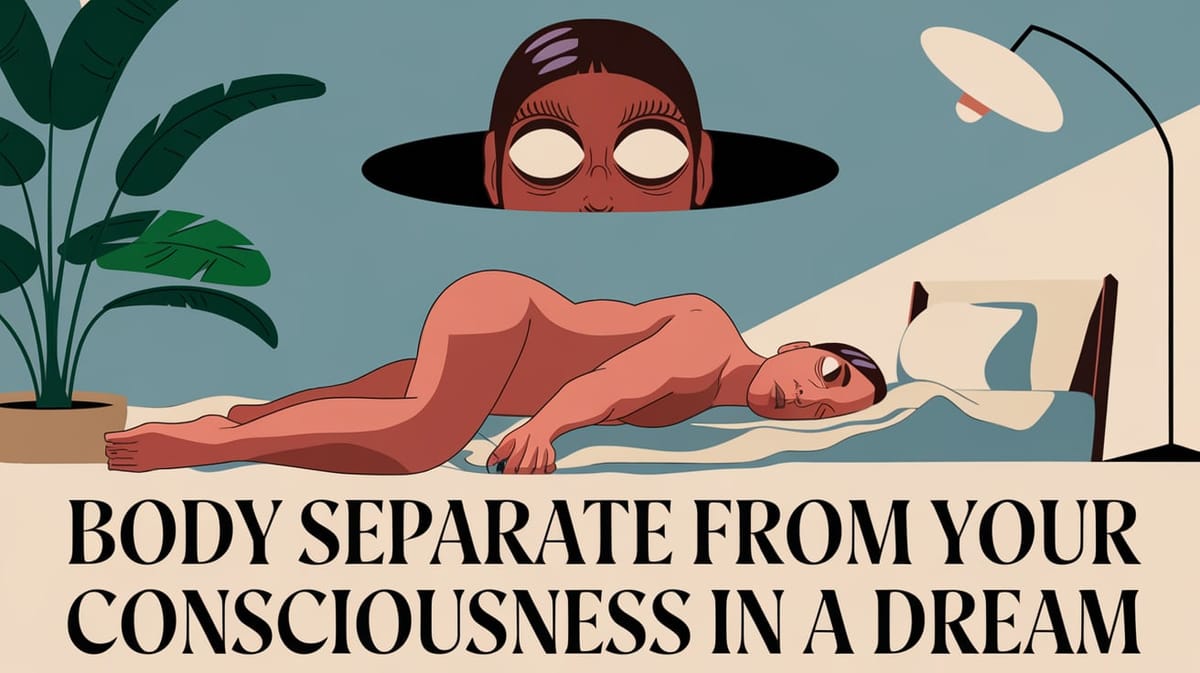
Quick answer: Dreaming of your body separating from your consciousness — often called an out-of-body experience or astral projection dream — signals heightened self-awareness, a period of spiritual questioning, or your mind's way of processing dissociation and emotional detachment during waking life.
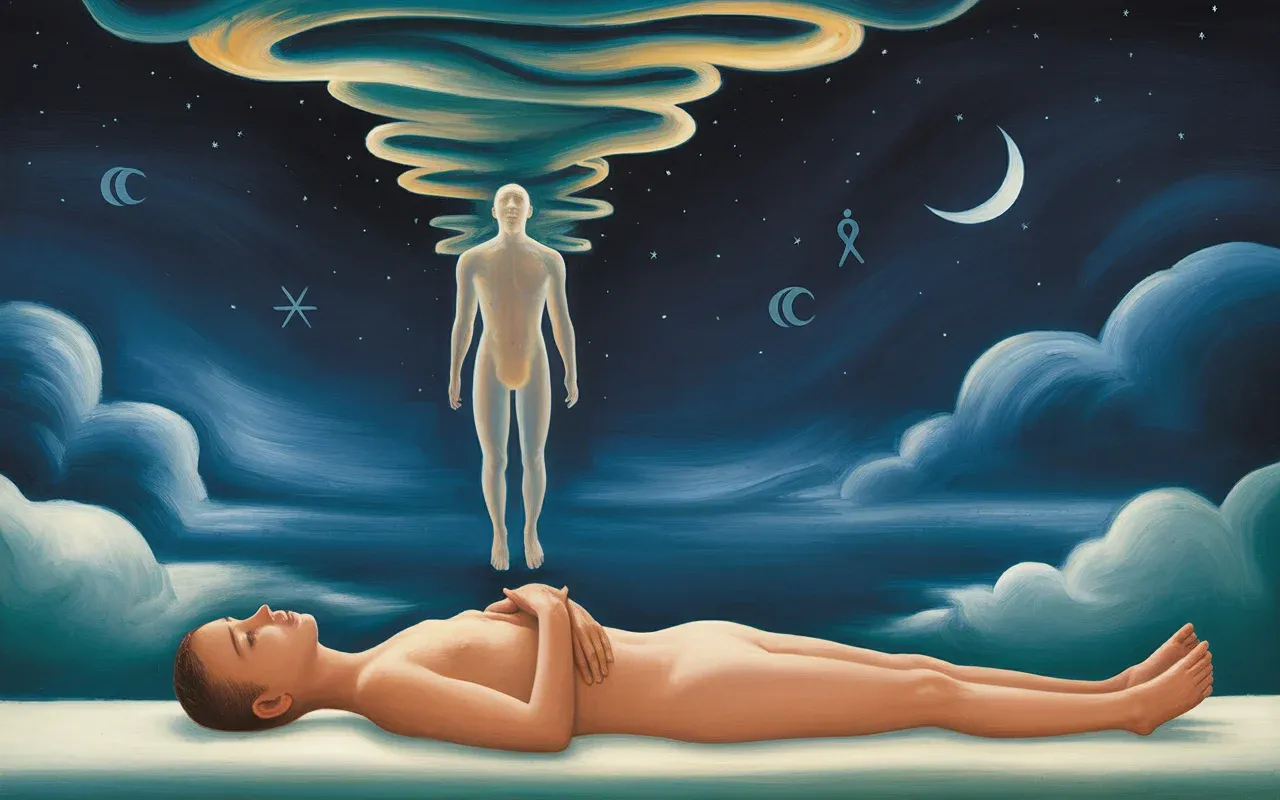
Dreams of watching your own body from a distance belong to a category that stops people mid-morning. They arrive vivid and slightly unsettling — you float above yourself, watching your physical form below while feeling completely alert and separate. In my research, these are among the most spiritually charged dream experiences people report, cutting across culture, religion, and scientific framework. I want to walk you through what they genuinely mean.
What Does It Mean to See Your Body Separate From Your Consciousness in a Dream?
This dream type — sometimes called a dissociative or out-of-body dream — reflects the mind's ability to observe itself. Symbolically it points to objectivity: your subconscious is stepping outside the ego to examine your life, choices, or sense of identity from a distance. The separation is rarely literal; it is almost always metaphorical for gaining perspective.
Common symbolic layers include:
- Introspection and self-awareness — You are ready to see yourself clearly, without ego defense.
- Spiritual awakening — Across traditions, consciousness leaving the body signals a threshold moment.
- Emotional detachment — A sign you may be suppressing feelings or dissociating from a situation in waking life.
- Higher-self communication — Jungian thought views this as the psyche surfacing deeper material for integration.
What Is the Spiritual Meaning Across Different Traditions?
Spiritual frameworks disagree on the mechanism but align on the significance:
| Tradition | Interpretation |
|---|---|
| Christianity | Soul temporarily leaving the body — echoes of 2 Corinthians 12:2-3 ("out of the body, I do not know"). Often read as divine encounter or prophetic vision. |
| Islam | The ruh (spirit) ascending during sleep. Hadith literature describes the soul departing nightly; dreaming of this separation can signal proximity to the divine or a warning. |
| Hinduism | The sukshma sharira (subtle body) separating from the physical. Linked to moksha awareness and the dissolution of ego-identification. |
| Jungian Psychology | Individuation — the psyche breaking from the persona to explore the shadow and higher self simultaneously. |
| Neuroscience | Disruption in multisensory integration during REM sleep; the brain's body-ownership circuits temporarily decouple. |
What Do Different Out-of-Body Dream Scenarios Mean?
The emotional texture of the dream shifts the interpretation significantly. The pattern I keep seeing is that the feeling during the separation matters more than the separation itself.

- Fearful separation — Fear of self-examination, avoidance of a truth you sense but aren't ready to confront.
- Peaceful or euphoric separation — Comfort with your spiritual path, emotional readiness for a significant life shift.
- Watching yourself sleep — A need for self-compassion; observing yourself at rest suggests exhaustion and a desire for renewal.
- Unable to return to your body — Resistance to re-engaging with daily life, possibly burnout or dissociation from identity.
- Loved ones watching the separation — Their presence signals that your relationships are part of what you're seeking perspective on.
- Controlling your floating form — Confidence and autonomy in your spiritual or psychological development.
- Separation in a fearful location — Anxiety about self-discovery in a specific area of life (work, relationships, health).
How Do Freud and Jung Interpret This Dream?
Freud would read body-consciousness separation as wish fulfillment — a desire for autonomy from social expectations and bodily constraints, or suppressed longing to escape a situation while remaining an observer rather than a participant.
Carl Jung's view is richer: this dream type is a classic individuation symbol. The body below represents the persona and ego; the rising consciousness represents the self attempting to integrate with the shadow and anima/animus. It is not a crisis — it is growth finding a language.
What Does Science Say About Out-of-Body Dreams?
Neuroscience has documented real out-of-body experiences during both sleep and waking states. Research from the Scientific American links them to disruptions in the temporoparietal junction (TPJ) — the brain region that integrates sensory signals to produce a sense of body ownership. During REM sleep, when the TPJ is inconsistently active, the mind can generate the experience of observing itself from outside. This is not pathological; it is a normal variation in REM sleep architecture.
What Causes Dreams of Body-Consciousness Separation?
Common triggers I've observed across dream journals and research:
- High-stress periods where dissociation feels protective
- Meditation practice or spiritual study before sleep
- Sleep deprivation — especially fragmented sleep or wake-back-to-bed routines
- Grief or identity transitions (job loss, relationship endings, moving)
- Psychedelic or near-death adjacent experiences in waking life
- Lucid dreaming practice — out-of-body dream induction is a common technique
Related Dream Meanings Worth Exploring
If this dream resonated, you may find these connected interpretations helpful:
- Cracked mirror dream meaning — another self-perception symbol that often pairs with dissociative dream themes
- Witnessing your own funeral in a dream — confronting mortality and identity transformation
- Meeting all versions of yourself in a dream — Jungian integration and the multiplicity of self
How Do I Cope With Distressing Body-Separation Dreams?
If the dream feels frightening rather than liberating:
- Journal immediately on waking — capture the emotion, not just the narrative. What were you avoiding looking at in the dream?
- Grounding practices before sleep — body scan meditation reconnects you to physical presence and reduces dissociative dreaming.
- Reduce sleep fragmentation — consistent sleep schedules lower the frequency of hyperreal REM experiences.
- Explore the metaphor in waking life — where are you operating on autopilot? The dream may be asking you to re-inhabit your life more fully.
- Seek support if distress persists — recurrent dissociative dreams alongside waking dissociation deserve professional attention.
Watch: Dream Interpretation — Funeral in a Dream
For another powerful self-reflection dream, our channel covers what it means when you witness your own funeral — a related theme about identity, transformation, and the observer self:
Frequently Asked Questions
Does dreaming of body-consciousness separation mean I'm having an actual astral projection?
Not necessarily. These dreams share imagery with astral projection beliefs, but most sleep researchers classify them as a normal REM phenomenon — the brain's multisensory integration temporarily decoupling. Whether something metaphysically "leaves" the body is a philosophical question beyond what dream research can confirm.
What does it mean spiritually in Islam when your soul separates from your body in a dream?
In Islamic interpretation, the soul (ruh) ascending during sleep is consistent with Hadith teaching that Allah holds souls during sleep. Dreaming of this separation can signal divine proximity, a call to prayer and reflection, or occasionally a warning to examine one's spiritual state.
What is the biblical meaning of seeing your body separate from your consciousness?
Biblically, the experience echoes Paul's account in 2 Corinthians 12:2-4 of being "caught up" out of the body. Christian dream interpreters often read this as a visionary or prophetic dream, a God-given perspective on one's life, or a reminder that the spirit transcends the physical.
Is it bad to dream about leaving your body?
No. Across traditions and psychology alike, these dreams are generally positive or neutral — they signal self-awareness and spiritual sensitivity. The emotional quality of the dream (fearful vs. peaceful) matters more than the theme itself.
Why do I keep having out-of-body dreams?
Recurring separation dreams usually indicate an ongoing psychological or spiritual theme that needs attention: prolonged stress, suppressed identity questions, or an active period of personal transformation. Keeping a dream journal to track patterns across weeks reveals the underlying thread.
What does it mean if I can't return to my body in the dream?
Struggling to reunite with your body suggests resistance to re-engaging with daily life — possibly burnout, avoidance of a difficult situation, or fear of what "returning to yourself" fully might mean. It's worth asking: what in your life are you not fully present in?
Can meditation cause out-of-body dreams?
Yes. Regular meditation — especially body-scan, visualization, or breathwork practices — increases awareness of the mind-body boundary and can make out-of-body dream experiences more frequent and vivid. This is generally considered a sign of deepening practice, not a problem.
What does Hinduism say about dreaming of the soul leaving the body?
Hindu philosophy identifies multiple bodies — the physical (sthula sharira) and the subtle (sukshma sharira). Dreaming of separation is interpreted as the subtle body becoming conscious of itself, a step toward recognizing the Atman (universal self) distinct from material identity.
What Your Dream Is Really Telling You
Dreams of your body separating from your consciousness are your psyche's way of granting you the gift of perspective. Rather than living inside your habits, emotions, and automatic responses, your sleeping mind lifts you out — and asks you to look. What you see from that vantage point is the work. Whether the message comes wrapped in spiritual language, Jungian symbolism, or pure neuroscience, the directive is the same: become more aware of the life you are living. The dream is not a warning. It is an invitation.