Spiritual Meaning of Seeing Your Life Played Out Like a Movie in a Dream

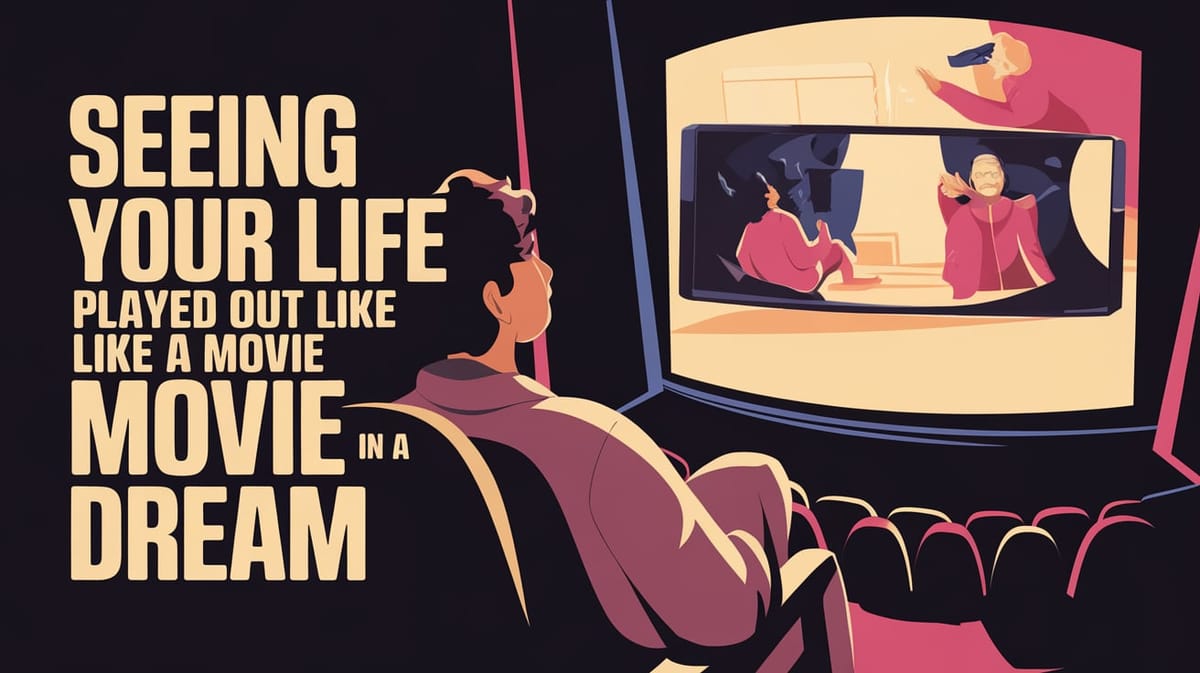
You fall asleep, and suddenly you\'re not inside your life — you\'re watching it. Your memories, choices, relationships, and pivotal moments play out on some inner screen while you sit in the audience. I\'ve had versions of this dream myself, and the feeling it leaves behind is hard to shake: a mix of wonder, nostalgia, and something almost like grief.
Quick answer: Dreaming of your life played out like a movie signals a deep need for self-reflection and objective perspective. It often arises during life transitions, emotional processing, or unresolved past events — your mind stepping back to review the narrative arc of your existence.
What Does It Mean Spiritually When Your Life Plays Like a Movie in a Dream?
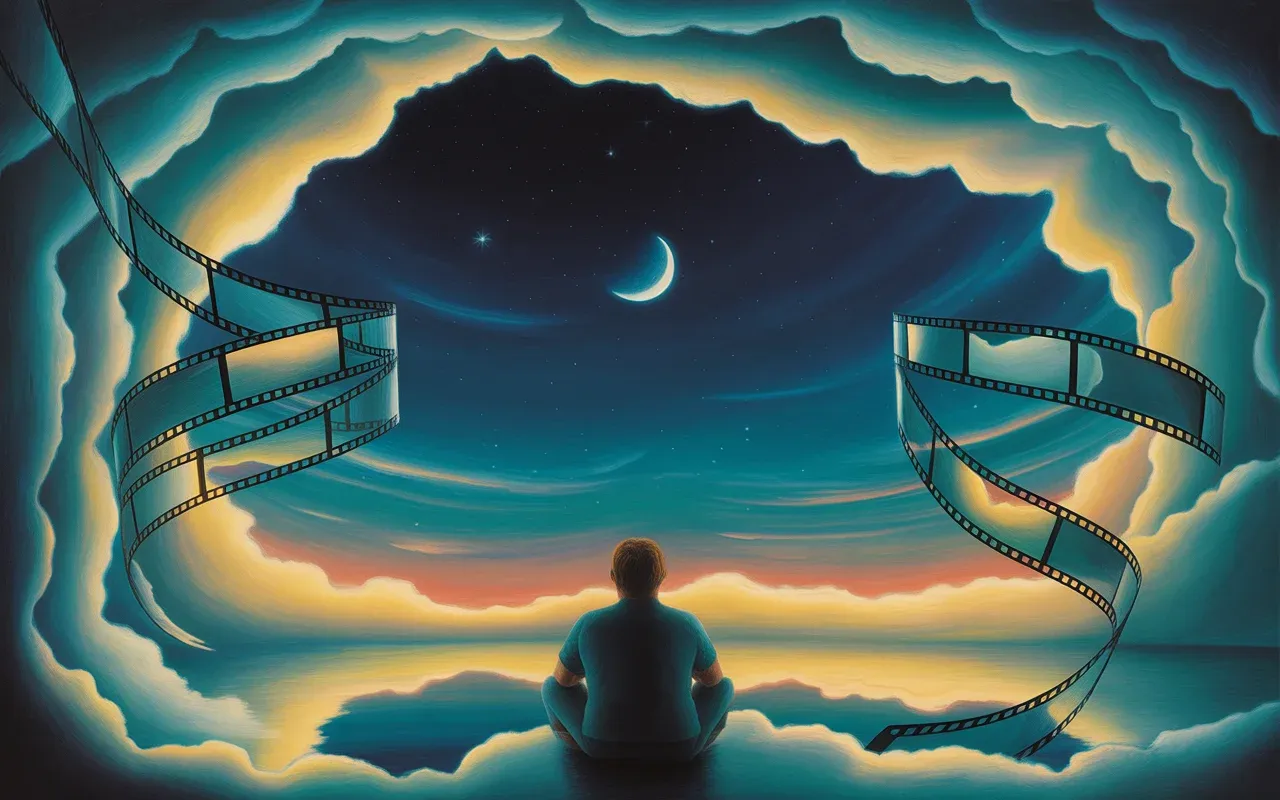
Across spiritual traditions, the "life review" is a sacred concept — a panoramic reckoning with one\'s journey. In this dream, your soul is the projector and the audience simultaneously. Spiritually, it suggests you are being called to witness your own story without judgment, to understand karmic patterns, or to see how your choices have woven together into a larger design.
Many mystics and near-death experience accounts describe an almost identical phenomenon — watching one\'s life from an elevated, detached vantage point. When this appears in a dream, it may point to a soul-level evaluation, a readiness to release old chapters, or a growing awareness of the bigger picture behind your daily experience.
What Do Psychology and Jung Say About Watching Your Life as a Film?
From a Freudian lens, this dream type points to the ego\'s need to survey suppressed memories and unresolved conflicts — a kind of nocturnal self-analysis. The distance of the "screen" lets the dreamer approach painful material without being overwhelmed by it.
Carl Jung would read it differently. In my research into Jungian frameworks, this dream type consistently maps to what Jung called the individuation process — the lifelong work of integrating all parts of the self into a coherent whole. Watching your life as a movie is the psyche showing you your own shadow, your persona, and your authentic Self side by side, asking you to hold them all without flinching.
The third-eye chakra in Reiki and energy healing traditions governs exactly this capacity — clear seeing, inner vision, and objective self-understanding. When this chakra is active, dreams of panoramic self-observation become more frequent.
\n\n| Dream Framework | Interpretation |
|---|---|
| Freudian | Ego surveying repressed memories and wish-fulfillment |
| Jungian | Individuation — integrating shadow, persona, and Self |
| Spiritual / Karmic | Soul review, recognition of life patterns and lessons |
| Reiki / Chakra | Third-eye activation — clear inner vision and objectivity |
| Neuroscience | REM memory consolidation and emotional regulation |
What Different Scenarios of This Dream Reveal
The emotional tone and your role in the "movie" matter enormously. Watching a joyful, triumphant version of your life suggests contentment and gratitude for how your path has unfolded. A tragic or painful film — featuring losses, regrets, or shame — often points to unprocessed grief or guilt seeking resolution.
The pattern I keep seeing in accounts from readers is that the most transformative versions of this dream involve a moment where the dreamer tries to intervene in a past scene, only to find they cannot. This inability to change the "footage" is the dream\'s way of delivering a message about acceptance: some chapters are finished, and healing means making peace with them rather than rewriting them.
Directing or editing the movie in your dream — cutting scenes, changing the lighting, rewriting dialogue — signals a strong drive to take authorial control of your life going forward.
Why Does This Dream Happen? Common Triggers
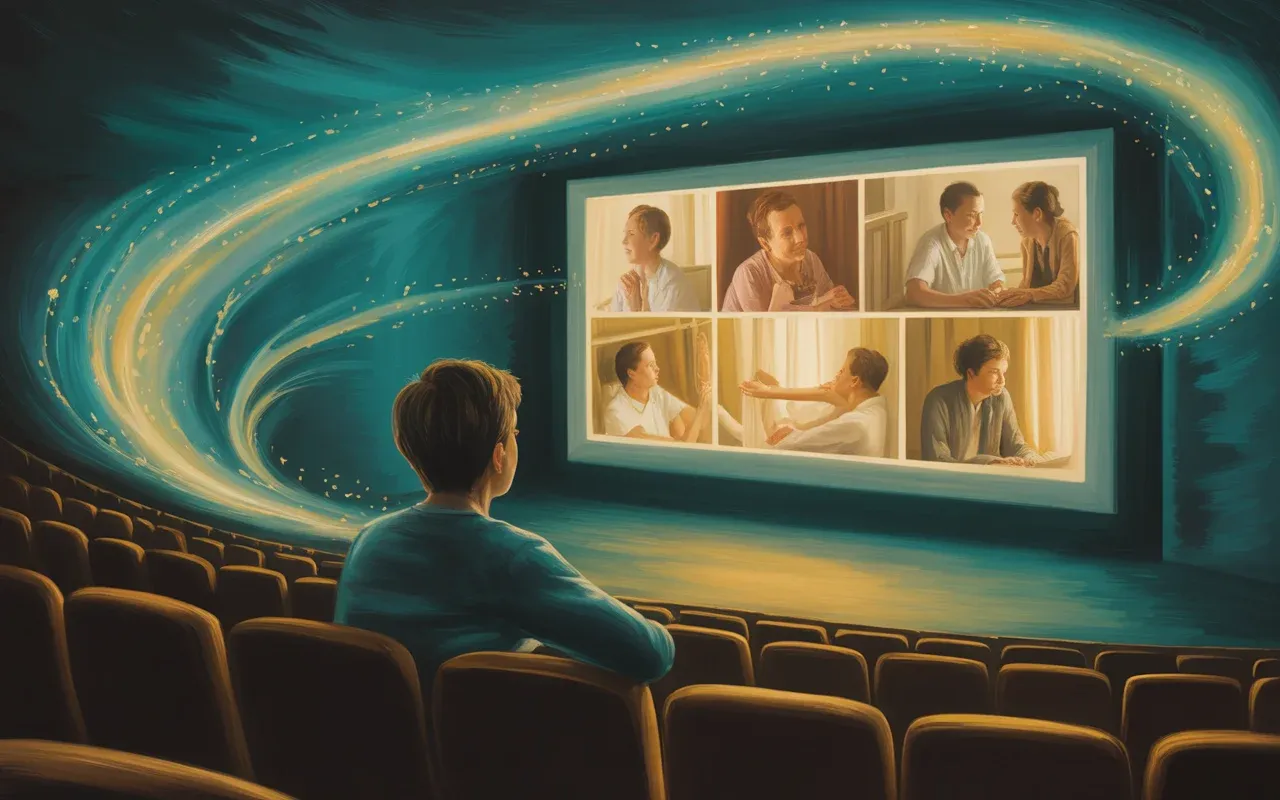
These dreams cluster around specific life circumstances. Major transitions — divorce, retirement, serious illness, the death of a loved one — often trigger them because the mind naturally enters "review mode" at turning points. People undergoing therapy or grief work frequently report this dream type as their inner processing deepens.
Guilt and regret are also reliable triggers. When something from your past remains unacknowledged, the sleeping mind will sometimes project it onto a screen where it cannot be ignored. The cinematic framing creates just enough distance for the material to surface without overwhelming you.
What Science Says About Movie-Like Vivid Dreams
Sleep researchers have identified that episodic memory — the autobiographical, narrative memory of your own life — is most actively processed during REM sleep. The brain\'s default mode network, which governs self-referential thinking and autobiographical reflection, is highly active during dreaming. Movie-like life review dreams are likely the brain\'s way of consolidating emotional memories, testing alternative narrative interpretations, and strengthening long-term memory structures.
A 2019 study from Nature Human Behaviour confirmed that emotional experiences are selectively replayed and reprocessed during sleep — the brain literally "edits" emotional memories overnight, which maps closely onto what happens subjectively in this dream type.
How to Work With and Integrate This Dream
Start with a dream journal entry immediately after waking — capture the scenes that appeared, the emotions they carried, and which chapters of your life were featured. Notice whether the dream focused on a particular period: childhood, a past relationship, a career chapter. That specificity usually points directly to what needs attention.
If the dream was distressing, consider whether professional support might help you process the underlying material. Recurring versions of this dream — especially those featuring regret or trauma — often respond well to therapeutic work.
For related dream experiences involving perspective-shifting and self-observation, explore what it means to be seeing yourself from a third-person perspective in a dream, which shares many of the same psychological roots. If your movie-dream includes nested realities or false awakenings, the dream within a dream experience may also be relevant. And if you want to learn how to gain conscious awareness during these kinds of surreal observations, lucid dreaming techniques can help you engage actively rather than just watch.
Frequently Asked Questions
Why did my dream look like a movie?
When a dream takes on a cinematic quality — wide shots, narrative arc, emotional score — it usually signals that your brain is processing autobiographical material from a reflective, evaluative distance rather than simply replaying events. The "movie" format gives your psyche room to examine your own story objectively.
What is it called when you watch yourself in a dream?
This phenomenon is called an autoscopic dream or third-person perspective dream. It differs from standard first-person dreaming in that you observe yourself as a character rather than inhabiting your own body. It is closely related to out-of-body experiences and is associated with heightened self-reflection.
What does it mean if I frequently dream my life is a movie?
Recurring life-as-a-movie dreams typically signal a habitual pattern of self-evaluation or introspection. They may reflect an ongoing need to make sense of your life\'s direction, process accumulated regrets, or gain perspective during a sustained period of change or uncertainty.
Could this dream reflect regrets or past traumas?
Yes — if the movie in your dream features painful scenes, evokes shame or guilt, or focuses on a specific loss, it is almost certainly processing unresolved emotional material. The cinematic distance is a psychological mechanism that allows difficult memories to surface safely during sleep.
Does this dream have a Christian or biblical meaning?
Biblically, the idea of one\'s life being "laid bare" before God has strong resonance with this dream type. In a Christian framework, it may be interpreted as a call to self-examination, repentance, or gratitude — an invitation to reflect on how faithfully you have lived according to your values.
What if I can control or edit the movie in my dream?
Dreaming that you can direct, edit, or rewrite scenes in your life-movie points to a strong desire — and possibly a readiness — to take conscious control of your narrative. This variant is often a signal that the dreamer is moving from passive reflection into active engagement with change.
What does it mean when you are not yourself in your own dream?
Being an observer of your own life rather than a participant suggests the psyche is creating distance for a reason — usually to help you see patterns or truths that are harder to perceive from the inside. It can also reflect a sense of feeling alienated from your own life in waking reality.
Is this related to lucid dreaming?
There is overlap. Both involve a meta-awareness of the dream state. However, in the life-as-a-movie dream, the observer role is usually involuntary — you find yourself watching rather than choosing to step back. Lucid dreaming, by contrast, involves deliberately recognizing and working within the dream.
Can dreams like this predict the future?
If the movie in your dream shows future scenes rather than past memories, it may reflect hopes, fears, or anticipatory thinking about what lies ahead — not literal prediction, but your mind rehearsing possible futures. These scenes reveal your deep expectations and anxieties more than they foretell actual events.
Final Thoughts
A dream where your life plays like a movie is one of the most psychologically significant experiences your sleeping mind can generate. It means the inner director has taken the booth — pulling back the camera to show you the full shape of your story rather than just the next scene. Whether you watch with pride, grief, wonder, or regret, the message is consistent: your life has meaning and form, and your subconscious wants you to see that clearly. The question worth sitting with when you wake is not just what you saw, but what you are now ready to do with what you\'ve been shown.