Sensing Evil in a Dream: Understanding Nightmares and Their Meanings

Quick answer: Sensing evil in a dream usually reflects unresolved inner fears, stress overload, or your subconscious flagging a real-life threat. From a Jungian angle it\'s your shadow archetype demanding attention — not a sign of actual danger, but an urgent invitation to look inward.
You wake up at 3 AM with your heart hammering, the room dark, the sheets damp. The dream is already fading — but that oppressive something lingers. I\'ve spoken with hundreds of dreamers about exactly this feeling, and what strikes me is how universal it is: the sensation of evil in a dream isn\'t just fear. It has a weight, a presence, a wrongness that ordinary nightmares don\'t carry.
This post breaks down what that experience actually means — psychologically, spiritually, and neurologically — and what you can do about it.
What does sensing evil in a dream actually mean?
At its core, sensing evil in a dream is your subconscious communicating through the most visceral signal it knows. These dreams sit at the collision point between conscious awareness and unprocessed emotion. The "evil" you feel isn\'t external — it\'s your mind externalizing something internal: a suppressed conflict, a mounting anxiety, or a warning your waking self has been ignoring.
The sensation goes beyond ordinary fear. Fear has an object — a threat you can name. Evil in dreams is more diffuse: it\'s an atmosphere, a pressure, a certainty that something is fundamentally wrong. That quality is precisely what makes it so unsettling and so worth paying attention to.

What does psychology say about evil in dreams?
The Freudian reading: repressed conflict surfacing
Freud saw dreams as the royal road to the unconscious. From his standpoint, an evil presence in a dream is the subconscious staging a confrontation with something you\'ve pushed down — a desire you\'ve judged as wrong, a fear you\'ve refused to acknowledge, or a conflict you\'ve chosen not to resolve. The "evil" is the dramatized form of that repression.
The Jungian shadow: meeting the part of yourself you reject
Carl Jung went further. He\'d say the evil entity in your dream is you — specifically the shadow archetype: the repository of traits, impulses, and memories you consider unacceptable and have buried. In my research, this is the interpretation I find most consistently useful. The shadow doesn\'t destroy you when it shows up in dreams — it asks to be integrated. When you stop running from it, the nightmares usually stop too.
An energy perspective
From an energy-healing framework, repeated evil dreams can signal disruption in your energetic field — blockages caused by chronic stress, boundary violations, or unresolved grief. Whether you find this framework useful depends on your worldview, but the practical advice it generates (reduce stress, restore boundaries, process grief) aligns with what modern psychology also recommends.
What is the spiritual significance of sensing evil in a dream?
Across cultures and centuries, this dream type has consistently been read as a call to heightened awareness rather than a simple omen of danger. Spiritually, the evil you sense often represents:
- A test of discernment — your inner wisdom demanding you look more carefully at something in your life
- An intuitive alarm — your gut registering a real-world threat your rational mind has rationalized away
- A shadow confrontation — an invitation to reconcile with rejected aspects of yourself before they calcify into self-destructive patterns
The pattern I keep seeing across dream accounts is this: people who engage curiously with these dreams — asking "what is this representing?" rather than just "how do I make this stop?" — tend to find meaningful answers.
What do specific evil dream scenarios mean?
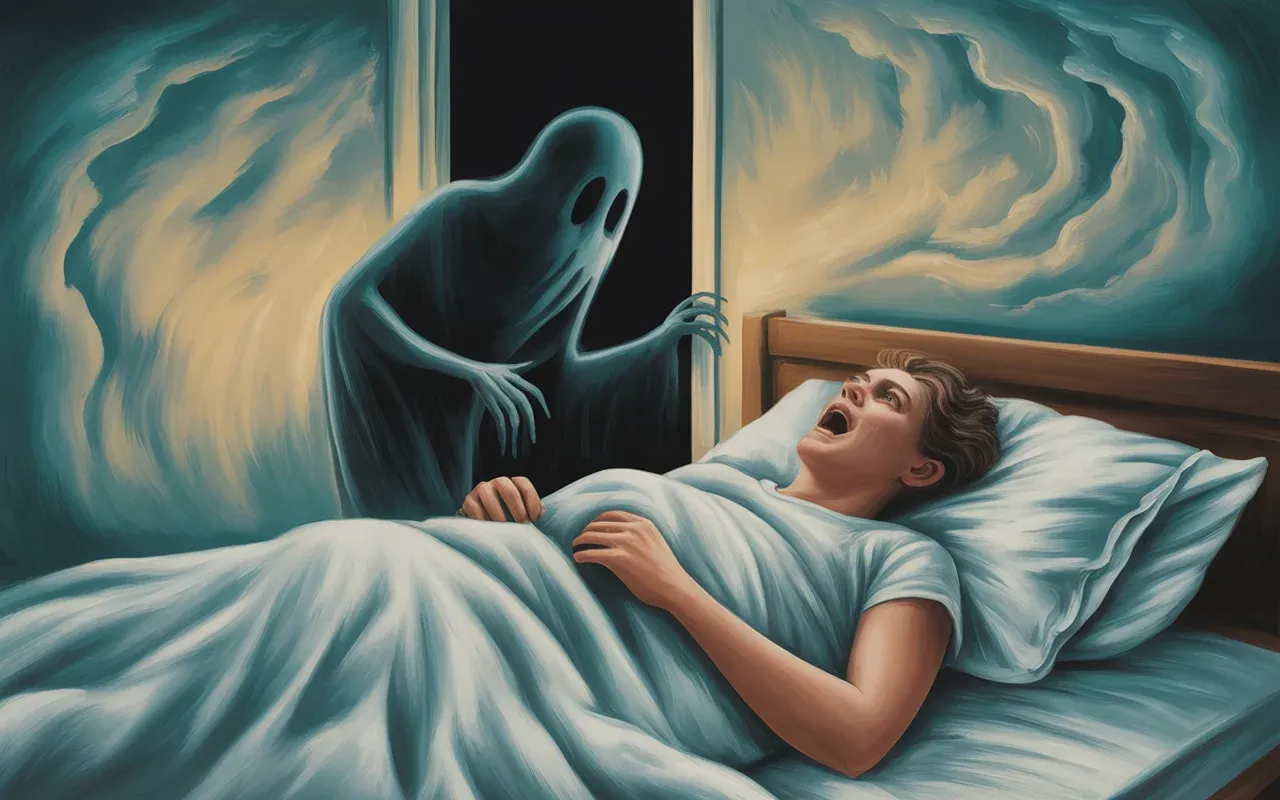
Shadows closing in around you
Converging shadows typically signal overwhelm — too many demands, too many unresolved issues accumulating until they feel like a physical encirclement. Ask what areas of your life feel like they\'re closing in. The dream is giving those feelings a shape.
An evil you can feel but not see
An invisible yet palpable presence points to vague, unnamed anxiety — the kind that\'s harder to address precisely because it lacks a clear object. This dream often appears during liminal periods: job transitions, relationship uncertainty, major life decisions. Your subconscious is registering tension your conscious mind hasn\'t fully articulated yet.
Malevolent voices or whispers
Sinister voices in dreams frequently mirror your own internal critic — the voice that catalogues your failures, questions your worth, predicts your defeat. When that voice becomes externalized and "evil" in a dream, it\'s often a sign the self-criticism has reached a volume your psyche can no longer absorb quietly.
An evil entity chasing you
Pursuit by a malevolent force is one of the most reported nightmare types. It almost always represents avoidance — of a person, a decision, a truth. The entity doesn\'t have to catch you for the dream to be meaningful; the chase itself is the message. See also: being chased in a dream and what it means spiritually.
What causes evil or threatening dreams?
\n\n| Cause | How it shows up in dreams |
|---|---|
| Chronic stress or anxiety | Formless evil presences, suffocating atmospheres |
| Major life transitions | Unknown entities, unfamiliar threatening environments |
| Unresolved interpersonal conflict | Known persons transformed into threatening figures |
| Sleep paralysis episodes | Hyperreal evil presence, inability to move or call for help |
| Suppressed guilt or shame | Being hunted, judged, or condemned in the dream |
| Overactive amygdala (REM) | Extreme fear responses to ambiguous stimuli |
What does science say about nightmares involving evil presences?
Neurologically, the amygdala — the brain\'s emotional processing hub — can become hyperactive during REM sleep, generating intense fear responses to neutral or ambiguous dream content. The brain then fills in the narrative: something must be causing this fear, and the story it constructs is often an evil presence.
Sleep paralysis is a particularly direct mechanism. During the transition between sleep stages, the motor cortex stays offline (preventing you from acting out dreams) while consciousness briefly returns. The result is full awareness with complete physical immobility — and the brain, seeking an explanation, often generates a hallucinatory threatening presence at the edge of perception. This is the biological origin of "old hag" and incubus/succubus experiences across world cultures.
Research from the Sleep Foundation confirms that nightmare frequency increases significantly under conditions of psychological stress, trauma, and anxiety disorders.
How do you stop or cope with recurring evil dreams?
- Dream journaling immediately on waking: Write the dream before the rational mind edits it. Look for recurring symbols, locations, or figures over weeks.
- Image rehearsal therapy (IRT): A clinically validated technique where you rewrite the nightmare ending while awake and rehearse the new version. Effective for PTSD-related nightmares.
- Address the waking-life stressor: Most persistent evil dreams have a correlate in waking life. Identify what you\'ve been avoiding or ignoring.
- Sleep hygiene: Consistent sleep schedule, cool room, no screens within 60 minutes of bed, no alcohol (which suppresses REM then rebounds it intensely).
- Therapeutic support: If dreams are causing significant distress or disrupting sleep consistently, a therapist trained in dream work or CBT-I can help meaningfully.
Dreams involving fear, danger, and dark presences often connect to larger themes — if you\'re also experiencing feeling scared in a dream, that post explores the fear response in more depth. And if a darker spiritual figure has appeared directly, seeing a demon in a dream covers that territory specifically. For shadow-figure pursuit, being followed by a shadow figure goes deeper into the Jungian reading.
What should you take away from an evil-sensing dream?
These dreams are not prophecy, not spiritual attack, and not evidence of mental illness. They are your subconscious doing exactly what it\'s designed to do: flagging unresolved material that needs conscious attention. The specifics matter — what the evil felt like, where it came from, how you responded. Write them down. Sit with them. They almost always point to something real.
The dreamers I\'ve found cope best with these experiences are the ones who stop trying to escape the dream and start getting curious about it. That shift — from avoidance to inquiry — is where these nightmares stop repeating and start resolving.
FAQ: Sensing Evil in a Dream
What does it mean to feel an evil presence in a dream?
An evil presence in a dream typically reflects unprocessed emotional content — fear, guilt, suppressed anger, or a situation your waking mind has been avoiding. It rarely predicts external events; it almost always points inward.
Is sensing evil in a dream a spiritual warning?
Some spiritual traditions interpret it that way — as intuition picking up on a real-world threat or a test requiring discernment. Whether you take a spiritual or psychological view, the practical response is the same: pay attention to what\'s troubling you in waking life.
Why do I keep having recurring evil dreams?
Recurring evil dreams usually mean the underlying issue hasn\'t been resolved. Your subconscious keeps replaying the scenario because it\'s still waiting for a response. Dream journaling and, if needed, therapeutic support are the most reliable ways to break the pattern.
What causes the feeling of evil during sleep paralysis?
During sleep paralysis, your motor cortex is offline while consciousness returns briefly. The brain generates a hallucinatory presence to explain the intense fear the body is registering. This is a well-documented neurological phenomenon, not a supernatural one — though it can feel utterly real.
What does it mean when an evil figure chases you in a dream?
Being chased by something evil usually represents avoidance — of a decision, a person, a difficult truth. The chase stops when you stop running, either in the dream (lucid dreaming) or by confronting the waking situation you\'ve been putting off.
What does a dark shadow in a dream mean?
A dark shadow often represents Jung\'s shadow archetype — the parts of yourself you\'ve disowned or rejected. It appears threatening because you haven\'t yet integrated it. When acknowledged rather than fled from, shadow figures in dreams often transform or lose their menace.
What does hearing an evil voice in a dream mean?
Evil voices in dreams frequently externalize internal self-criticism. The "voice" is usually your own — amplified, distorted, and projected outward by the dream state. Paying attention to what it says often reveals the specific self-judgment causing the most damage.
Can evil dreams have a positive meaning?
Yes — consistently. These dreams act as pressure valves and diagnostic tools. They surface what\'s been suppressed, force confrontation with avoided truths, and often precede periods of real psychological growth. The discomfort is the point; it\'s your mind insisting you pay attention.