Spiritual Meaning of Being Chased by Your Own Shadow in a Dream

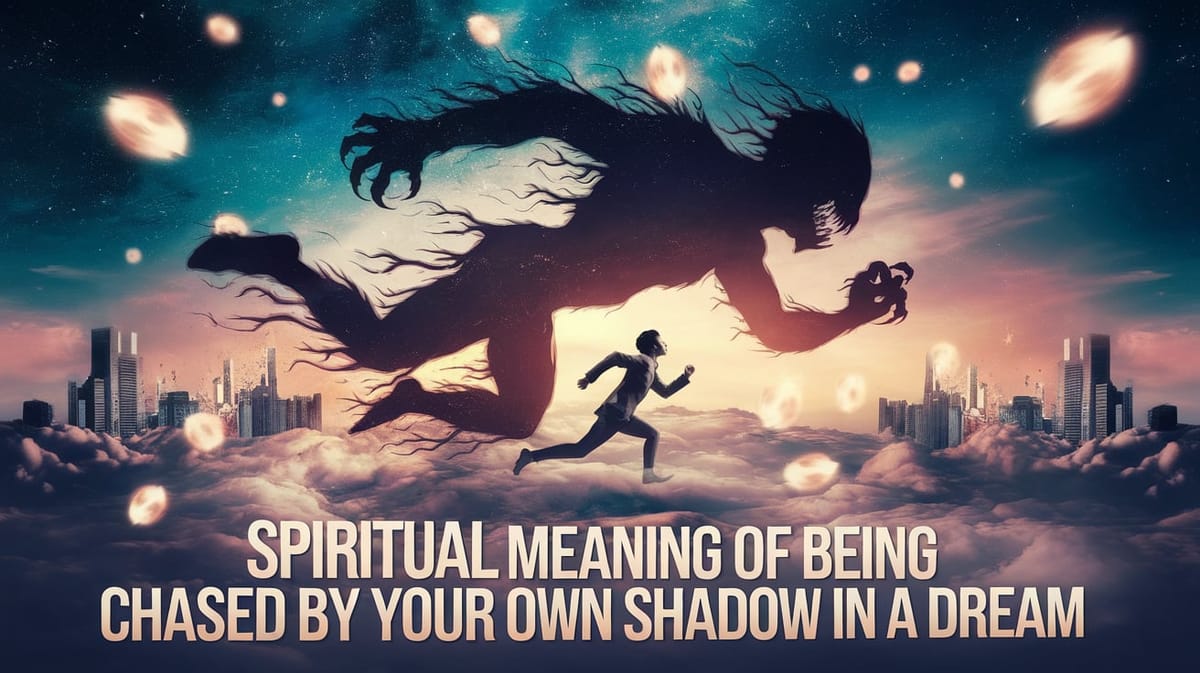
Being chased by your own shadow in a dream is one of the most unsettling — and revealing — experiences the sleeping mind can produce. Unlike a monster or a stranger, your shadow is you. That\'s precisely why this dream carries such psychological weight.
Quick answer: Being chased by your own shadow in a dream usually signals avoidance of a part of yourself you haven\'t fully accepted — repressed fears, denied emotions, or traits you\'ve pushed into the unconscious. The chase itself is an invitation to turn around and face what\'s following you.
What Does It Mean to Be Chased by Your Own Shadow in a Dream?
In dream symbolism, being chased almost always points to avoidance — running from something you\'d rather not confront. When the pursuer is your own shadow, the interpretation sharpens considerably. Carl Jung described the Shadow as the unconscious side of the personality: the qualities, impulses, and memories that the ego refuses to own. Your dreaming mind may be saying: you cannot outrun yourself.
Spiritual traditions echo this. In many mystical frameworks, the shadow is not evil — it\'s simply unintegrated. Chasing dreams of this kind often appear at life transitions, during periods of inner conflict, or when someone is doing serious inner work and hasn\'t yet brought something to the surface.
The Jungian Shadow: What Psychology Says About This Dream
Jung\'s Shadow Archetype is perhaps the most useful lens for this dream. According to analytical psychology, every person has a shadow — a collection of traits, desires, and impulses that were rejected or suppressed, usually in childhood. These don\'t disappear; they live in the unconscious and can project outward onto others or, as in this dream, pursue us in sleep.
Freud, by contrast, might see the chasing shadow as suppressed id-energy breaking through. Repressed desire, unacknowledged aggression, or a grief never processed — these are the kinds of forces that wear a shadow\'s face in dreams.
From a neuroscience angle, the amygdala (the brain\'s fear-processing center) stays highly active during REM sleep. Chase dreams activate this region intensely, which is why waking up from them can feel physically real. The brain uses the emotional charge to flag something important.
In my research across hundreds of dream accounts, I\'ve noticed that shadow-chase dreams tend to cluster around three life situations: unresolved conflict with a parent or authority figure, a period of major identity change, and suppressed creative or emotional expression.

What Do Different Scenarios Mean in This Dream?
\n\n| Dream Scenario | Likely Meaning |
|---|---|
| You run and never escape | Deep-rooted avoidance; the unacknowledged part is persistent |
| You stop and face your shadow | Readiness to confront suppressed aspects; a positive integration signal |
| Shadow feels aggressive or menacing | Suppressed anger, grief, or fear demanding acknowledgment |
| Shadow is silent and simply follows | Subconscious awareness that something is present but not yet urgent |
| You merge with your shadow | Rare but highly positive: psychological integration underway |
| Shadow speaks to you | Your unconscious mind is attempting direct communication |
The emotional tone during the chase matters enormously. Terror suggests strong resistance; curiosity or sadness suggests you\'re closer to acceptance than you might think.
Spiritual Interpretations Across Traditions
Many spiritual traditions have their own version of the shadow concept. In Jungian-influenced spirituality, shadow work — the deliberate practice of acknowledging and integrating rejected aspects of self — has become central to modern psychological growth. Dreams like this one are often seen as the unconscious initiating that work on your behalf.
Christian mysticism speaks of the "dark night of the soul," a period where hidden spiritual wounds surface for healing. A shadow-chase dream in this context might represent the soul\'s unfinished business before deeper union with the divine.
In Islamic dream interpretation, a dark pursuing figure can represent hidden sins or unresolved moral conflicts seeking acknowledgment and repentance.
Reiki and energy healing practitioners often interpret shadow dreams as signs of imbalanced or blocked energy in the lower chakras — the energetic sites associated with identity, safety, and personal power.
Common Causes and Triggers for This Dream
The pattern I keep seeing is that shadow-chase dreams rarely appear randomly. There are clear situational triggers:
- Major life transitions — career changes, relationship endings, moving away from home
- Suppressed identity — hiding aspects of yourself from others (or yourself)
- Unprocessed grief or anger — emotions that were too intense to feel at the time
- Active shadow work — therapy or journaling that has stirred things up
- Chronic self-criticism — habitually rejecting parts of yourself as "unacceptable"
- Heightened stress or anxiety — the amygdala becomes more active, amplifying threat-based dreams

Coping Strategies When This Dream Recurs
Recurring shadow-chase dreams are an invitation, not a curse. A few approaches that genuinely help:
- Dream journaling: Write the dream down immediately on waking. Patterns in the shadow\'s behavior reveal what needs attention.
- Shadow work prompts: Ask yourself, "What quality in others bothers me most?" — this often reflects a disowned part of yourself.
- Somatic practices: Yoga, breathwork, and movement help discharge the physical tension that shadow energy accumulates in the body.
- Therapy: A Jungian or depth psychologist is particularly suited to this kind of inner work.
- Imagery rehearsal: Before sleep, mentally rehearse turning to face your shadow calmly and asking it what it wants. This can shift recurring chase dreams.
If you\'re interested in how avoidance shapes other kinds of chase dreams, my piece on being chased in a dream covers the broader symbolism in depth. For shadow figures specifically, being followed by a shadow figure in a dream explores variations where the pursuer is external rather than your own reflection. And if your dream involves physical paralysis — unable to run even when you want to — see the spiritual meaning of being unable to run in a dream.
For a deeper dive into Jung\'s original framework, The Society of Analytical Psychology\'s overview of the Shadow is one of the clearest academic resources available.
What the Running-in-a-Dream Video Teaches Us About Shadow Chases
Running is the body\'s response to the chase — and the two motifs are deeply connected. This YouTube breakdown of running in a dream explores why the act of flight in sleep carries so much emotional charge, which maps directly onto shadow-chase dynamics.
Frequently Asked Questions
What do shadows represent in dreams?
Shadows in dreams typically represent the unconscious — specifically the aspects of yourself that haven\'t been acknowledged or integrated. They\'re not inherently negative; they\'re simply the parts of you that live outside conscious awareness.
What does it mean when your shadow chases you?
When your shadow pursues you in a dream, it suggests those unacknowledged parts are asserting themselves. The "chase" dynamic indicates you\'re actively avoiding confrontation with something inside yourself that wants recognition.
What is the Jungian Shadow in dreams?
Jung\'s Shadow is the unconscious repository of traits, memories, and impulses the ego rejects. In dreams, it appears as a dark figure, a pursuer, or — as in this case — your own shadow, acting as a messenger from the unconscious to the conscious mind.
What does it mean to chase shadows spiritually?
Spiritually, chasing shadows often represents pursuing illusions or unresolved spiritual questions. When reversed — when the shadow chases you — it suggests your own unfinished spiritual business is catching up with you and asking for attention.
What if I stop running and face my shadow in the dream?
This is genuinely significant. Turning to confront your shadow in a dream often marks a turning point in psychological integration. It suggests readiness — conscious or unconscious — to stop avoiding and begin understanding the rejected part of yourself.
Does this dream mean I have a "dark side"?
Everyone does. The shadow isn\'t about being fundamentally flawed — it\'s about being human. Shadow material includes qualities like anger, jealousy, and selfishness, but also positive traits like ambition or creativity that were suppressed for social reasons.
Can recurring shadow-chase dreams be a mental health signal?
If the dreams are frequent and cause significant distress or anxiety on waking, that\'s worth discussing with a therapist. Recurring nightmares can sometimes be linked to unprocessed trauma, anxiety disorders, or unresolved grief. Shadow-specific work with a depth psychologist can be particularly effective.
What does a menacing or aggressive shadow mean?
An aggressive shadow usually points to suppressed anger, shame, or other powerful emotions that have been denied outlet. The more threatening the shadow appears, the more urgently those emotions are pushing for acknowledgment.
What to Do When Your Shadow Catches You
If this dream has visited you, treat it as useful data rather than a bad omen. Your shadow isn\'t chasing you to harm you — it\'s chasing you because it has been ignored long enough. The most common resolution for recurring shadow-chase dreams is not finding a way to run faster, but choosing to stop. In waking life, that means asking honestly: what quality, emotion, or aspect of myself have I been refusing to look at? Shadow work — whether through journaling, therapy, or deliberate inner reflection — tends to end the chase, because there\'s nothing left to flee from when you\'ve finally turned around.