Spiritual Meaning of Being in Two Places at Once in a Dream

Quick answer: Dreaming of being in two places at once reflects internal conflict between competing roles, desires, or life paths. It often signals your subconscious is processing duality — career vs. home, logic vs. emotion, or your current self vs. who you're becoming.
I've been researching this dream type for years, and few images capture the divided modern psyche as vividly as standing simultaneously in two entirely different places. It's disorienting, yet strangely compelling — and your brain generated it for a reason.
What does it mean to dream of being in two places at once?
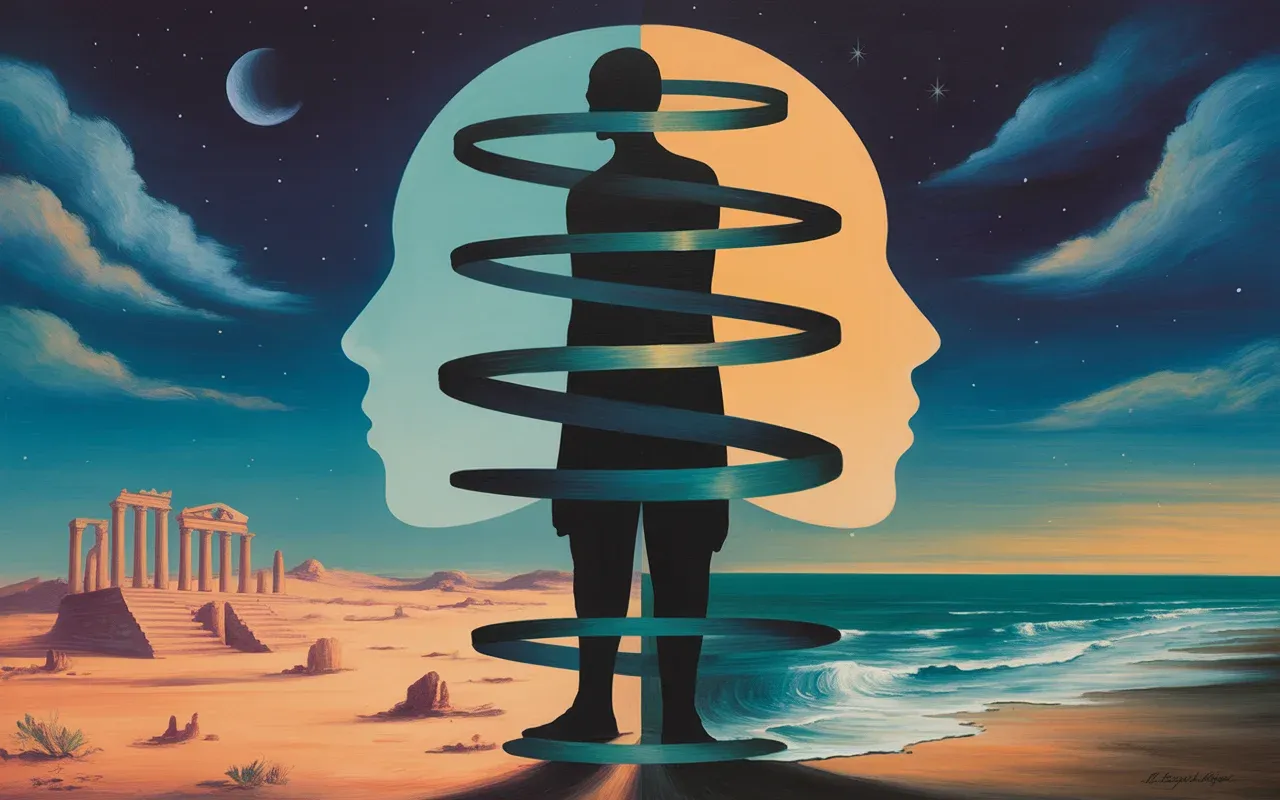
This dream almost always signals duality — a split between two roles, two desires, or two opposing aspects of your personality. The locations are not random. They're symbolic stand-ins for the competing forces pulling at you in waking life. Being at work and home simultaneously, for example, points directly to work-life tension. Two wildly contrasting environments — desert and ocean, city and forest — suggest a more fundamental emotional or identity conflict.
Spiritually, this type of dream echoes the concept of bilocation: the mystical idea (found in shamanism, Sufism, and Catholic saint traditions) that consciousness can be present in more than one place. While that's metaphor rather than literal fact, the dream uses the image powerfully — your soul is being pulled in two directions and trying to reconcile them.
What is the spiritual significance of bilocation in dreams?
Across traditions, bilocation represents the integration of paradox: yin and yang, conscious and subconscious, earthly and divine. In Jungian terms, this dream is the psyche's way of staging the individuation process — the lifelong work of integrating opposing parts of yourself into a coherent whole.
Energy healing frameworks (such as Reiki) interpret this dream as a sign of chakra imbalance or a fluctuation in your energetic body — your energy is "split" between two states, and the dream is asking you to restore flow.
Religious traditions are also relevant here. Catholic mystics documented bilocation as a gift (Padre Pio, for instance). Sufi and shamanic traditions describe the dreaming body — an aspect of the self that travels independently of the physical form. The dream may be activating those deep archetypal images even if you have no conscious belief in them.
| Tradition | Interpretation of Two-Place Dream |
|---|---|
| Jungian Psychology | Individuation; integration of opposing self-aspects |
| Freudian Psychology | Conflict between desire and reality; divided loyalties |
| Shamanism | Dreaming body traveling; the "double" |
| Catholic Mysticism | Bilocation as spiritual gift; soul stretching toward purpose |
| Reiki / Energy Healing | Chakra imbalance; split energetic focus |
| Sufism | Consciousness expanding beyond physical limits |
What do the specific locations in this dream reveal?
The locations are the dream's language. Pay close attention to them — they carry the precise emotional message your subconscious is trying to deliver.
- Home + work: Classic work-life tension; competing obligations for your time and energy.
- Present city + childhood home: Tension between who you are now and who you were — or unresolved past identity.
- Desert + ocean: Isolation vs. emotional depth; spiritual thirst vs. subconscious overwhelm.
- Two unknown places: Uncertainty about which direction to go; decision fatigue.
- Real place + surreal/impossible place: Your logical mind vs. a repressed creative or spiritual urge.
How do Freud and Jung interpret bilocation dreams?
Freud read these dreams as expressions of inner conflict — competing desires pulling the ego in opposite directions, or repressed material fighting for expression. He would link the specific locations to suppressed wishes or unresolved tensions from early life.
Jung went further. For him, appearing in two places wasn't a problem to solve — it was the psyche at work on individuation. The two locations represent the ego (the known self) and the shadow or unconscious (the unfamiliar, disowned aspects). The dream is literally staging the encounter between them, inviting synthesis rather than resolution through dominance.
In my research, I keep seeing that people who report this dream frequently are often at genuine crossroads — they're facing a fork in the road and haven't yet allowed themselves to consciously acknowledge it. The dream does the acknowledging for them.
What triggers dreams about being in two places at once?
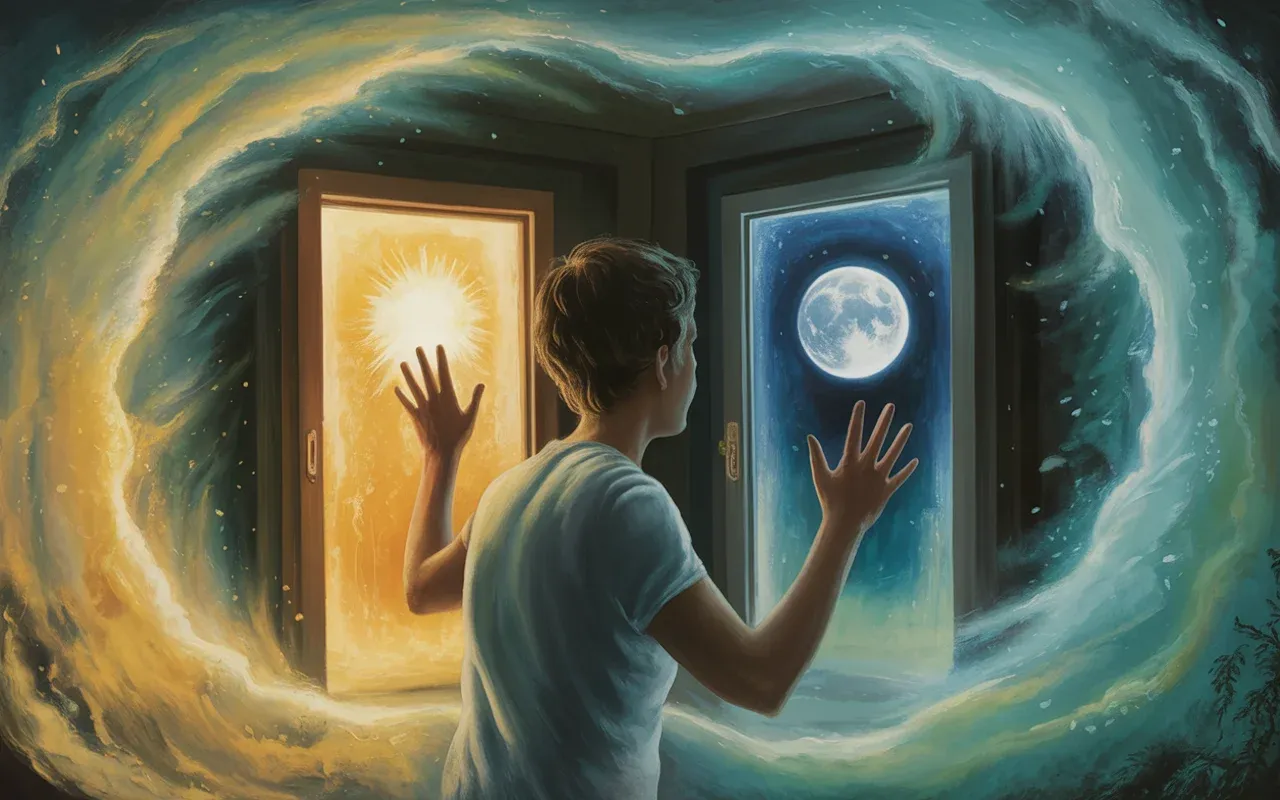
These dreams appear most often when:
- You're stretched between significant competing responsibilities (new job + family demands)
- You're processing a major identity shift (becoming a parent, leaving a relationship, changing careers)
- You've been suppressing an aspect of yourself that's demanding attention
- You're dealing with unresolved loyalty conflicts — feeling you "should" be somewhere else
- You're experiencing REM-rich sleep during high-stress periods (cortisol affects dream vividness)
Scientifically, the brain's high imaginative capacity during REM allows it to construct logically impossible scenarios. This specific image — being in two places — is the brain's efficient shorthand for "you are pulled in two directions and something needs to give."
How do you work with this dream after waking?
First, write down the two locations immediately. Don't analyze yet — just capture them. Then ask: what do these places represent in my waking life? What feelings did each location carry in the dream?
If the dream recurs, treat it as a signal worth investigating with more depth. Consider:
- Keeping a dream journal to spot patterns across multiple nights
- Somatic grounding (breathwork, walking) to reconnect with your body's single location
- Journaling on the question: "Where am I truly choosing not to be fully present in my life?"
- If distress persists, working with a therapist familiar with dream analysis
For related themes in dream analysis, explore how seeing yourself from a third-person perspective in a dream reveals dissociation patterns, or read about manipulating time in a dream for more on how your subconscious bends the rules of reality. Dreams of encountering a doppelganger of yourself share similar themes of fragmented identity worth examining alongside this one.
For further reading on how the brain constructs impossible dream scenarios, NIH research on cortisol and dream recall provides solid scientific grounding.
Frequently Asked Questions
Is bilocation possible in dreams — or is it just a metaphor?
Dream researcher Robert Moss notes that when you become aware you're dreaming (lucid dreaming), you can experience a form of bilocation — your dream self is in one place while you remain aware of your physical body elsewhere. Whether this is literal or metaphorical depends on your worldview, but the experience is real and documented.
Why do I keep having this dream repeatedly?
Recurring two-place dreams point to an unresolved underlying theme in your life — a split between roles, desires, or identity paths that your waking self hasn't yet addressed. The dream will often ease once you make a clear decision or take action on the tension it's reflecting.
Does this dream mean I have a split personality?
No. This dream reflects normal human complexity — the fact that we carry multiple roles, desires, and self-aspects simultaneously. It doesn't indicate any psychiatric condition. Dissociative identity disorder is a complex clinical diagnosis entirely separate from dream symbolism.
What does it mean if the two places feel very different emotionally?
Emotional contrast between the two locations is the most important signal. One place may feel like freedom, the other like obligation. One may feel authentic, the other performed. That emotional gap is what your subconscious is asking you to examine.
Can this dream be connected to astral projection or out-of-body experiences?
Some people in spiritual communities interpret this dream as an OBE or soul travel experience. Whether or not you hold that belief, the imagery aligns with accounts of bilocation in shamanic and mystical traditions. The more relevant question is what the two locations symbolize for you personally.
What does it mean if one of the two places doesn't exist in real life?
An impossible or unfamiliar location usually represents an unexplored part of yourself — a potential future, a suppressed desire, or an aspect of your personality you haven't yet integrated. It's often the more significant of the two locations in terms of the dream's message.
Should I be worried if I wake up feeling disoriented from this dream?
Temporary disorientation after vivid spatial dreams is normal as your brain reorients to physical reality. If the feeling persists or the dreams cause significant anxiety, that's worth discussing with a mental health professional — not because the dream itself is dangerous, but because it may be pointing to stress worth addressing.
Does the number 2 have any spiritual significance in this dream?
Yes — in numerology and many spiritual traditions, 2 represents balance, duality, partnership, and the need to find your true path between opposing forces. The dream of being in two places literally embodies that energy.
What this dream is really telling you
Dreaming of being in two places at once is your subconscious staging a conversation you haven't had with yourself yet. It's not a warning — it's an invitation. The two locations are a map of your internal conflict, and the dream is asking you to stop splitting your energy and start making a conscious choice about where you truly want to stand. The most useful question to sit with after this dream: Which of these two places feels most like me?