Spiritual Meaning of Birds in a Dream: Discover Their Symbolism

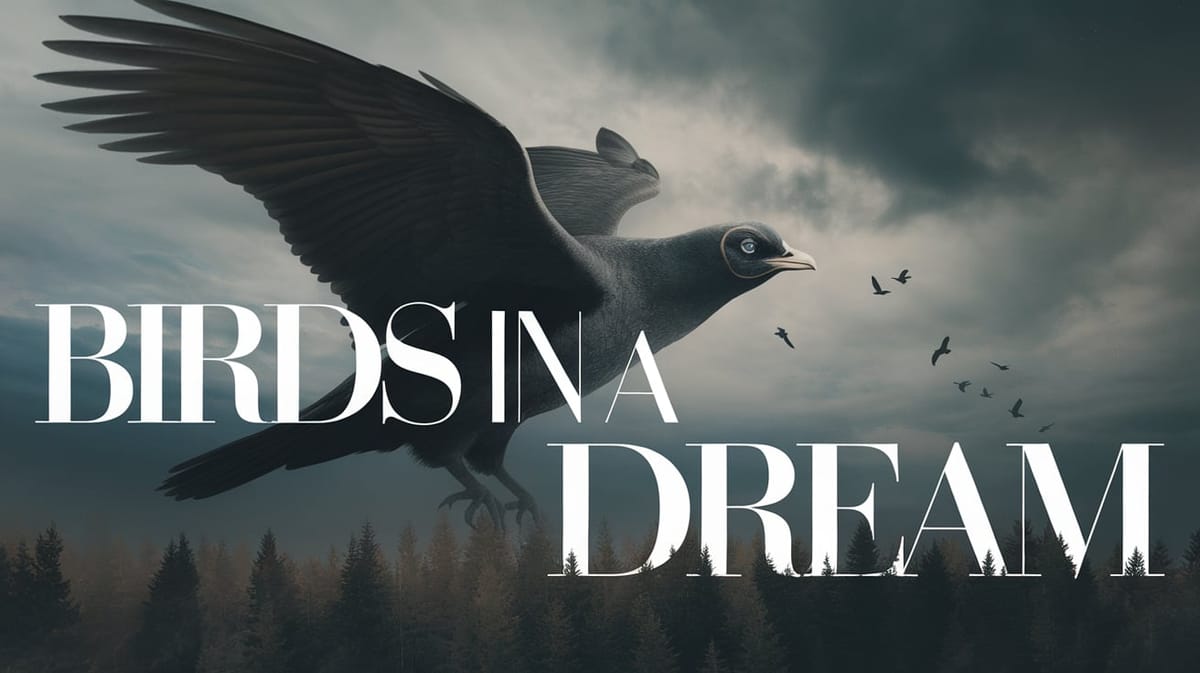
Quick answer: Birds in dreams symbolize freedom, spiritual transcendence, and the desire to rise above everyday concerns. The specific type of bird, its behavior, and your emotional reaction in the dream all shape the final meaning — from a dove\'s peace to a raven\'s mystery.
Dreaming of birds is one of the oldest and most universal dream experiences humans have recorded. Across ancient Egypt, Indigenous traditions, and modern psychology, birds carry the same core message: something in you wants to fly. In my research into dream symbolism, I\'ve found that bird dreams almost always surface during moments of personal transition — when the dreamer is wrestling with a decision or craving a change they haven\'t yet made consciously.

What does it mean spiritually to see birds in a dream?
Spiritually, birds are messengers between the earthly and divine. When they appear in your dreams, many traditions interpret this as your higher self reaching out — urging you to trust your instincts or pay attention to a guiding sign. Doves point to peace and incoming comfort. Blackbirds or ravens suggest something hidden or unresolved calling for your attention. Eagles carry themes of power, vision, and rising above obstacles. Owls, long tied to wisdom and the underworld, often appear before a major revelation or loss.
\n\n| Bird | Spiritual Meaning | Common Emotional Trigger |
|---|---|---|
| Dove | Peace, reconciliation, divine love | Grief, longing for resolution |
| Eagle | Power, clarity, spiritual authority | Ambition, desire to lead |
| Owl | Hidden wisdom, transition, the unseen | Uncertainty, fear of change |
| Blackbird / Raven | Mystery, shadow, unresolved truth | Secrets, repressed emotions |
| Peacock | Beauty, pride, spiritual awakening | Desire for recognition or self-worth |
| Hummingbird | Joy, resilience, the sweetness of life | Burnout, need for lightness |
For a deeper look at owl symbolism specifically, read our guide on what an owl symbolizes in a dream.
How does the dream scenario change the meaning?
The same bird can mean vastly different things depending on what it\'s doing and how you feel watching it.
- A single bird flying freely: Personal quest, independence, or a breakthrough approaching. The dreamer often feels a surge of hope on waking.
- A flock of birds: Community, collective momentum, or social dynamics at play. If the flock feels threatening, examine group pressures in your waking life.
- A bird in a cage: Constraint, a suppressed desire, or a situation you feel trapped in. The empty cage is equally significant — something has already been released.
- A wounded or dead bird: An aspiration that has been clipped, or grief over lost freedom. This dream rarely means literal death; it more often points to a hope that needs reviving.
- Birds attacking you: Anxieties or fears pressing in from the outside. Often appears during periods of high external pressure.
- Feeding birds: Nurturing your own creativity or spiritual side. A positive sign of self-care. See also our guide on what it means to feed animals in a dream.
What do psychologists say about bird dreams?
Psychology offers two distinct lenses, and both are worth considering.
Freudian view: Freud saw birds as symbols of the libido — specifically the mind\'s wish to escape confinement. If the bird is caged or clipped, it may point to repressed desires or creativity blocked by external expectations.
Jungian view: For Jung, birds were classic symbols of the psyche\'s higher functions — intuition, spirit, the "anima" or "animus" trying to make itself known. A flock in formation could represent the collective unconscious surfacing, while a solitary bird often signals individuation: the process of becoming fully yourself.
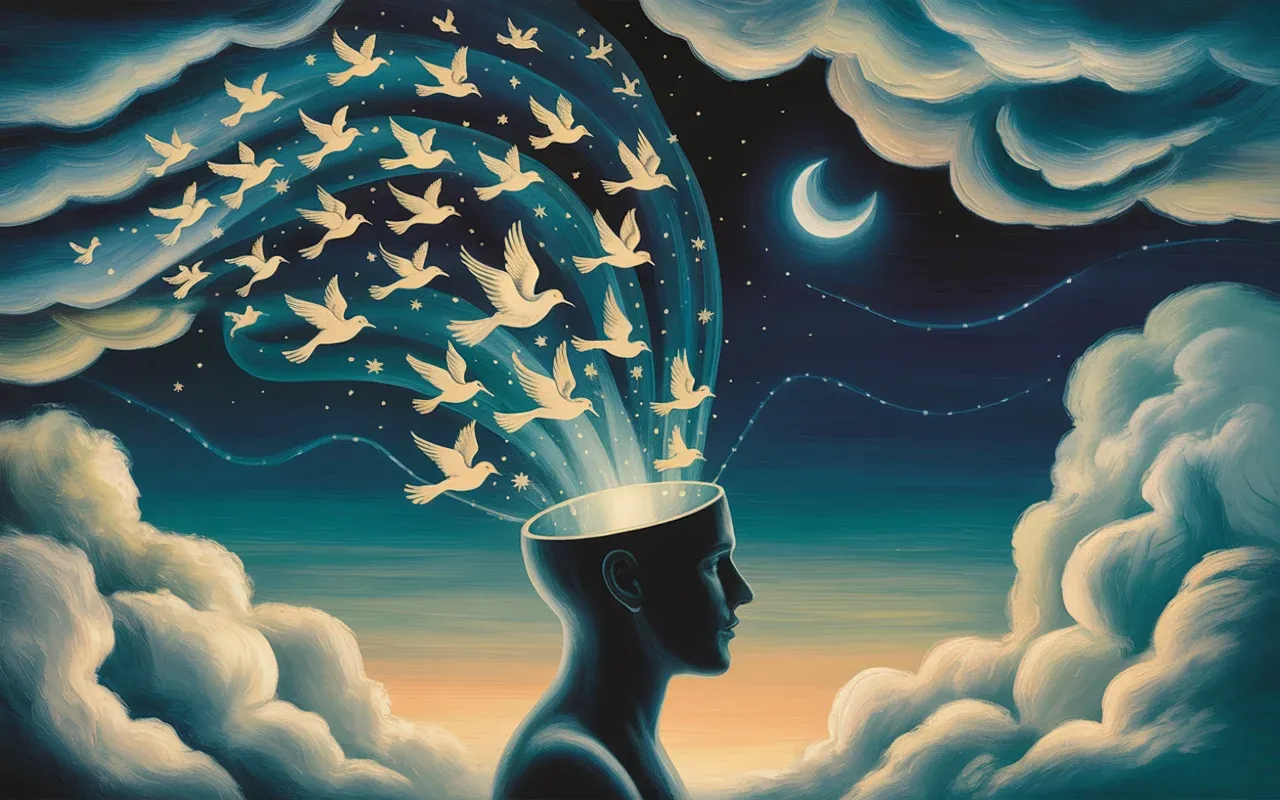
The pattern I keep seeing in reader accounts is that bird dreams cluster around moments of identity transition — career changes, relationship endings, moves to new cities. The subconscious uses flight to process what the waking mind hasn\'t yet resolved.
For another angle on how your psyche speaks through dreams, explore the spiritual meaning of flying in a dream.
What causes bird dreams to appear?
Several triggers reliably produce bird-related dreams:
- Life transitions: Career shifts, moving home, ending or starting relationships — the subconscious uses flight imagery to process major change.
- Stress and anxiety: When waking life feels suffocating, the dreaming mind reaches for open skies as a pressure valve.
- Spiritual seeking: People going through periods of prayer, meditation, or questioning their faith frequently report vivid bird dreams.
- Sensory memory: Hearing birdsong near your window as you sleep, or recently watching a nature documentary, can seed bird imagery into REM sleep.
- Unprocessed grief: In many cultures, birds carry the souls of the departed. Dreams of birds following a bereavement often carry a distinct emotional texture — comfort rather than fear.
What is the scientific explanation for dreaming about birds?
Neuroscience frames it differently, but the overlap with psychology is striking. During REM sleep, the motor cortex activates patterns associated with movement — including the sensation of flight. The brain then builds a narrative around this activation, and birds are a natural symbol for motion, ascent, and freedom.
Memory consolidation also plays a role: if you\'ve had meaningful encounters with birds recently, or spent time in nature, those experiences are likely being processed and filed during sleep. Sleep researcher Rosalind Cartwright\'s work on emotional memory suggests that charged experiences get replayed symbolically in dreams rather than literally — which is why your unconscious casts a bird instead of the actual event that triggered the emotion.
Sleep disruptions, particularly fragmented REM cycles, can make bird dreams feel more intense or alarming than they would otherwise be.
Watch: Birds in a Dream Explained
For a visual walk-through of the key symbols, watch this short from the Meaning In a Dream channel:
▶ Birds in a Dream — YouTube Short
How to use a bird dream for self-reflection
Rather than simply looking up a meaning, try using the dream as a prompt:
- Write it down immediately. Even fragments matter. The species, the color, the movement.
- Note your emotion on waking. Fear and wonder point in very different directions.
- Ask: where in my life do I feel caged right now? And: where am I already flying?
- Consider the bird\'s behavior. A bird that lands near you invites stillness; one that flies away may signal something you\'re letting go.
- Look for real-life parallels. Dream birds rarely require exotic interpretations — the answer is almost always already visible in waking life.
For a comprehensive reference on one of the most specific bird types, check out our white crow in a dream interpretation.
FAQ: Birds in Dreams
What does it mean when a bird flies into your house in a dream?
A bird entering your home in a dream often signals that a new idea, opportunity, or piece of news is about to arrive in your personal life. In some folk traditions it\'s an omen; psychologically it points to something external seeking entry into your private world.
What does it mean to dream of colorful birds?
Brightly colored birds — parrots, toucans, peacocks — typically represent creativity, self-expression, and joy. They can also signal a need to pay attention to something you\'ve been overlooking. The more vivid the color, the stronger the emotional signal.
Is dreaming of dead birds a bad sign?
Not necessarily. A dead bird in a dream more often represents the end of a phase — an old belief, relationship pattern, or aspiration that has run its course. It clears the way for something new rather than predicting literal loss.
What does it mean to dream of birds singing?
Birdsong in dreams is generally positive — a signal of incoming good news, emotional relief, or a period of creative productivity. Pay attention to how the song made you feel; joyful song suggests alignment, while an eerie or mournful call may point to something unresolved.
What does it mean to dream of birds attacking you?
Birds attacking you typically represent external pressures, criticism, or anxieties that feel overwhelming. It can also reflect an internal conflict — parts of yourself (symbolized by the birds) demanding to be acknowledged.
What does it mean to dream of a white bird?
White birds across most traditions carry meanings of purity, peace, and spiritual guidance. A white dove is the most classic example, but any white bird in a dream tends to signal clarity, protection, or a message from your higher self.
Why do I keep having recurring bird dreams?
Recurring bird dreams usually indicate an unresolved issue the subconscious keeps circling back to. The specific scenario that repeats is the key — ask yourself what in waking life matches the feeling of that dream.
What does it mean to hold a bird in your hands in a dream?
Holding a bird in your hands suggests you have — or could have — something precious and fragile within your grasp. It can represent a new opportunity, a fledgling idea, or a relationship that requires careful attention not to be lost.
Final Thoughts
Bird dreams are your subconscious communicating in one of its oldest languages. Whether you\'re dreaming of a solitary hawk circling overhead or a flock of starlings erupting from a field, the message is almost always about freedom, transition, and the gap between where you are and where part of you wants to go. The most useful question to ask yourself after a bird dream isn\'t "what does this symbol mean?" — it\'s "where in my life right now does this feeling of flight — or confinement — apply?" That\'s where the real interpretation lives.