Spiritual Meaning of Finding Yourself in a Maze with No Exit in a Dream


Quick answer: Dreaming of a maze with no exit signals that you feel trapped, stuck, or overwhelmed by a waking-life situation — a job, relationship, or decision that seems impossible to resolve. Your subconscious is processing that pressure, not predicting the future.
Few dreams hit quite as hard as the maze with no exit. I've heard this one from readers more times than I can count, and what strikes me is how vivid and physically real the walls feel — that creeping panic as every turn leads nowhere. It's one of the most emotionally loaded dream types the subconscious produces, and it almost always points to something concrete happening in your waking life right now.
What does a maze with no exit mean in a dream?
A maze without an exit is your mind's shorthand for any situation where you feel your options are closed off. The labyrinth walls represent constraints — social, emotional, or practical. The absence of an exit amplifies the sense that no path forward exists, even when one does. Psychologists link this imagery directly to decision paralysis and unresolved life stressors.
| Dream detail | What it tends to signal |
|---|---|
| Panicking and freezing | High anxiety about a situation you feel powerless to change |
| Calmly searching | Determination and problem-solving drive, even under pressure |
| Dark, menacing maze | Fear of failure or an intimidating real-world challenge |
| Bright, almost pleasant maze | A challenge you're ready for, or a growth opportunity in disguise |
| Being chased inside the maze | A deadline, conflict, or threat you're avoiding |
| Finding an exit | Resolution, breakthrough, or confidence returning |
What is the spiritual significance of the maze symbol?
Spiritually, the maze has been a sacred symbol for thousands of years — from Cretan labyrinths dedicated to transformation, to medieval cathedral floor mazes walked as prayer journeys. When it appears in dreams without an exit, many traditions read it as a test of patience and inner trust. The path exists; the dreamer simply hasn't found it yet. This is the maze as initiation: the route to clarity runs through the confusion, not around it.
Energy traditions sometimes associate this dream with blockages in the solar plexus chakra — the centre of personal will and direction — or the third eye, connected to intuition and clarity of vision.

How do psychology and dream science explain the maze dream?
From a Freudian angle, the closed maze maps onto psychological conflict — repressed material or unresolved tension that keeps cycling without release. From a Jungian perspective, the maze is the unconscious itself: full of shadow material, archetypes, and unlived potential. Getting lost in it is not a failure — it's the journey toward integrating hidden parts of yourself.
Neuroscience adds a practical layer. REM sleep is when the brain replays emotionally charged memories and attempts to problem-solve. If you're stuck on a real dilemma, the brain may literally use a maze as a visual metaphor for the decision tree it's running through. The "no exit" element often means the brain hasn't resolved it yet — which is why recurring maze dreams tend to fade once the underlying issue is addressed.
In my research on recurring dream patterns, I consistently see maze dreams peak during major life transitions: job changes, relationship endings, creative blocks. They're the brain's honest report card on your stress level.
What do different maze dream scenarios mean?
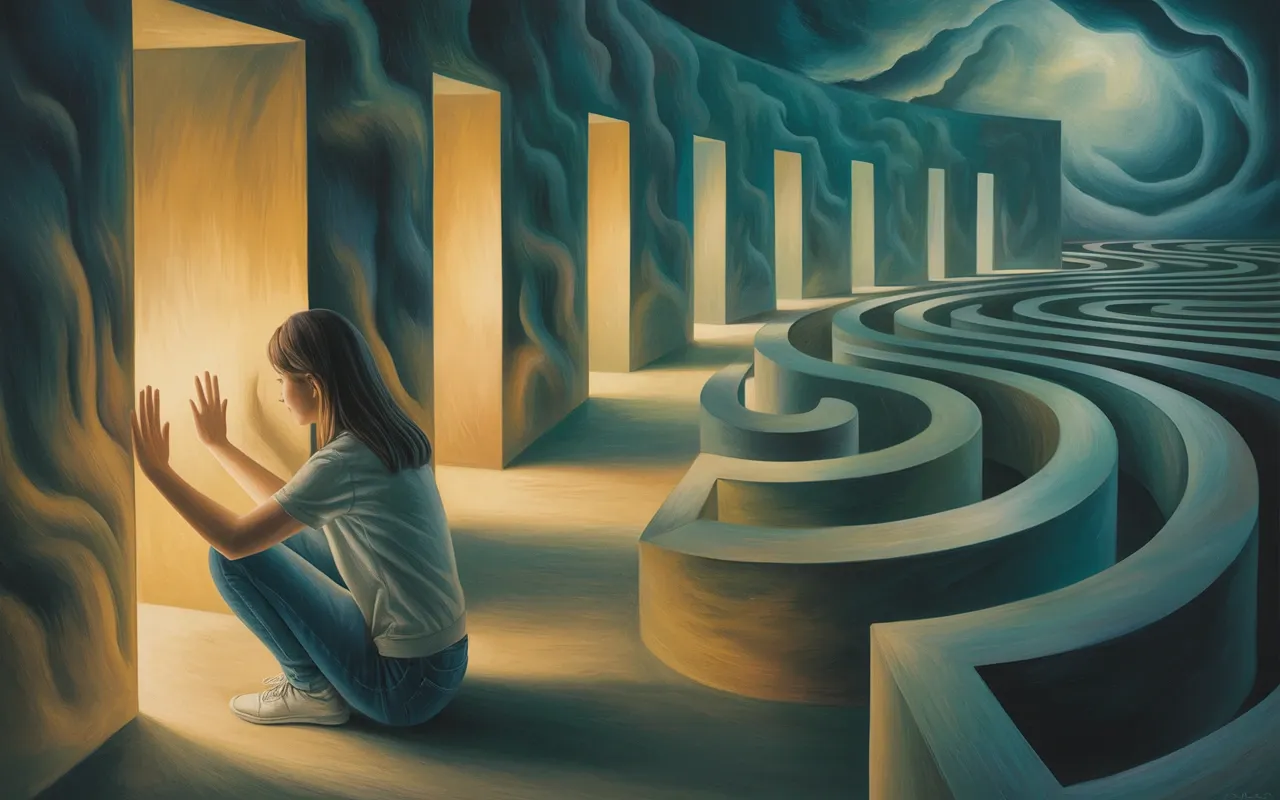
Being chased in the maze: A pursuer adds urgency. This usually maps onto a real deadline, a conflict you're avoiding, or a fear you haven't faced. The chase escalates the trapped feeling — you can't go forward and can't go back.
The maze keeps changing: Shifting walls suggest a situation in waking life that keeps evolving before you can get a grip on it. It can also point to the unsettling dream motif of things that keep changing, where the subconscious uses flux as a symbol of instability.
Finding a hidden exit: A positive sign. Something you overlooked — a conversation, a decision, a change in perspective — may be the way through. Pay attention to what or who opened the door in the dream.
Being in a maze-like house: Houses in dreams typically symbolise the self. A maze house means you feel confused about your own identity, values, or direction. This connects to the broader pattern explored in the dream of a house that keeps changing.
Observing the maze from above: You've gained perspective. This is often the sign of a shift in consciousness — moving from being overwhelmed by a problem to being able to see it clearly.
What causes maze dreams — what real-life triggers create them?
Research published in sleep and clinical psychology journals identifies three primary triggers for trapped/lost dream scenarios:
- Decision fatigue: Too many open decisions with no clear criteria for choosing
- External constraint: A situation (job, relationship, financial) that genuinely limits your options
- Avoidance: A problem you know exists but have been pushing out of conscious thought
Life events that frequently precede maze dreams: job loss or stagnation, relationship conflict, academic pressure, chronic stress, and major life crossroads. If you've recently been feeling "stuck" about anything, that's almost certainly what the maze is mapping.
How do you stop recurring maze dreams?
The pattern I keep seeing is that maze dreams stop when the underlying issue is named and acted on — not necessarily solved, but acknowledged. A few practical steps that help:
- Dream journaling: Write the maze down immediately on waking. Note your emotional state, who else was present, how you responded. Patterns emerge over 2–3 weeks.
- Waking-life audit: Ask honestly — where am I feeling trapped right now? Name it. Write it down. That cognitive act alone reduces the brain's need to keep running the dream simulation.
- Imagery rehearsal therapy (IRT): A CBT technique for recurrent nightmares. Rewrite the dream ending while awake (e.g., you find the exit, or the walls dissolve). Rehearse the new version for a few minutes before sleep. Clinical evidence supports this for reducing nightmare frequency.
- Mindfulness and sleep hygiene: Stressed brains produce more negative dream content. Basic interventions — consistent sleep schedule, reduced evening screen time, a wind-down routine — noticeably shift dream tone over weeks.
If maze dreams recur nightly and cause significant distress, a therapist specialising in CBT or dream-focused therapy is well worth consulting. There's nothing to be embarrassed about — this is your brain doing its job, just rather loudly.
For a related trapped sensation, the dream of being trapped in an elevator shares many of the same roots and is worth exploring if the maze dream resonates.
Frequently asked questions about maze dreams
What does it mean to dream of being lost in a maze?
Being lost in a maze signals feelings of confusion, indecision, or entrapment in a waking-life situation. Your brain is processing a problem it hasn't resolved yet — usually tied to a major decision, relationship, or constraint.
What does a maze represent spiritually?
Spiritually, the maze represents the journey through confusion toward clarity. Ancient traditions used labyrinth-walking as a meditative practice, trusting that following the path — even when you can't see the end — leads to transformation and self-knowledge.
Why do I keep having recurring maze dreams?
Recurring maze dreams typically signal an unresolved issue your mind keeps returning to. They often stop once you acknowledge and begin addressing the underlying problem — whether that's a career decision, a relationship conflict, or a suppressed fear.
What does it mean when you dream about not finding an exit?
No exit amplifies the sense of being trapped. It usually reflects a waking situation where you feel powerless or unable to see a way forward. This is the brain's way of flagging urgency — something needs your attention and honest action.
Is dreaming of a maze a bad sign?
Not necessarily. The maze reveals stress or confusion, but it also means your mind is actively engaged in problem-solving. Finding your way through — or eventually finding the exit — points toward resilience and forward movement.
What does it mean to dream of a maze-like house with endless rooms?
A maze house typically relates to the self. You may be feeling uncertain about your identity, values, or life direction. Each room can represent a different role, relationship, or aspect of yourself that feels disconnected from the others.
Can stress cause maze dreams?
Yes. Elevated cortisol and anxiety directly increase the frequency and intensity of stress-processing dreams, including those featuring being trapped or lost. Improving sleep quality and reducing active stressors tends to reduce these dreams over time.
What does it mean to dream of escaping a maze?
Escaping the maze is a positive sign — a breakthrough, resolution, or new perspective is arriving. It often follows a period of sustained effort on a difficult problem, or a decision you've finally made after prolonged indecision.
Does the appearance of the maze matter in the dream?
Yes. A dark, ominous maze intensifies fear-based interpretation — a serious challenge feels threatening. A lighter, more open maze suggests the problem feels more manageable. Geometric, orderly mazes can reflect analytical minds trying to impose logic on a messy situation.
The maze dream as a message worth reading
A maze with no exit is not a curse — it's a mirror. Your subconscious is working overtime on something real, something that matters. The dream won't stop until you engage with what it's pointing at. Start by naming the thing. Write it down. Then take one small step toward the exit — even if you can't see it yet. The walls don't have to come down all at once. You just need to move.
For further reading on how the brain uses symbols to process life challenges, the American Psychological Association's guide to dreams is a reliable starting point.