Spiritual Meaning of Seeing Mythical Creatures in a Dream: Insights

Waking up from a dream full of dragons, unicorns, or mermaids tends to stick with you. I've found that these dreams are among the most emotionally charged people describe — vivid, symbolic, and oddly hard to shake. They feel significant because, in many frameworks of dream analysis, they are.
Quick answer: Dreaming of mythical creatures typically signals something rising from your unconscious — unprocessed emotions, hidden strengths, or deep fears seeking attention. The specific creature matters: dragons relate to power and conflict, unicorns to hope and idealism, mermaids to emotional depth, and fairies to imagination and joy.
What Is the Spiritual Meaning of Seeing Mythical Creatures in a Dream?
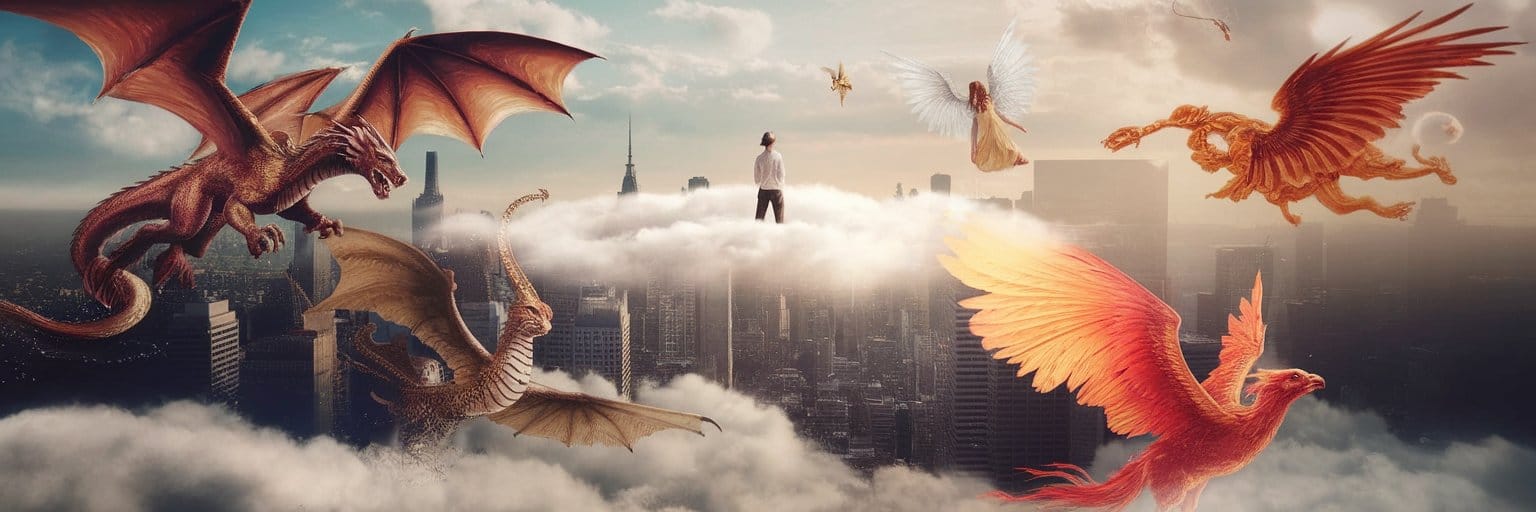
Spiritually, mythical creatures in dreams are guides — figures that appear when the unconscious has something it can't express through ordinary imagery. Dragons point to raw inner power or a conflict you're avoiding. Unicorns carry themes of hope, purity, and goals that feel just out of reach. Mermaids signal emotional undercurrents or a pull toward self-exploration. Each creature brings a distinct message tied to its mythological weight across cultures.
Across the dream accounts I've studied, people who encounter mythical creatures rarely describe neutral dreams — the emotional tone is almost always intense, whether awe, fear, joy, or longing. That intensity itself is a signal worth paying attention to.
What Does Each Mythical Creature Mean in a Dream?
| Creature | Core Symbolism | Key Dream Scenario |
|---|---|---|
| Dragon | Power, conflict, inner strength | Battling = internal struggle; riding = harnessing your own power |
| Unicorn | Hope, purity, idealism | Seeing one = longing for peace; unable to catch it = unattainable goal |
| Mermaid | Emotional depth, allure, self-discovery | Joyful encounter = creative flourishing; lured to depths = risky emotional path |
| Fairy | Imagination, wonder, wishes | Dancing with fairies = reconnecting with childlike joy or playfulness |
| Phoenix | Rebirth, transformation | Seeing it rise = major change or recovery after loss |
| Griffin | Courage, dual nature | Guarding something = protection of what you value most |
What Do Mythical Creatures Represent Psychologically?
The two dominant frameworks here give very different answers — and both are useful.
Freudian View
Freud read mythical creatures as displaced expressions of repressed desire. The monster, the seductive mermaid, the dominant dragon — all are stand-ins for drives the conscious mind won't acknowledge directly.
Jungian View
Carl Jung's model is more expansive. He saw mythical creatures as archetypes from the collective unconscious — inherited psychological patterns shared across all human cultures. In his framework, dreaming of a dragon isn't personal neurosis; it's contact with something ancient and universal. The creature asks you to integrate it — to own the shadow it represents rather than fear it.
In my research, the Jungian reading tends to resonate more with people who have recurring creature dreams. When the same dragon keeps showing up, it's rarely random — there's usually an unresolved conflict that matches the archetype.
What Mythological Creature Is Associated with Dreams Itself?
In Greek mythology, Oneiros (Ὄνειρος) is the personification of dreams. Homer's Iliad describes Zeus sending an Oneiros to Agamemnon — a dream figure that carries divine messages. The plural Oneiroi were said to pass through two gates: the gate of ivory (false dreams) and the gate of horn (true dreams). This distinction between deceptive and prophetic dreams is one of the oldest ideas in Western mythology.
Other traditions have their own dream guardians: the Iroquois concept of the dream soul, Slavic household spirits, and the Hindu Swapna-deva. Mythical creatures in dreams may tap directly into these ancient archetypes without you consciously knowing the mythology.
What Causes Dreams About Mythical Creatures?
Three recurring triggers show up consistently:
- Stress and transition: Major life changes — job shifts, relationship endings, moves — push the subconscious toward big symbolic imagery. Mythical creatures are the brain's way of dramatizing what's at stake.
- Creative immersion: Reading fantasy, playing RPGs, watching mythology-heavy films all seed the dreamscape. The brain synthesizes this material during REM sleep.
- Unprocessed emotion: Fear, grief, suppressed ambition — these find expression in vivid, archetypal form when waking life doesn't give them room.
What Does It Mean to Dream of Mythical Creatures in Christianity and Islam?
In Christian tradition, creatures like dragons are often associated with evil or spiritual opposition — Revelation 12 describes a great dragon as an adversary. Dreaming of one can prompt reflection on what forces or habits feel threatening to your faith or values. Angels and celestial beings, by contrast, are seen as divine messengers.
In Islamic dream interpretation (ta'bir al-ru'ya), strange or unknown creatures in dreams are generally analyzed by their behavior and the emotional state of the dreamer. A fearsome creature that doesn't harm you may indicate that a feared situation will resolve safely. Scholars like Ibn Sirin advised examining the context, not just the creature's identity.
How to Work with Mythical Creature Dreams
- Journal immediately: Write down the creature, your emotional state, any action taken. Patterns emerge over weeks, not days.
- Identify the creature's mythology: Look up the cultural background. Dragons in Chinese mythology are benevolent; in European mythology, often threatening. The tradition you grew up in shapes how your unconscious uses the symbol.
- Ask what it wanted: In the dream, was the creature helping, threatening, fleeing, or communicating? The relationship — not just the creature — holds the meaning.
- Try active imagination: Jung's technique of continuing a dream consciously while awake. Re-enter the scene in your mind and let the creature speak. What does it say?
If these dreams recur or feel distressing, a therapist familiar with Jungian methods can help you work through the symbolism without it feeling abstract.
Related Dream Interpretations
Mythical creatures often appear alongside other fantastical elements. If your dream featured beings from beyond ordinary reality, these posts connect to that territory:
- Spiritual meaning of seeing aliens in a dream — another category of non-human encounter with distinct symbolic weight
- Encountering unicorns and dragons specifically in a dream — a deeper look at these two creatures
- Seeing a demon in a dream — when the creature is explicitly threatening or malevolent
FAQ: Mythical Creatures in Dreams
What does it mean when you see monsters in your dreams?
Monsters in dreams typically represent the shadow self — the rejected or feared parts of your personality that your conscious mind suppresses. In Jungian psychology, they're archetypes from the collective unconscious (Jung, 1964). The monster isn't an enemy; it's asking to be acknowledged. How you respond to it in the dream — fight, flee, or engage — often mirrors how you handle difficult emotions in waking life.
What do mythical creatures represent symbolically?
Historically, mythical creatures emphasized the heroism of those who defeated them — they were obstacles that defined the hero. In modern psychological terms, they represent archetypal forces: power, fear, desire, transformation. The meaning shifts depending on the creature and the culture. A dragon in a European context often means threat; the same dragon in Chinese symbolism means fortune and wisdom.
What mythological creature is associated with dreams?
In Greek mythology, Oneiros (Ὄνειρος) is the personification of dreams. Homer's Iliad describes Zeus sending an Oneiros to Agamemnon as a divine messenger. The Oneiroi were said to enter through two gates — ivory for false dreams, horn for true ones. This is one of the oldest recorded frameworks for distinguishing meaningful dreams from random noise.
What is the spiritual meaning of mythical creatures in dreams in Christianity?
Christian symbolism treats mythical creatures contextually. Dragons often represent spiritual opposition or evil (per Revelation 12). Angels carry divine messages. Phoenix-like imagery can relate to resurrection themes. What matters is whether the creature feels like a threat or a messenger — and what action, if any, you take toward it in the dream.
What does seeing an unknown creature in a dream mean in Islam?
Islamic dream interpretation focuses on the creature's behavior and the dreamer's emotional state rather than the creature's appearance alone. According to the tradition of Ibn Sirin, an unknown creature that doesn't harm you may indicate that a feared outcome won't materialize. One that attacks can signal a real adversary or internal conflict requiring attention. Context and prayer for clarity are both recommended.
What does dreaming of fairies mean spiritually?
Fairies in dreams are associated with imagination, childlike wonder, and the hidden magic of ordinary life. Spiritually, they can signal that you've disconnected from joy or playfulness — or that a wish you've set aside is still alive. Dancing with fairies is widely read as a positive sign: creative energy is accessible and worth following.
What animal or creature represents nightmares?
The Mare — a spirit from Germanic folklore — gave nightmares their name. It was said to sit on sleepers' chests and cause terrifying dreams. Across other traditions: the Baku in Japanese mythology is a dream-eater that consumes nightmares. The Nuckelavee in Orkney folklore and the Alp in German tradition also map onto nightmare experiences. These creatures represent the unconscious processing of fear, not actual supernatural visits.
Why do mythical creature dreams feel so vivid and real?
REM sleep — when most vivid dreams occur — involves heightened neural activity nearly identical to waking states. The brain synthesizes memory, emotion, and creative cognition into narrative. Mythical creatures are emotionally charged symbols, so when they appear, the amygdala (your emotional processing center) fires strongly, making the experience feel significant and memorable. It's not a glitch; it's the brain treating the symbol as important.
The Pattern That Keeps Appearing
What stands out to me is how consistent the emotional signature is across reports of mythical creature dreams: they don't feel random. They feel like a message. Whether you read that through a Jungian lens, a spiritual one, or a neuroscientific framework, the practical response is the same — pay attention, write it down, and ask what the creature wanted from you. Start with your dream journal tonight: note the creature, your emotion, and any action you took. That's usually where the real meaning lives.