Witnessing Your Own Funeral in a Dream: Deciphering Elegies of the Self

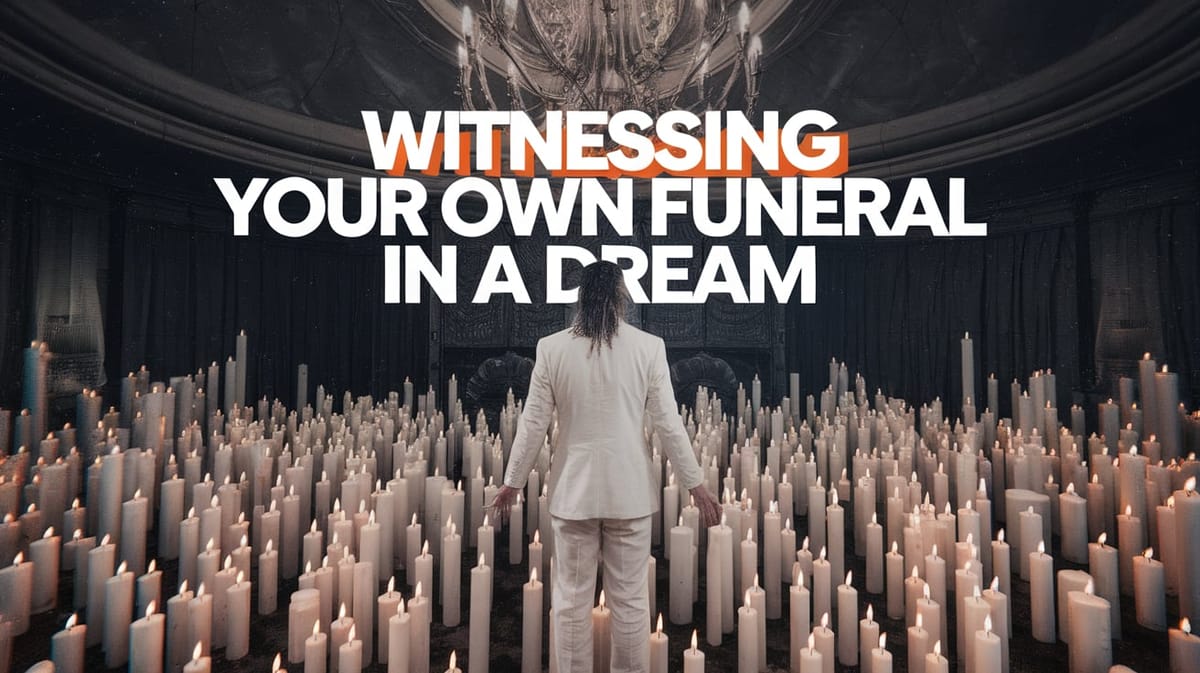
Dreaming about your own funeral is one of the most jarring experiences the sleeping mind can produce. You watch the ceremony unfold — the casket, the mourners, the rituals — and you are simultaneously the subject and the observer. In my research into recurring dream archetypes, this is the one people feel most reluctant to talk about, yet it consistently carries some of the richest symbolic meaning.
Quick answer: Witnessing your own funeral in a dream almost never predicts death. It typically signals the end of a life phase, the shedding of an old identity, or the subconscious processing of major personal change. The dream invites self-reflection, not fear.
What Does It Mean Spiritually to Witness Your Own Funeral in a Dream?
Across spiritual traditions, death in a dream is rarely taken literally — it is read as symbolic transition. Witnessing your own funeral brings that symbolism into sharp focus: you are not just dying in the dream; you are watching yourself die, which adds a layer of conscious witnessing to the transformation.
In many traditions, the observer self that watches the funeral is the higher self — the part of you that transcends any single life phase. Your spirit is acknowledging that something is ending, blessing it, and preparing for what comes next. The pattern I keep seeing across the accounts people share with me is that this dream tends to arrive at genuine turning points: a career shift, the end of a long relationship, a move that severs ties with an old identity.
Islamic dream interpretation treats death in a dream as a sign of repentance or spiritual awakening rather than physical death. Biblical tradition similarly reads "dying to self" as a prerequisite for renewal. In both frameworks, your own funeral dream carries the weight of a sacred transition, not a curse.
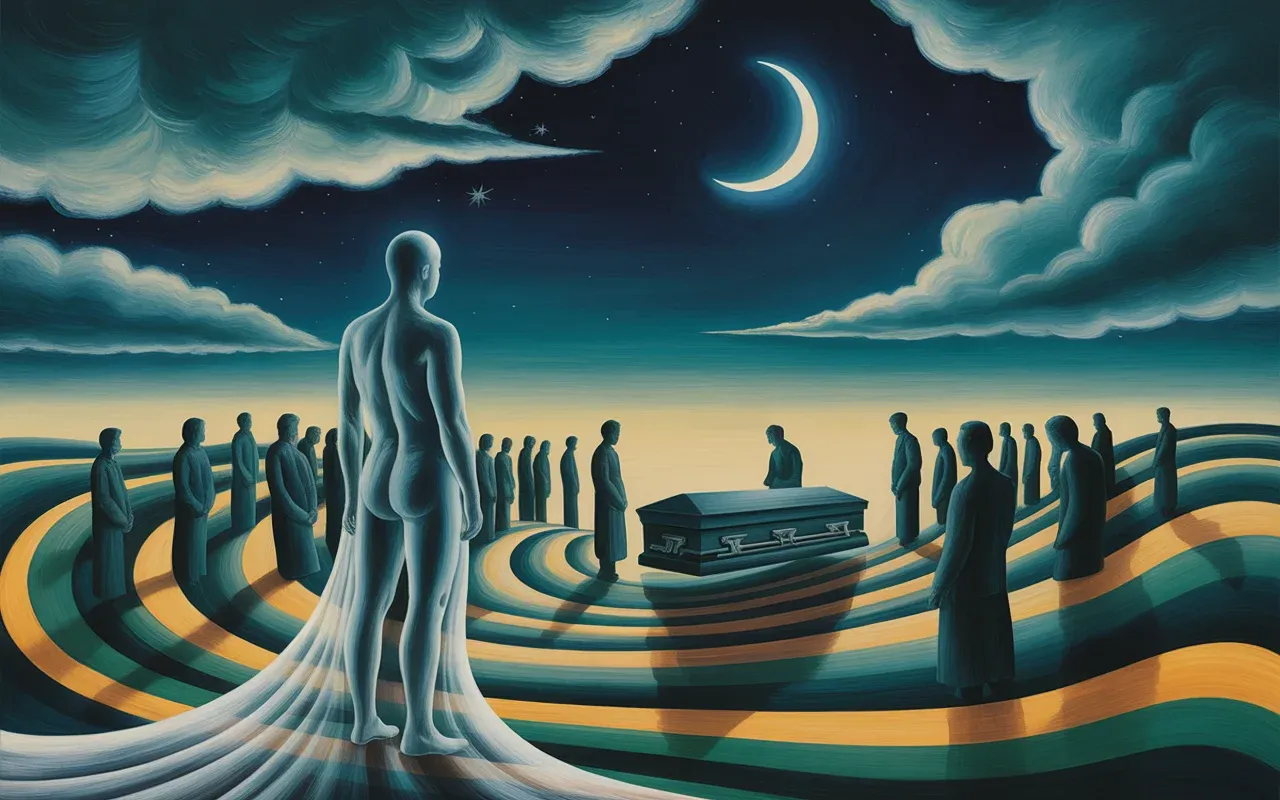
What Do Different Funeral Dream Scenarios Actually Mean?
The details inside the dream shift its meaning considerably. Here is how the most common variations break down:
\n\n| Scenario | Core meaning |
|---|---|
| Seeing yourself in the casket | Feeling trapped or constrained; readiness to shed a limiting role |
| Watching your own cremation | Purging what no longer serves you; total transformation |
| Being happy or peaceful | Acceptance of change; positive attitude toward transition |
| Feeling fearful or anxious | Resistance to an unavoidable change; grief over what is ending |
| No mourners present | Loneliness; fear of being forgotten; self-reliance in transition |
| Specific people absent | Questions about who will support you through a major change |
| A religious or spiritual figure present | Seeking higher guidance; spiritual dimension to the transition |
| Arranging your own funeral | Active preparation for change; conscious readiness for a new phase |
| Third-person perspective | Emotional detachment; need for objective self-assessment |
What Does Psychology Say About Dreaming of Your Own Funeral?
Psychologically, this dream is less about death and more about identity. The funeral is a social ritual that marks the formal end of a person's presence in the world. When you dream of your own, your psyche is staging a formal acknowledgment that something about who you are — a role, a relationship, a belief system — is coming to an end.
Freud would likely interpret the dream as an expression of repressed mortality anxiety, or of unconscious wishes around escape from a burdensome life situation. The funeral offers a kind of release fantasy: what would it be like to leave it all behind?
Jung's framework is often more useful here. For Jung, the death of the ego-self in a dream is a prerequisite for individuation — the process of becoming more fully yourself. Witnessing your own funeral means your unconscious mind is staging the death of the persona (the social mask you wear) so that the deeper self can emerge. Research on dream function from the American Psychological Association supports the idea that emotionally significant dreams help the brain process identity-level changes during sleep.
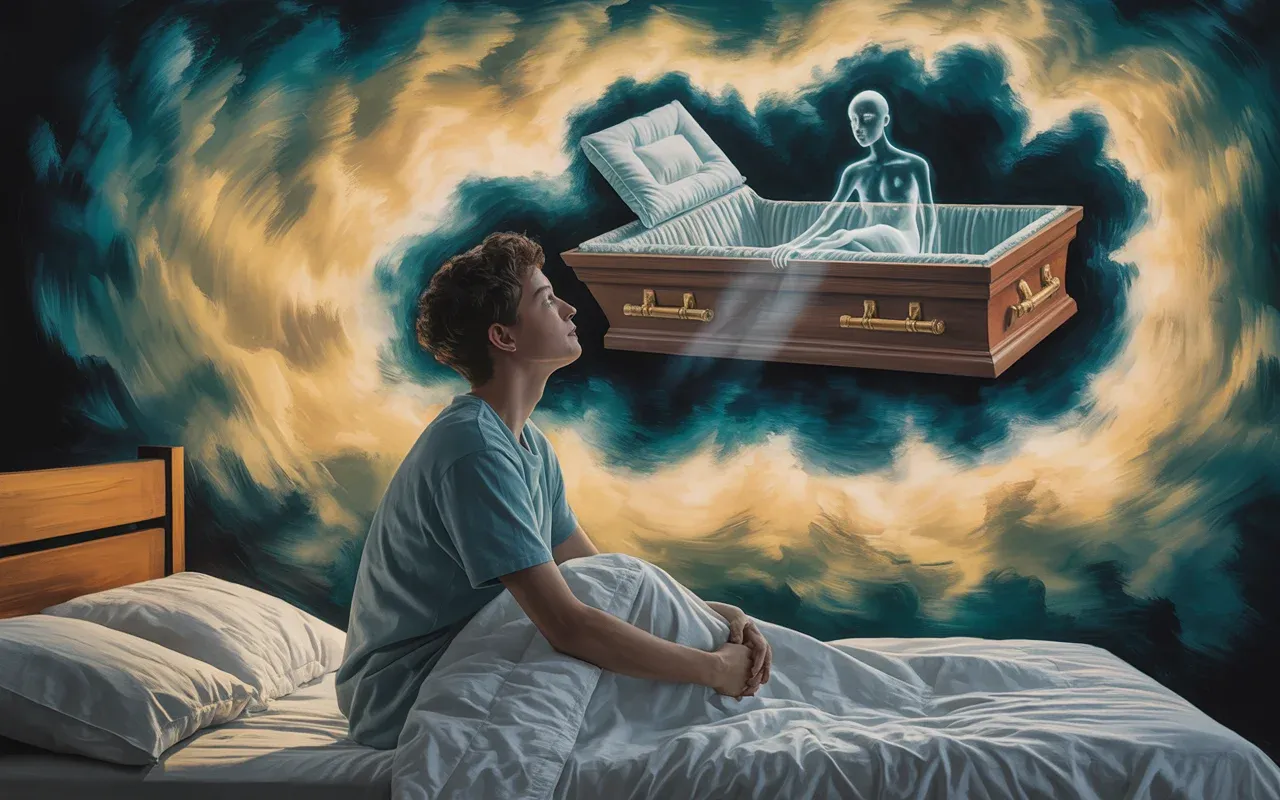
What Causes This Dream? Common Triggers
The dream does not appear randomly. It surfaces when waking life contains the raw material for it:
- Major life transitions — job changes, retirement, divorce, relocation, the end of a long project
- Identity shifts — becoming a parent, leaving a religion, recovering from addiction
- Grief and loss — processing the death of a loved one can cause the brain to rehearse mortality symbolically
- Midlife reflection — periods of stocktaking naturally produce death-and-renewal imagery
- Suppressed feelings — emotions that have not been processed consciously will surface in dream form
This connects to similar dreams about seeing yourself age rapidly in a dream, which also arrives during periods of accelerated personal change, and being unable to run when in danger, which shares the theme of feeling stuck during transition.
What Does Science Say About Why We Dream of Our Own Death?
Neuroscience does not assign fixed meanings to specific dream content, but it does explain why emotionally charged themes like funerals appear in dreams at all. During REM sleep, the brain's default mode network — which handles self-referential thinking — is highly active. This is why dreams so often center on "you" and your place in your social world.
The amygdala, which processes fear and emotional memory, is also active during REM. When a person is going through significant change, the brain uses dream states to rehearse emotional responses and consolidate new self-models. A funeral is, neurologically speaking, an emotionally rich rehearsal for a major identity shift.
How to Stop — or Work With — Distressing Funeral Dreams
If the dream is causing distress, a few approaches help:
- Keep a dream journal — record the dream immediately on waking, noting emotions and current life events. Patterns become clear within a few weeks.
- Ask what is ending — rather than avoiding the dream's message, sit with the question: what phase of my life is ready to close?
- Reframe the symbol — remind yourself that funerals in dreams signal rebirth. The ceremony is an ending, but every ending creates space for what follows.
- Address waking anxiety — stress management, regular sleep, and reduced screen time before bed all reduce nightmare frequency.
- Seek support if needed — if the dreams are frequent and interfering with sleep, a therapist familiar with recurring dream patterns can help.
Video: Understanding Funeral Dreams
If you prefer to explore this topic in video format, I discuss the symbolism of funeral dreams and what they reveal about your waking life over on the MeaningInADream YouTube channel:
Summary: What Your Funeral Dream Is Really Telling You
Dreams of witnessing your own funeral are the psyche's way of staging a formal goodbye to an outgrown version of yourself. They are uncomfortable precisely because they carry real weight — something is genuinely changing, and part of you knows it. Rather than pushing the imagery away, I find that the people who make the most of these dreams are the ones who ask: what do I need to release to move forward? The funeral in your dream is not an ending — it is an invitation.
For further reading on related dream themes, the spiritual meaning of aging rapidly in a dream explores how the subconscious processes time and mortality in symbolic form.
Frequently Asked Questions
Does dreaming of my own funeral predict my death?
No. Dreams work in symbols, not literal forecasts. Dreaming of your own funeral represents personal transformation, the end of a life phase, or major identity change — not physical death or bad luck. Cultures worldwide interpret death in dreams as a symbol of renewal.
What does it mean when you dream about witnessing a funeral?
Witnessing a funeral — your own or someone else's — typically signals that something in your waking life is ending. It may represent the close of a relationship, a career chapter, or a belief you have outgrown. The witnessing aspect suggests your conscious mind is ready to acknowledge the ending.
What does it mean when you dream about your own funeral in Islam?
In Islamic dream interpretation, dreaming of one's own death or funeral is generally read as a sign of repentance, spiritual awakening, or the need to turn back toward faith. It is not considered an omen of literal death, but a call to examine one's spiritual life.
What does it mean to dream about your own funeral from a biblical perspective?
Biblically, death and resurrection are central metaphors for spiritual transformation. Dreaming of your own funeral may reflect the concept of "dying to self" — shedding ego, pride, or sinful patterns — to be reborn in faith. It is widely interpreted as a spiritually positive sign of inner renewal.
What does it mean to dream you are at your own funeral and no one shows up?
An empty funeral often surfaces feelings of isolation, invisibility, or fear that your struggles go unrecognized. It may also reflect a sense of self-sufficiency — that you handle transitions alone. In either case, it is worth asking who you feel unsupported by in waking life.
Why would I keep having recurring dreams about my own funeral?
Recurring funeral dreams suggest a change that your subconscious has been processing for some time — one that has not yet resolved in waking life. Something is asking for your conscious attention: a relationship, a job, a self-image, or an emotional pattern that needs to be formally acknowledged and released.
What does it mean if I feel happy at my own funeral in a dream?
Feeling peaceful or happy at your own dream funeral is actually a positive sign. It reflects acceptance of change and readiness to move forward. You are not resisting the transition — you are welcoming it. This is one of the most constructive emotional responses this dream can carry.
What does it mean to dream of arranging your own funeral?
Arranging your own funeral in a dream indicates active preparation for change. Rather than being a passive observer of transition, you are consciously organizing it. This often appears when someone is deliberately making a major life decision — ending a relationship, changing careers, or leaving a community.