
Out-of-Body Experiences in Dreams: Unlock the Mystery

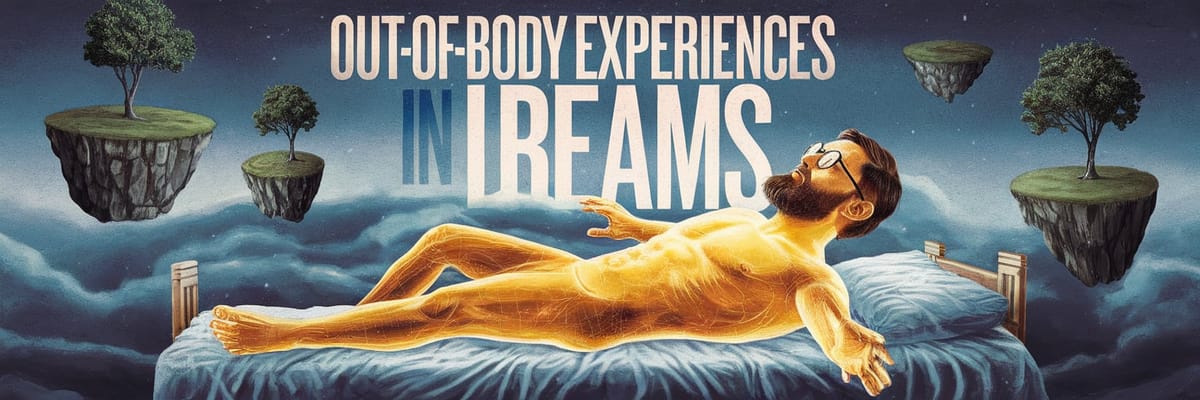
You\'re asleep — and then suddenly you\'re watching yourself sleep. The perspective shifts. You\'re above your body, or drifting through a wall, or hovering in a corner of your own bedroom. It doesn\'t feel like an ordinary dream. It feels real. That\'s an out-of-body experience (OBE) in a dream, and it leaves most people shaken, fascinated, or both.
Quick answer: An out-of-body experience in a dream is when your perspective shifts outside your physical body — floating, flying, or watching yourself from above. Psychologically, OBEs signal heightened self-awareness or stress. Spiritually, they\'re linked to soul consciousness and the boundary between the physical and non-physical self.
I\'ve studied hundreds of OBE dream accounts, and one thing stands out: people who have these experiences almost never dismiss them as "just a dream." The sensation of watching yourself from outside carries a weight that ordinary dreams don\'t. In my research, OBEs cluster around periods of major life change, physical illness, or emotional pressure — the mind seeking distance from something it can\'t face head-on.

What exactly is an out-of-body experience in a dream?
An OBE is when your dreaming perspective detaches from your body — you observe yourself from the outside rather than experiencing the dream from within. According to Wikipedia\'s overview of OBEs, the phenomenon involves perceiving the world from a location outside one\'s physical body. In dreams, this can look like floating above your sleeping form, gliding through your home, or watching yourself from across the room.
OBEs in dreams overlap with lucid dreaming — both involve heightened awareness during sleep — but they\'re not identical. In a lucid dream, you know you\'re dreaming and can control the experience. In an OBE, the defining feature is the external viewpoint: you\'re watching, not just knowing.
What does an out-of-body experience mean spiritually?
Spiritually, OBEs are interpreted as the soul demonstrating its independence from the physical body. Many traditions treat them as evidence of consciousness continuing beyond death. Ancient Egyptian texts, Tibetan Buddhist teachings, and Hindu scriptures all describe a "subtle body" that can travel during sleep. The experience isn\'t a malfunction — it\'s the soul moving freely.
The most common spiritual readings:
\n\n| OBE Scenario | Spiritual Interpretation |
|---|---|
| Floating gently above your body | Peace-seeking; desire for spiritual detachment from daily burdens |
| Sudden, jarring separation | Unresolved anxiety; a part of you is fleeing a threatening situation |
| Flying over familiar places | Need for wider perspective; you\'re too close to a current problem |
| Fear or disorientation during OBE | Loss-of-control fear; internal conflict demanding resolution |
| Euphoric, expansive feeling | Alignment with your authentic path; a confirmation signal |
| Watching yourself in danger | Protective dissociation; emotional self-observation mode |

What do psychologists say about OBEs in dreams?
The psychological angle is less mystical but no less interesting. Freud would likely read an OBE as escape from an overwhelming emotional situation — the dreaming mind creating literal distance from a problem the waking mind won\'t face. Jung\'s view goes deeper: the OBE is an encounter with the self as archetype, an opportunity to observe your own psyche from the outside with unusual clarity.
The pattern I keep seeing in dream reports is that OBEs spike during transitions: new relationships, job loss, moving cities, serious illness. The mind creates an observer position when normal first-person processing feels insufficient.
Related experiences worth understanding: if your OBE dream also involves being unable to move, you may be brushing against sleep paralysis — a physiologically distinct but emotionally similar phenomenon. And if your dream involved awareness within a dream nested inside another dream, compare it with what happens in a dream within a dream.
What does neuroscience say about OBEs during sleep?
Research pins OBEs partly to the temporoparietal junction (TPJ) — the brain region that integrates sensory information to produce your sense of "where I am in space." When TPJ activity is disrupted, as can happen during REM sleep transitions, the brain loses its grip on first-person perspective. The result is the floating, watching-yourself sensation.
A 2024 review in Neuroscience & Biobehavioral Reviews found OBEs are more frequent during vivid, emotionally charged dreaming in REM sleep. Sleep deprivation, fever, and high stress all increase TPJ disruption — which explains why OBE dreams cluster around stressful periods.

OBE vs. lucid dreaming vs. astral projection — what\'s the difference?
Three terms that people use interchangeably but mean different things:
\n\n| Experience | Defining Feature | Consciousness Level |
|---|---|---|
| OBE in dream | External viewpoint — watching yourself | Dreaming (may or may not be lucid) |
| Lucid dream | Awareness that you\'re dreaming | Dreaming + metacognition active |
| Astral projection | Intentional soul travel to other locations | Spiritual framework; induced deliberately |
| Sleep paralysis | Conscious but unable to move body | Between waking and sleep |
Astral projection is the spiritual reframing of OBEs — the same sensation, interpreted as intentional soul travel rather than a neurological event. Whether you prefer the scientific or spiritual explanation, the experience itself is real.
What triggers out-of-body experience dreams?
Common triggers I\'ve found across dream reports:
- Chronic stress or anxiety — the psyche seeks a literal "outside view" of overwhelming situations
- Major life transitions — job loss, relationship ending, relocation, bereavement
- Sleep disturbances — irregular sleep, insomnia, or oversleeping increase REM intensity
- Illness or physical vulnerability — the body\'s fragility becomes a conscious concern
- Suppressed emotional conflicts — issues the waking mind avoids surface in displaced, observer-mode dreams
How should you respond to recurring OBE dreams?
Three practical steps that actually help:
- Keep a dream journal. Write the OBE down immediately on waking — timing, emotional tone, location, what you saw. Patterns across multiple entries reveal the underlying trigger faster than any single analysis.
- Map it to your waking life. Ask: what situation right now do I feel detached from? Where do I want a "higher view"? OBEs are frequently the mind\'s way of showing you something you\'re too close to see clearly.
- Work on sleep quality first. Consistent sleep schedule, dark room, no screens 45 minutes before bed. Many OBE episodes reduce when sleep architecture stabilizes.
If OBE dreams are distressing or recurring nightly, a therapist who works with somatic or dissociative symptoms can help trace the underlying emotional driver.
How do different traditions interpret OBEs in dreams?
OBE dream experiences appear in nearly every major spiritual tradition, usually as evidence of the soul\'s independence:
- Christianity: Soul-leaving experiences are treated cautiously — some traditions see them as spiritual gifts, others as requiring discernment. The soul leaving the body during sleep appears in accounts of mystical prayer.
- Islam: The ruh (soul) is understood to leave the body during sleep and return at waking. OBE dreams may be read as the soul\'s journey during this nightly departure.
- Hinduism: The sukshma sharira (subtle body) travels during deep sleep. OBEs are consistent with this framework and treated as normal spiritual phenomena.
- Tibetan Buddhism: The bardos (transitional states) include a state similar to OBEs. Practitioners are taught to recognize the "dream body" as distinct from the physical.
Also worth reading: seeing your body separate from your consciousness in a dream explores the dual-perspective experience in more depth.
FAQ: Out-of-Body Experience Dreams
Can you have an out-of-body experience in a dream?
Yes. OBEs are reported during vivid, emotionally intense dreams — particularly REM sleep. Research in the journal Neuroscience & Biobehavioral Reviews (2024) found OBEs cluster around emotionally charged REM phases. The experience involves perceiving yourself from outside your body while asleep.
What does "out-of-body experience" mean spiritually?
Spiritually, OBEs are interpreted as the soul or consciousness temporarily separating from the physical form. Many traditions see this as proof of the soul\'s existence independent of the body. Some researchers at UVA Health have also noted that OBEs may function as a psychological coping mechanism triggered by overwhelming stress.
What is the spiritual meaning of an out-of-body experience?
Astral projection frameworks interpret OBEs as intentional soul travel to other planes of existence. More broadly, spiritual interpretations treat OBEs as a sign that your consciousness is seeking freedom, broader perspective, or escape from a confining situation in waking life.
What does it mean if you have an out-of-body experience in your sleep?
Neuroscience points to the temporoparietal junction (TPJ) — the brain area that constructs your sense of where you are in space. Disruptions to TPJ activity during sleep, especially under stress, produce the floating-outside-yourself sensation. Emotionally, it often signals that your mind is creating distance from something overwhelming.
Out of body experience while sleeping — is it dangerous?
No. OBE dreams are not harmful. They\'re a recognized category of unusual dream experience, not a medical symptom. If they\'re consistently distressing or you can\'t distinguish them from waking reality, speaking with a sleep specialist is worthwhile — but the experiences themselves cause no physical harm.
How is an OBE different from lucid dreaming?
In a lucid dream, you know you\'re dreaming and can influence events. In an OBE, the defining feature is the external viewpoint — you watch yourself rather than inhabiting your own perspective. OBEs can happen inside lucid dreams, but not all OBEs are lucid, and not all lucid dreams involve the external viewpoint.
Is an out-of-body experience the same as astral projection?
Astral projection is the deliberate, spiritually-framed version of an OBE. The sensory experience is similar; the difference is intention and interpretation. OBEs happen spontaneously during sleep or stress. Astral projection is a practice some people cultivate deliberately using meditation or hypnagogic states.
How do I stop out-of-body experience dreams?
The most effective approach is improving overall sleep quality: consistent sleep/wake times, reduced screen use before bed, and stress reduction practices like journaling before sleep. Recurring OBE dreams usually have an emotional trigger — identifying and addressing that trigger (sometimes with a therapist) is more effective than trying to suppress the dream itself.
What does dreaming of your soul leaving your body mean?
It\'s a variant of the OBE experience with explicit spiritual framing. In many traditions this is seen as the soul\'s natural nightly journey. Psychologically, it often indicates a desire to step back from your current life circumstances and observe them with detachment — the psyche\'s way of creating emotional distance from a situation that feels too close.
What your OBE dream is actually telling you
Out-of-body experience dreams aren\'t random noise. They\'re the mind choosing an observer position — building distance between you and something in your waking life that feels too close, too intense, or too unresolved. The spiritual traditions that treat OBEs as soul travel and the neuroscience that traces them to TPJ disruption aren\'t as contradictory as they look: both are describing the same experience from different angles. If you\'re having frequent OBEs, start a dream journal tonight and note the emotional context. Within two weeks, the pattern usually becomes clear.