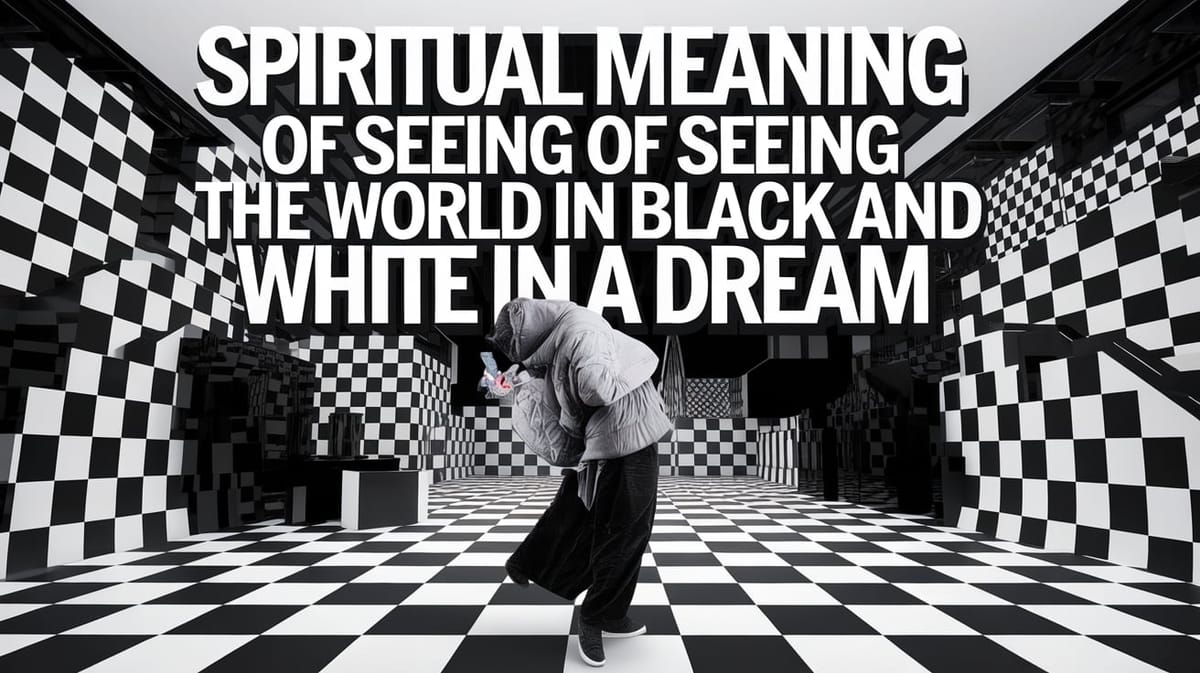
Spiritual Meaning of Seeing the World in Black and White in a Dream

Quick answer: Dreaming in black and white often signals that you\'re processing life through an all-or-nothing lens. It can point to suppressed emotions, a craving for clarity, or a subconscious nudge to look beyond rigid either/or thinking and find the gray areas you\'ve been ignoring.
What Does It Mean to Dream in Black and White?
Most people dream in color, so when the world goes monochrome in your sleep, your mind is flagging something. I\'ve found that black-and-white dreams usually show up during periods of emotional numbness, forced decision-making, or when someone is stuck in binary thinking — right vs. wrong, yes vs. no, with no room for anything in between.
White tends to represent clarity, purity, and conscious awareness. Black points toward the unknown, the unconscious, and the parts of yourself you haven\'t fully examined. When they appear together without any other hue, the dream is often asking: where have you lost your color?
What Is the Spiritual Meaning of Seeing the World in Black and White in a Dream?
Spiritually, a black-and-white dreamscape strips away distraction. Many traditions read it as a call to discernment — your higher self asking you to see past surface appearances and find the essential truth underneath. In my research, people who report these dreams are frequently at a spiritual crossroads, weighing two paths or belief systems.
In Christianity, black and white often mirror the concepts of light and darkness, good and evil, truth and deception. Biblical dream interpretation treats the absence of color as a sign to seek God\'s guidance in a situation where moral clarity feels lost. Hindu dream traditions may connect monochrome visions to the interplay of sattva (purity/light) and tamas (darkness/inertia), pointing toward the need for spiritual balance.
Why Does Your Brain Dream in Black and White? The Psychology
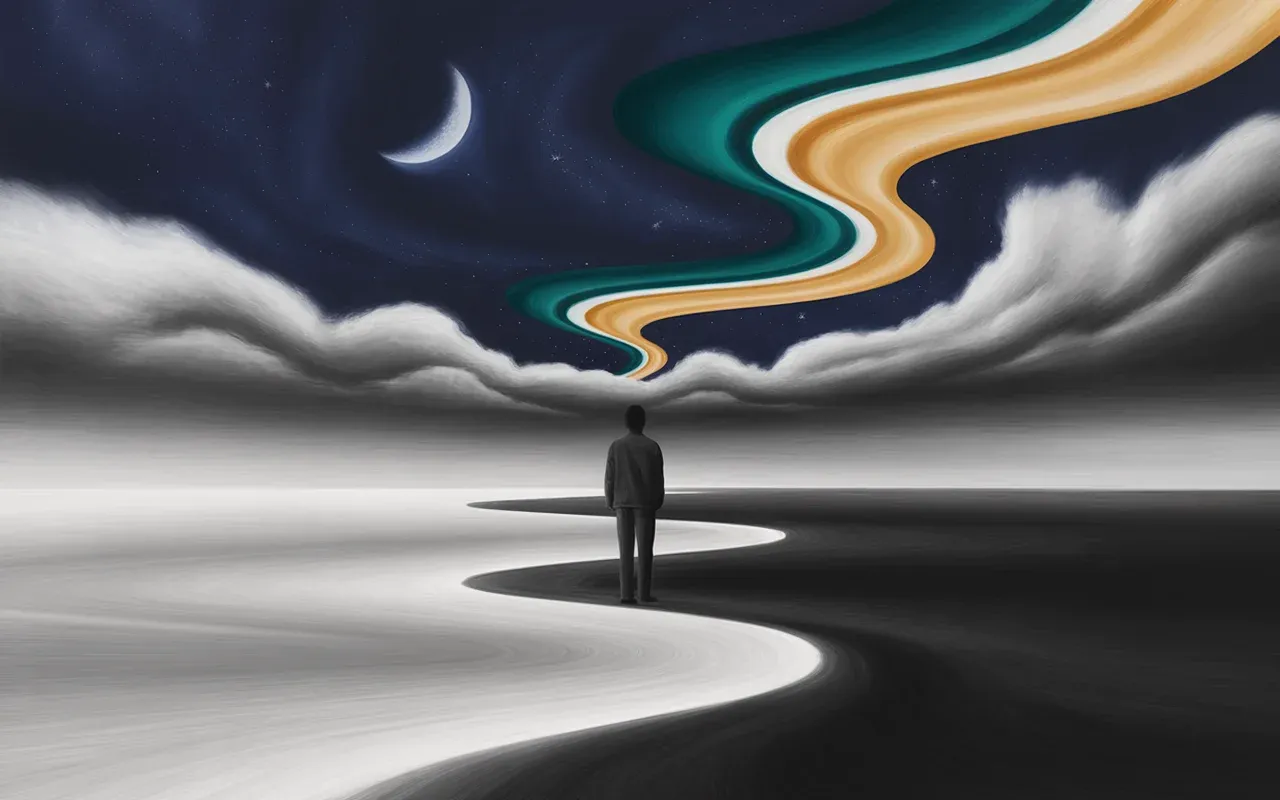
Freud would read a colorless dream as a sign of emotional repression — feelings pushed so far down they\'ve literally lost their hue. Jung\'s take is more layered: the black-and-white split mirrors the tension between your conscious self (light) and your shadow (dark). The pattern I keep seeing in dreamers who report monochrome dreams is a rigid thinking style that leaves little room for ambiguity.
Research from the University of Dundee found that people who grew up watching black-and-white television are more likely to dream in grayscale, suggesting that early visual experience shapes dream color. For everyone else, the shift to monochrome often tracks with emotional states — stress, detachment, or a sense of going through the motions.
\n
| Dream Element | Freudian Reading | Jungian Reading |
|---|---|---|
| All white scene | Desire for innocence or escape | Overidentification with persona |
| All black scene | Repressed fears or grief | Confronting the shadow self |
| Mixed black & white | Internal conflict between desires | Integration of opposites needed |
| Color breaking through | Repressed emotion surfacing | Individuation in progress |
\n
What Do Different Black and White Dream Scenarios Mean?
Context changes everything. Feeling calm in a monochrome world usually means you\'re at peace with simplicity — you\'ve cut through noise and are comfortable with the basics. Feeling anxious or trapped, on the other hand, points to a fear that life has become flat, drained of passion or meaning.
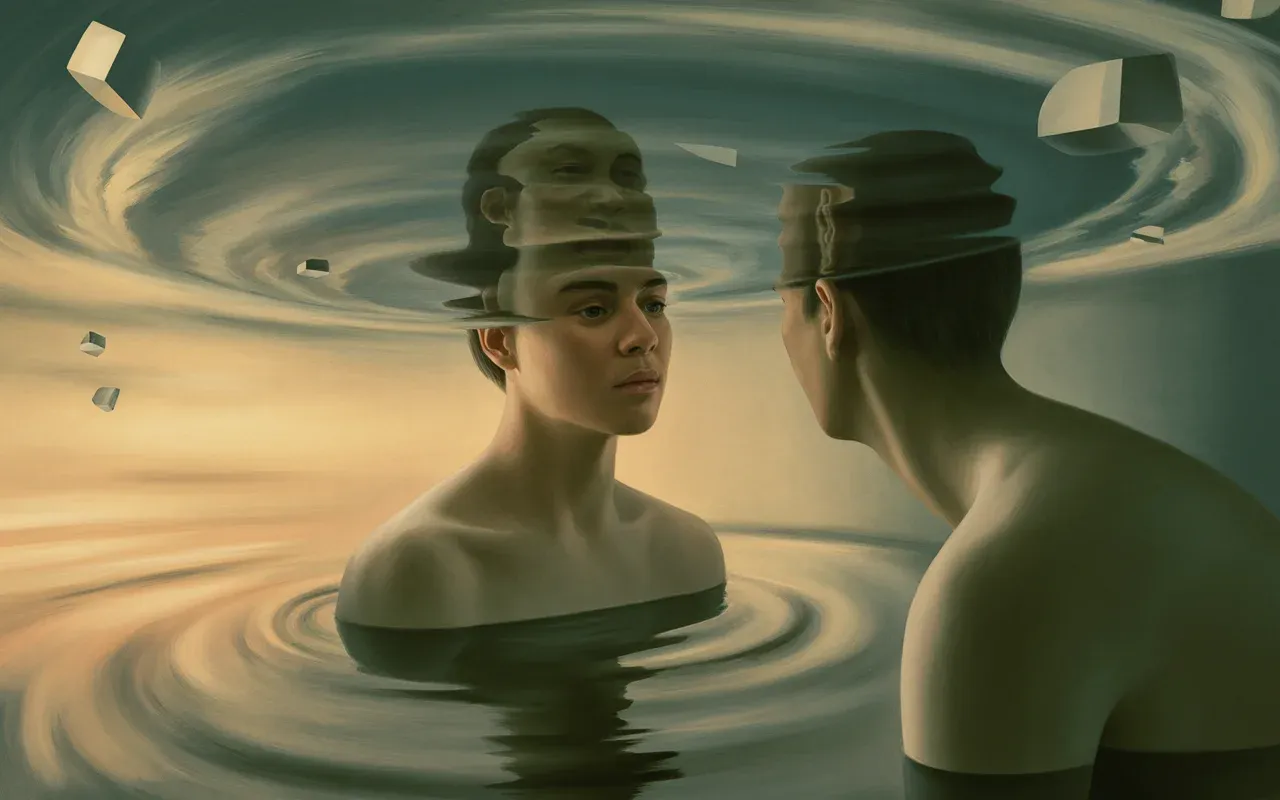
A familiar place appearing in black and white — Your feelings about that place have shifted. Nostalgia, grief, or emotional distance from what that location once meant to you.
People you know appearing colorless — You may feel emotionally disconnected from those people, or you\'re seeing them through a simplified, perhaps unfair, lens.
Color slowly returning during the dream — One of the most hopeful versions. It suggests emotional healing, a shift in perspective, or the beginning of a more open-minded phase.
You\'re in color but the world is black and white — You feel like the odd one out. Everyone else seems stuck in rigid patterns while you see things differently.
What Triggers Black and White Dreams?
Several real-world situations tend to produce these dreams:
- Emotional suppression — Bottling up feelings long enough that your dream world reflects the flatness
- Major decisions — Facing a binary choice where you feel forced into one of two options
- Grief or loss — The world literally losing its color mirrors how loss can make everything feel muted
- Burnout or depression — Going through the motions without engagement
- Media influence — Watching old films or looking at black-and-white photography before bed
- Medication changes — Some antidepressants and sleep medications affect dream color perception
Is It Rare to Dream in Black and White?
It depends on your age. Studies show that about 12% of people consistently dream in grayscale, but among those born before 1960, the number jumps significantly — likely due to growing up with black-and-white media. For younger dreamers, monochrome dreams are unusual enough to feel noteworthy, which is exactly why they tend to carry strong symbolic weight when they do occur.
What Is the Biblical Meaning of Dreaming in Black and White?
Scripture uses light and darkness as primary metaphors. "God is light, and in him is no darkness at all" (1 John 1:5). A black-and-white dream in biblical context can signal a period of spiritual testing — being asked to distinguish truth from deception without the comfort of obvious signs. It may also represent the stripping away of worldly distraction so you can focus on what God is actually saying.
How Should You Respond to Recurring Black and White Dreams?
If these dreams keep showing up, they\'re worth paying attention to:
- Keep a dream journal — Track when monochrome dreams happen and what\'s going on in your waking life at those times
- Check your emotional state — Are you suppressing feelings or avoiding difficult conversations?
- Challenge binary thinking — Practice finding the middle ground in situations where you default to either/or
- Add sensory richness to your days — Spend time in nature, engage with art, listen to music that moves you
- Talk to someone — If the dreams coincide with persistent low mood, a therapist can help you unpack what\'s underneath
Related Dream Experiences Worth Exploring
Black-and-white dreams often connect to other perception-shifting dream themes. If you\'ve experienced seeing colors that don\'t exist in reality in a dream, it suggests your subconscious is actively experimenting with how you process the world. Similarly, dreaming of becoming a color that doesn\'t exist points to identity transformation beyond normal categories. And if shadows play a role in your monochrome dreams, understanding being followed by a shadow figure in a dream can add another layer to your interpretation.
What Your Black and White Dream Is Telling You
A black-and-white dream is your subconscious holding up a stripped-down mirror. It\'s showing you where your emotional palette has narrowed — where you\'ve fallen into rigid thinking, emotional shutdown, or spiritual stagnation. The good news: the dream itself is evidence that part of you recognizes the flatness and wants to change it. Pay attention to which areas of your life feel colorless right now. That\'s where the work is.
Frequently Asked Questions
What does black and white symbolize in dreams?
Black and white together represent duality — conscious and unconscious, known and unknown, certainty and mystery. When your dream strips away all other colors, it\'s highlighting a situation where you\'re thinking in extremes or where emotional complexity has been reduced to simple opposites.
Is dreaming in black and white a sign of depression?
Not automatically, but there is a connection. People experiencing depression or emotional flatness sometimes report monochrome dreams. The absence of color can mirror anhedonia — the inability to feel pleasure. If you\'re having persistent colorless dreams alongside low mood, it\'s worth talking to a mental health professional.
Can black and white dreams indicate a psychopath?
No. The internet rumor connecting black-and-white dreams to psychopathy has no scientific basis. Dream color is influenced by media exposure, emotional state, and individual brain differences — not personality disorders. This is a myth that should be dismissed.
Do black and white dreams mean you\'re receiving a spiritual message?
Many spiritual traditions interpret them that way. The stripping of color is seen as removing distraction so a clearer message can come through. Whether you read it as divine communication or subconscious processing depends on your framework, but the dream is definitely asking you to pay closer attention to something.
Why do older people dream in black and white more often?
Research points to early media exposure. People who watched black-and-white television during childhood are significantly more likely to dream in grayscale throughout their lives. The brain\'s visual templates are partly shaped by what we see during formative years, according to a 2008 study in Consciousness and Cognition.
What does it mean when color starts returning in a black and white dream?
It\'s a strong positive signal. Color breaking through grayscale typically represents emotional breakthrough — suppressed feelings finally surfacing, a shift from rigid thinking to openness, or the beginning of healing after a period of numbness or grief.
Are black and white dreams more meaningful than color dreams?
They tend to feel more significant because they\'re unusual. The rarity makes dreamers take notice, which means the symbolic content gets more attention. Whether they\'re objectively "more meaningful" is debatable, but their uncommon nature often marks them as worth examining closely.
Can medication cause black and white dreams?
Yes. Certain antidepressants (particularly SSRIs), blood pressure medications, and sleep aids can alter dream vividness and color perception. If you started dreaming in monochrome after a medication change, mention it to your prescribing doctor.
What does a black and white dream mean in Hindu interpretation?
Hindu dream analysis may connect black-and-white visions to the gunas — the three qualities of nature. A colorless dream can reflect an imbalance between sattva (light, clarity) and tamas (darkness, inertia), with rajas (passion, color) suppressed. It often signals a need to restore balance through spiritual practice or self-reflection.
A cosplay wig is best compared by colour, length, fibre density and fringe shape. Storage on a stand or in a protected bag helps preserve the shape. When comparing colour and fringe shape, Marin Kitagawa heat-resistant cosplay wig(喜多川海夢 耐熱コスプレウィッグ) keeps the choice tied to the intended character. Fit can be reviewed together with the wig cap and securing method. Comfort improves when the cap, hairline and securing points are adjusted carefully. Final styling is easiest after the costume neckline and accessories are considered.